

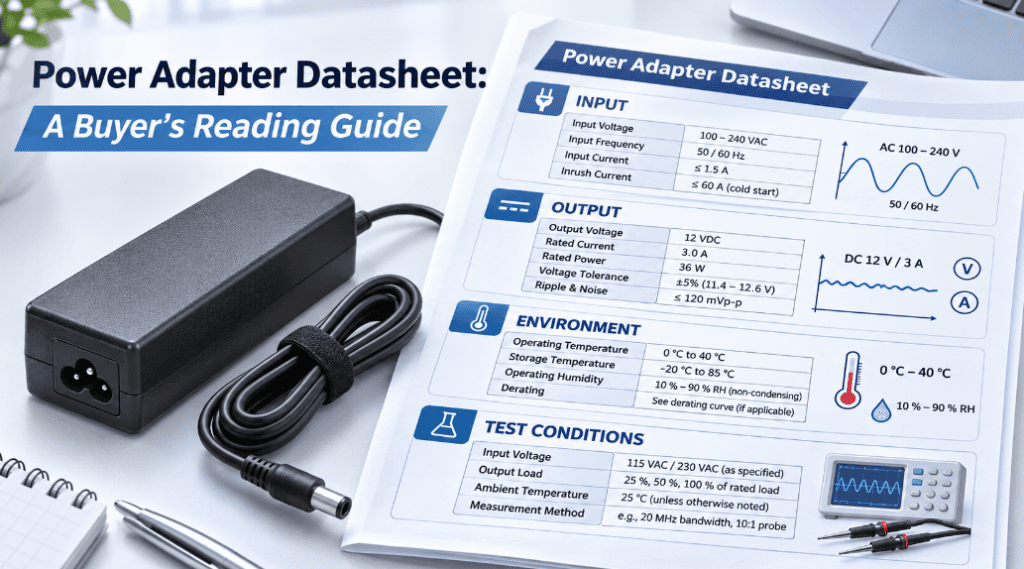
A power adapter datasheet is a technical document that describes an adapter’s electrical input, DC output, environmental limits, safety characteristics, and performance testing conditions. For buyers, it helps determine whether an adapter can meet an application’s requirements before sample testing or bulk purchasing. The most useful way to read a datasheet is to examine four areas: input specifications, output specifications, environmental ratings, and the conditions under which performance figures were measured.
Not every datasheet presents information in the same order. Some provide detailed tables, while others list only basic ratings. Understanding what each specification actually means makes it easier to compare products and identify information that needs clarification.
1. Input Specifications: What Power Can the Adapter Accept?
The input section describes the electrical supply conditions under which the adapter is designed to operate.
Common entries include:
| Specification | What It Means |
|---|---|
| Input Voltage | The supported AC voltage range, such as 100–240 VAC |
| Input Frequency | The supported AC frequency, commonly 50/60 Hz |
| Input Current | The specified maximum or rated AC current draw under defined conditions |
| Inrush Current | The brief surge of input current when power is first applied |
An adapter rated for 100–240 VAC can generally accommodate common mains systems in different regions. However, this does not automatically confirm compatibility with every local plug or certification requirement.
Input current also deserves attention. It is not the same as the DC output current and may vary with supply voltage, load, and efficiency.
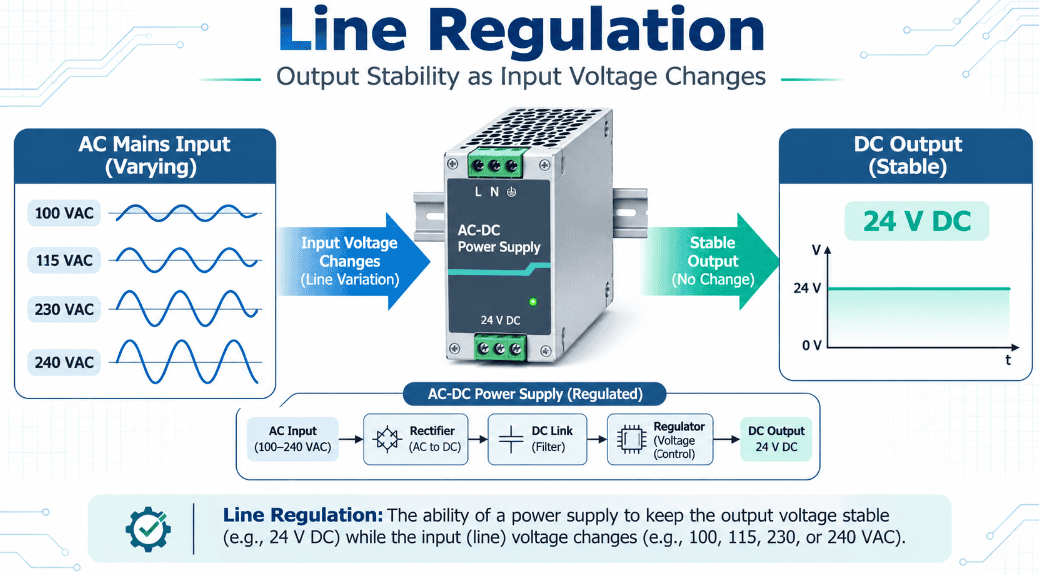
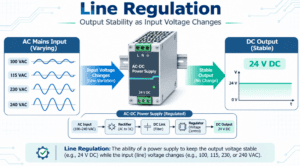
For applications involving different mains voltages, buyers should also understand line regulation, which describes how the DC output changes as the input voltage varies.
2. Output Specifications: What Does the Adapter Deliver?
The output section usually contains the specifications buyers examine first: voltage, current, and rated power.
For example, a datasheet might list:
- Output Voltage: 12 VDC
- Rated Output Current: 3 A
- Rated Output Power: 36 W
- Output Voltage Tolerance: ±5%
- Ripple and Noise: 120 mVp-p maximum
These are illustrative specifications, not measurements or ratings for a particular JIALU adapter.
A 12 V, 3 A rating means the adapter is designed to provide up to 3 A at its specified output voltage under its rated operating conditions. It does not mean the connected device will continuously consume 3 A.
The remaining output figures describe how consistently that power is delivered.
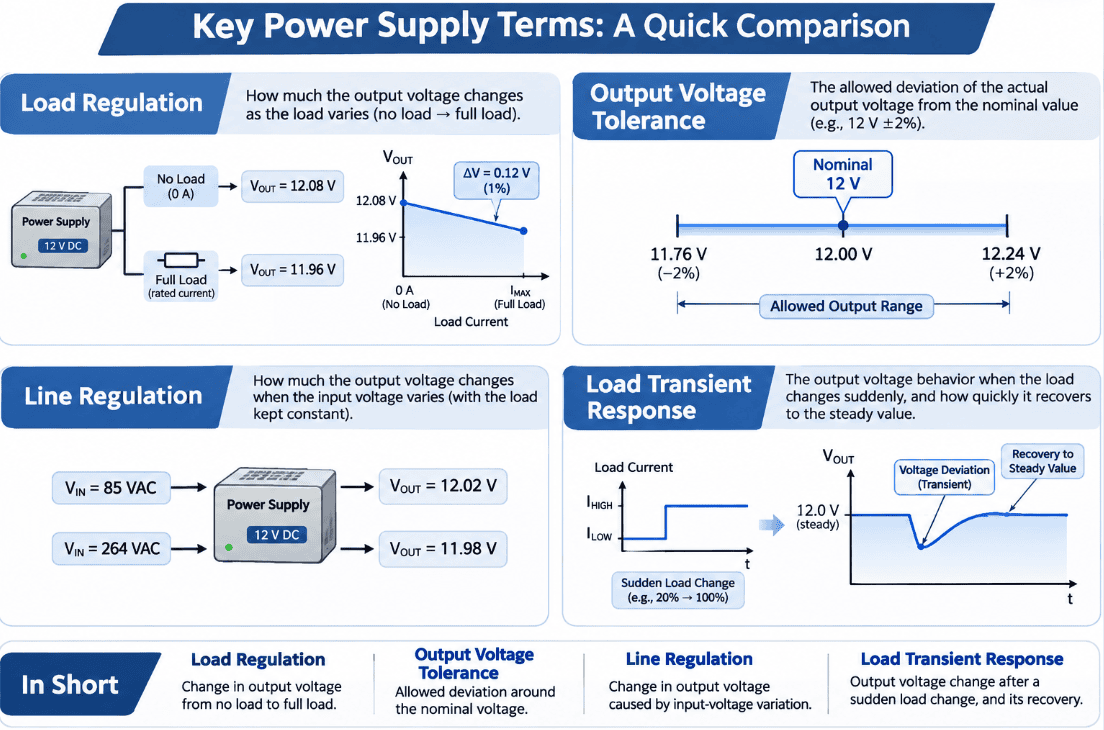
Output voltage tolerance defines the permitted deviation from the nominal output voltage. A 12 V output with ±5% tolerance corresponds to a range of 11.4–12.6 V under the conditions covered by that specification. See our output voltage tolerance guide for a closer explanation.
Load regulation describes how output voltage changes when the connected equipment draws different amounts of current. This is especially relevant to devices that frequently switch between standby and active operation. Read more about load regulation.
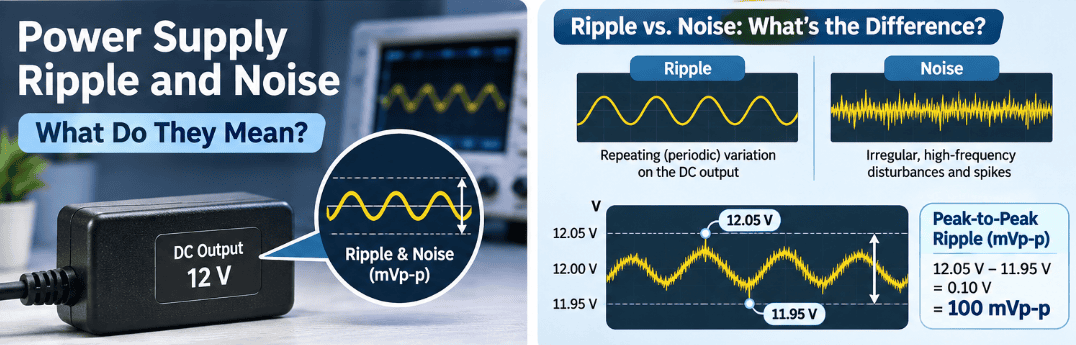
Ripple and noise describe unwanted voltage fluctuations superimposed on the DC output. When comparing ripple figures, the measurement bandwidth, probe arrangement, and load conditions matter as much as the stated value. Our guide to ripple specifications and measurement conditions explains why.
Buyers should also check whether the datasheet specifies the DC connector, polarity, and cable configuration. A correct electrical rating does not guarantee physical compatibility. For common cylindrical connectors, the DC barrel connector size guide provides additional detail.
3. Environmental Specifications: Where Can the Adapter Operate?
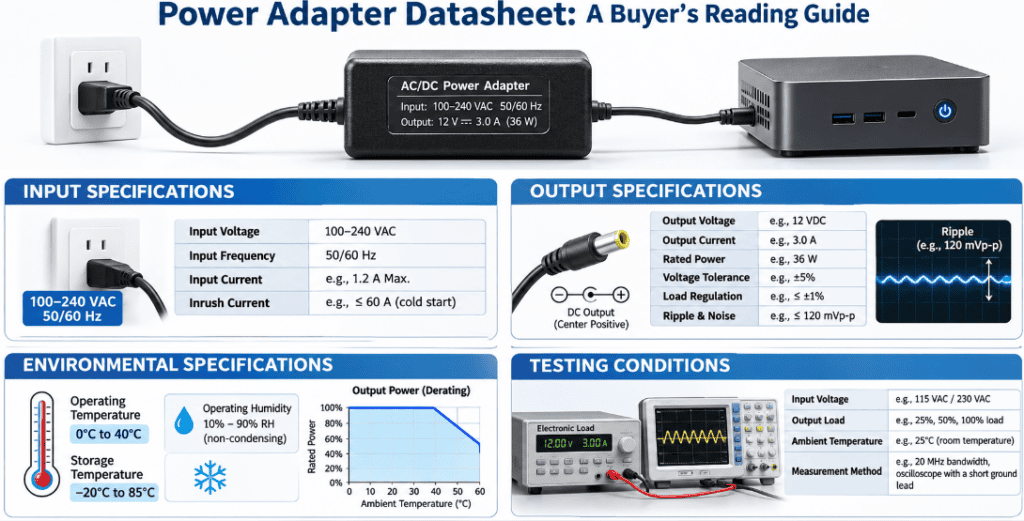
Environmental ratings indicate the conditions in which the adapter can operate or be stored.
Typical datasheet entries include:
| Specification | What to Check |
|---|---|
| Operating Temperature | Ambient temperature range for normal operation |
| Storage Temperature | Temperature limits when the adapter is not operating |
| Operating Humidity | Permitted humidity range and whether condensation is excluded |
| Derating | Whether available output power decreases at higher temperatures or under other conditions |
For example, an operating temperature rating of 0°C to 40°C does not necessarily mean the adapter can deliver full rated power in every installation throughout that range.
An adapter inside a poorly ventilated enclosure may experience a higher local ambient temperature than the surrounding room.
Buyers should look for any temperature derating curve or installation restrictions, particularly when evaluating higher-power desktop power supplies used in commercial equipment.
Environmental limits should always be interpreted together with rated output power and cooling conditions.
4. Testing Conditions: How Were the Specifications Measured?
This section is easy to overlook, yet it often determines whether two datasheets can be compared fairly.
A datasheet may publish impressive efficiency, voltage regulation, or ripple figures. Those numbers are only meaningful when the test conditions are understood.
Pay attention to four details:
- Input voltage: Was the measurement performed at 115 VAC, 230 VAC, or across the full rated range?
- Output load: Was the adapter tested at 25%, 50%, or 100% load?
- Ambient temperature: Was performance measured at room temperature or at the maximum rated operating temperature?
- Measurement method: What instruments, bandwidth settings, and connections were used?
For example, a ripple specification measured at 20 MHz bandwidth should not automatically be compared with a value obtained using a different bandwidth or probe setup.
Similarly, an efficiency figure measured at a particular load point does not describe efficiency under every operating condition.
Safety approvals also require careful reading. A datasheet may list standards or certification marks, but buyers should confirm which model variants and markets the supporting documents actually cover. JIALU provides a separate certificates and quality approvals page for reviewing relevant documentation.
5. What Should Buyers Do When Information Is Missing?
Not every power adapter datasheet includes a complete set of technical values. A shorter specification sheet may be sufficient for initial product screening, but it should not be treated as a complete verification record.
If a key parameter is absent, ask the supplier for the relevant test report, measurement conditions, or confirmation for the exact model being considered.
For OEM projects, it is particularly important to confirm whether the supplied datasheet describes a standard product or a customized configuration. Changes to the DC cable, connector, housing, or electrical design may require additional verification.
The goal is not to demand the longest possible datasheet. It is to obtain enough reliable information to evaluate the adapter against the intended application.
Final Thoughts
A power adapter datasheet is most valuable when its specifications are read together rather than individually.
Input ratings explain the electrical supply the adapter accepts. Output ratings describe the power it delivers and its stability. Environmental specifications establish operating limits, while testing conditions explain how the published performance figures were obtained.
For buyers comparing power adapter products, understanding these four areas helps turn a specification sheet into a useful technical evaluation tool before proceeding with sample approval or production.