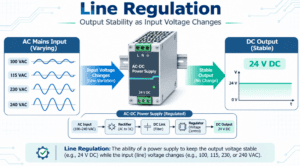


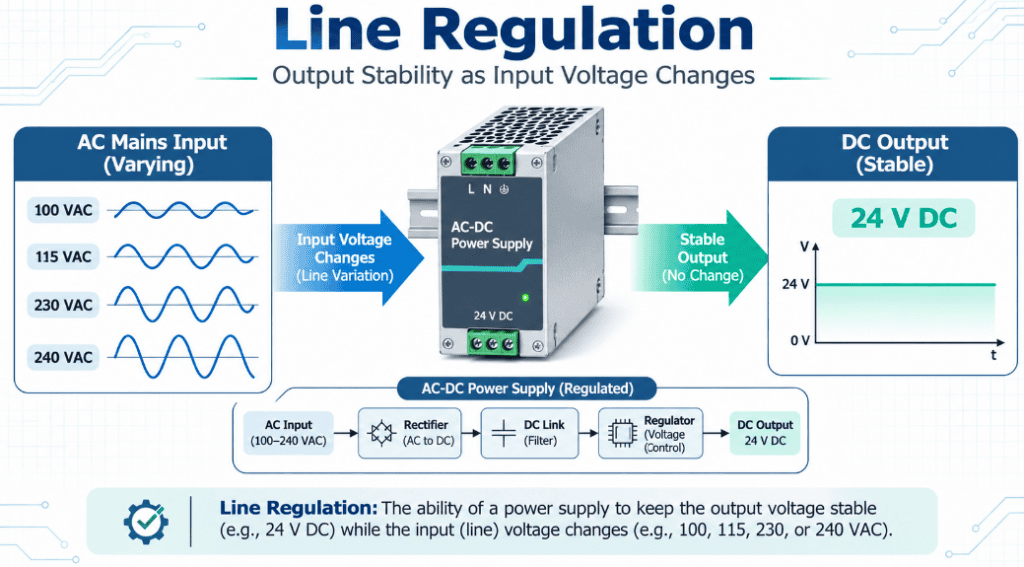
Line regulation describes how much a power supply’s output voltage changes when its input voltage varies while the output load remains constant. For an AC-DC power supply, it indicates how effectively the unit maintains a stable DC output as the AC mains voltage rises or falls within its specified operating range. A lower line regulation value generally means the output is less affected by input voltage changes.
Why Does Input Voltage Change?
AC mains voltage is not perfectly constant. It can fluctuate due to changes in electrical demand, utility distribution conditions, or the operation of large equipment connected to the same electrical network.
For example, a power supply designed for 100–240 VAC input may be used in regions with different nominal mains voltages. Even at a single installation, the actual supply voltage can vary throughout the day.
A regulated power supply is designed to accommodate these variations and keep its DC output within specified limits.
However, accepting a wide input voltage range does not automatically mean the output voltage remains exactly the same at every input level. This is where line regulation becomes relevant.
How Is Line Regulation Measured?
Line regulation is typically evaluated by changing the input voltage across a specified range while keeping the output load and other test conditions constant.
Consider a regulated 24 V DC power supply operating at a fixed load:
| AC Input Voltage | Measured DC Output |
|---|---|
| 100 VAC | 24.02 V |
| 115 VAC | 24.00 V |
| 230 VAC | 23.99 V |
| 240 VAC | 23.98 V |
These are illustrative values, not measurements from a specific product.
The maximum output voltage difference is 0.04 V across the tested input range.
One common way to express line regulation is:
Line Regulation (%) = (Maximum Output Voltage − Minimum Output Voltage) / Nominal Output Voltage × 100%
Using the values above:
Line Regulation = (24.02 − 23.98) / 24 × 100% ≈ 0.17%
This means the measured output variation is approximately 0.17% of the nominal voltage across the tested input range.
Manufacturers may use different calculation conventions or reference conditions. Always check the datasheet definition before comparing line regulation specifications.
Line Regulation vs. Load Regulation
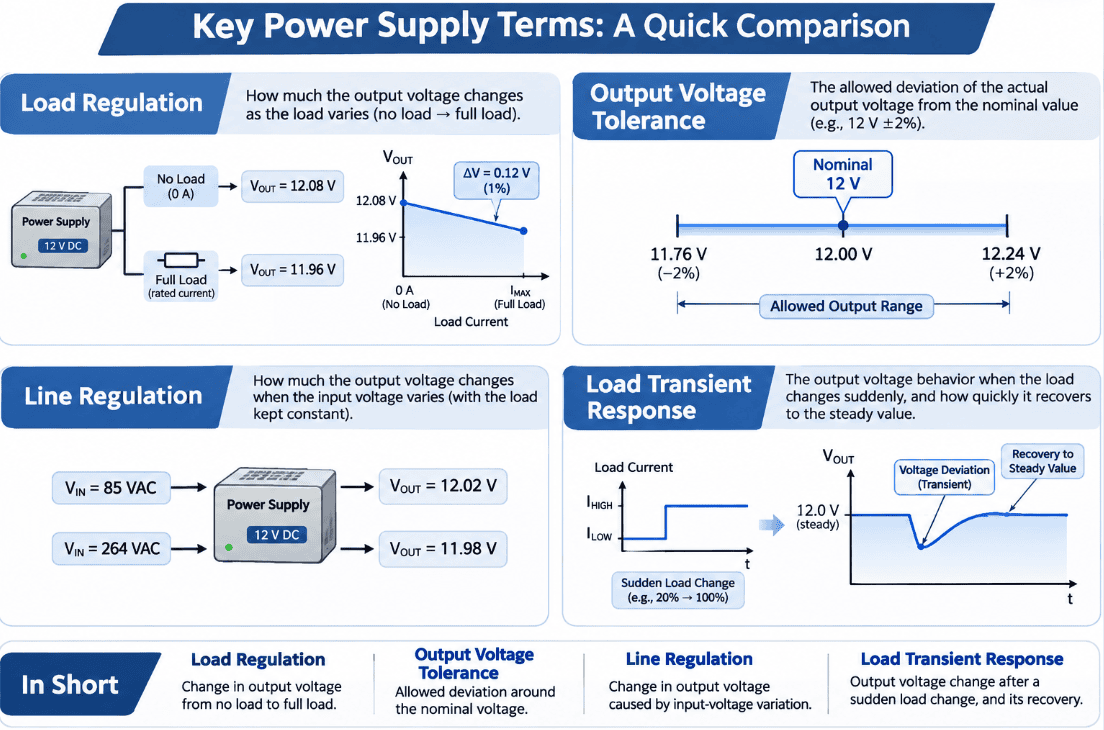
Line regulation and load regulation both describe output voltage stability, but they measure different effects.
Line regulation measures output voltage changes caused by input voltage variations while the connected load remains constant.
Load regulation measures output voltage changes as the load current varies while the input voltage remains constant.
For example, if a 24 V power supply experiences a small output change when the AC input moves from 115 VAC to 230 VAC, that change relates to line regulation.
If the output changes when connected equipment draws more current, that behavior relates to load regulation.
In actual applications, input voltage and load current may change simultaneously. Evaluating these specifications separately helps engineers understand what causes the output to vary.
Line Regulation Is Not Cable Voltage Drop
The word “line” can sometimes cause confusion. In power supply specifications, line regulation does not refer to voltage loss along the output cable.
Line regulation describes the power supply’s ability to maintain its output when the input voltage changes.
Cable voltage drop occurs because electrical current flows through conductors with resistance. Longer cables, smaller conductor sizes, and higher currents generally produce greater voltage losses.
For example, a power supply may maintain 24.00 V at its output terminals while a connected device receives only 23.70 V due to resistance in the output wiring.
That 0.30 V difference is not a line regulation measurement.
The distinction matters because improving a power supply’s line regulation will not necessarily solve voltage loss caused by undersized or excessively long output cables.
What Does Line Regulation Tell You About a Power Supply?
Line regulation helps indicate how consistently a power supply maintains its output under changing input voltage conditions.
It is particularly useful when equipment operates in regions with different mains voltages or in electrical environments where the available input voltage fluctuates.
However, line regulation alone does not describe overall power supply performance.
Other specifications also deserve attention:
- Output voltage tolerance defines the permitted deviation from the nominal output voltage under specified conditions.
- Load regulation describes how output voltage changes with load current.
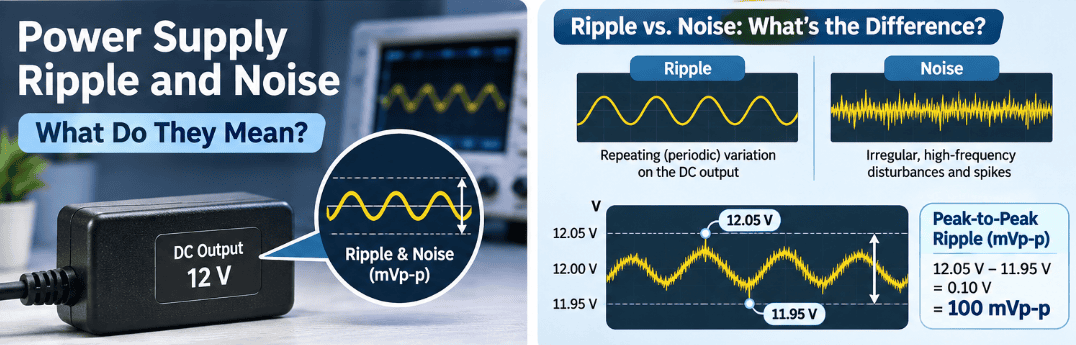
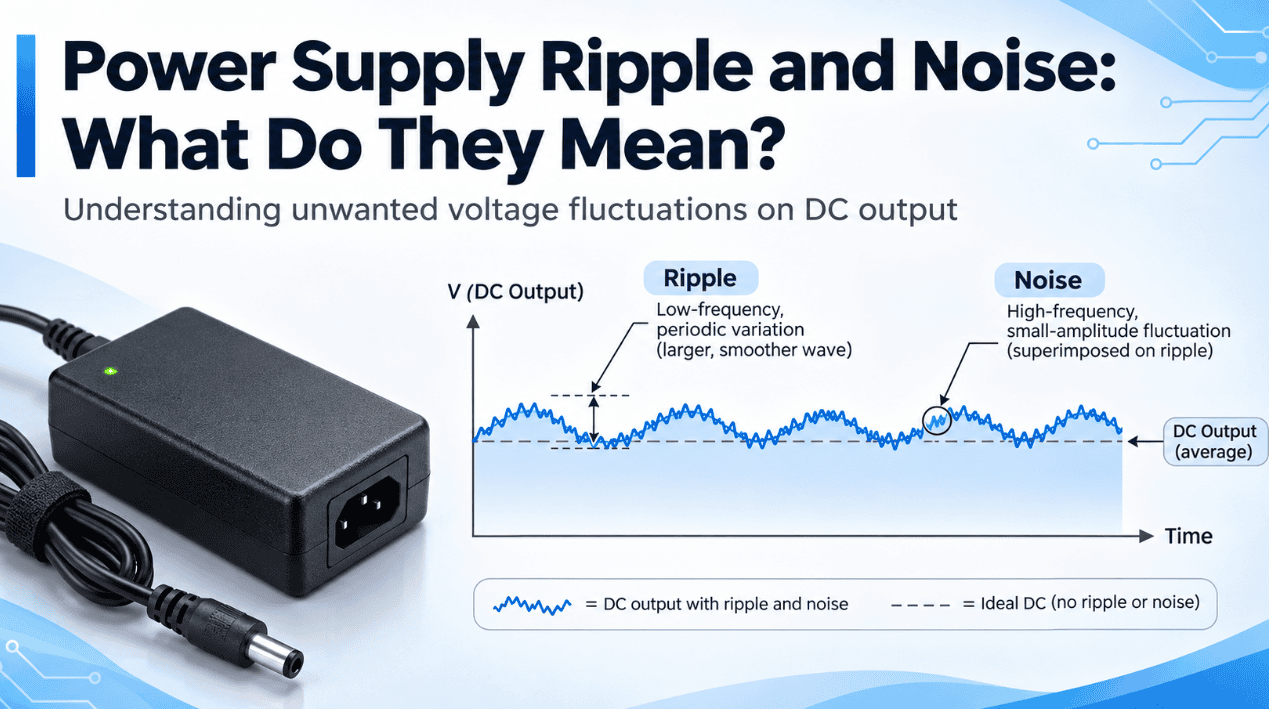
- Power supply ripple and noise describes unwanted AC voltage components superimposed on the DC output.
These specifications describe different aspects of output behavior and should not be treated as interchangeable.
Line regulation also primarily describes steady-state performance. It does not directly indicate how quickly a power supply responds to sudden input disturbances or how long it can maintain its output during a brief power interruption.
How to Read Line Regulation in a Datasheet
Suppose a 24 V power supply lists line regulation as ±0.5%.
Since 0.5% of 24 V is 0.12 V, this percentage corresponds to a 0.12 V deviation relative to the stated reference voltage. However, the exact interpretation depends on the manufacturer’s definition of the specification.
It does not automatically mean the power supply’s total output voltage tolerance is ±0.5%.
The actual output voltage range may also depend on initial voltage accuracy, load conditions, temperature, and other operating factors.
When comparing power supplies, check whether the published line regulation values apply to similar input ranges and test conditions. A smaller percentage is meaningful only when the underlying specifications are comparable.
Final Thoughts
Line regulation answers a practical question: How stable is a power supply’s output voltage when its input voltage changes?
A well-regulated power supply minimizes this variation throughout its rated input voltage range, helping connected equipment receive consistent DC power.
For a complete understanding of output stability, line regulation should be considered alongside load regulation, output voltage tolerance, and the electrical conditions of the intended application.