

Load regulation describes how much a power supply’s output voltage changes as the connected load varies, typically from no load to full load. A power supply may be rated for a fixed output voltage, such as 12 V, but its actual output can shift slightly as the load draws more current. Load regulation measures this change under specified operating conditions and indicates how consistently the power supply maintains its output voltage.
Why Does Output Voltage Change with Load?
An ideal power supply would deliver exactly the same voltage regardless of how much current the load requires. In practice, every power supply has some limitations.
As load current increases, voltage drops across internal resistance, switching components, PCB traces, and output connections can become more noticeable. The power supply’s feedback and control circuit works to compensate for these changes, but it cannot always eliminate them completely.
For example, a regulated 12 V power supply might produce 12.08 V with no load connected and 11.96 V at its rated maximum load. Both readings are close to the nominal output, but the difference between them represents the voltage change associated with load regulation.
The direction and magnitude of this change depend on the power supply design. Output voltage does not necessarily decrease continuously as load increases.

How Is Load Regulation Calculated?
Load regulation is commonly expressed as a percentage of the output voltage:
Load Regulation (%) = [(VNo-load − VFull-load) / VReference] × 100%
Where:
- VNo-load: Output voltage with no external load connected.
- VFull-load: Output voltage at the rated maximum load.
- VReference: The reference voltage specified for the calculation, often the nominal or full-load output voltage.
Consider a 12 V power supply with the following measurements:
| Load Condition | Output Voltage |
|---|---|
| No load | 12.08 V |
| Full load | 11.96 V |
| Voltage difference | 0.12 V |
Using 12 V as the reference:
Load Regulation = (0.12 / 12) × 100% = 1%
This means the output voltage changes by 1% of the nominal voltage between the two measured load conditions.
Manufacturers may use slightly different calculation conventions or specify the maximum absolute voltage deviation. Always check the definition and test conditions in the datasheet before comparing products.
Load Regulation vs. Output Voltage Tolerance
Load regulation and output voltage tolerance are related, but they describe different characteristics.
Load regulation measures how the output voltage changes when load current changes.
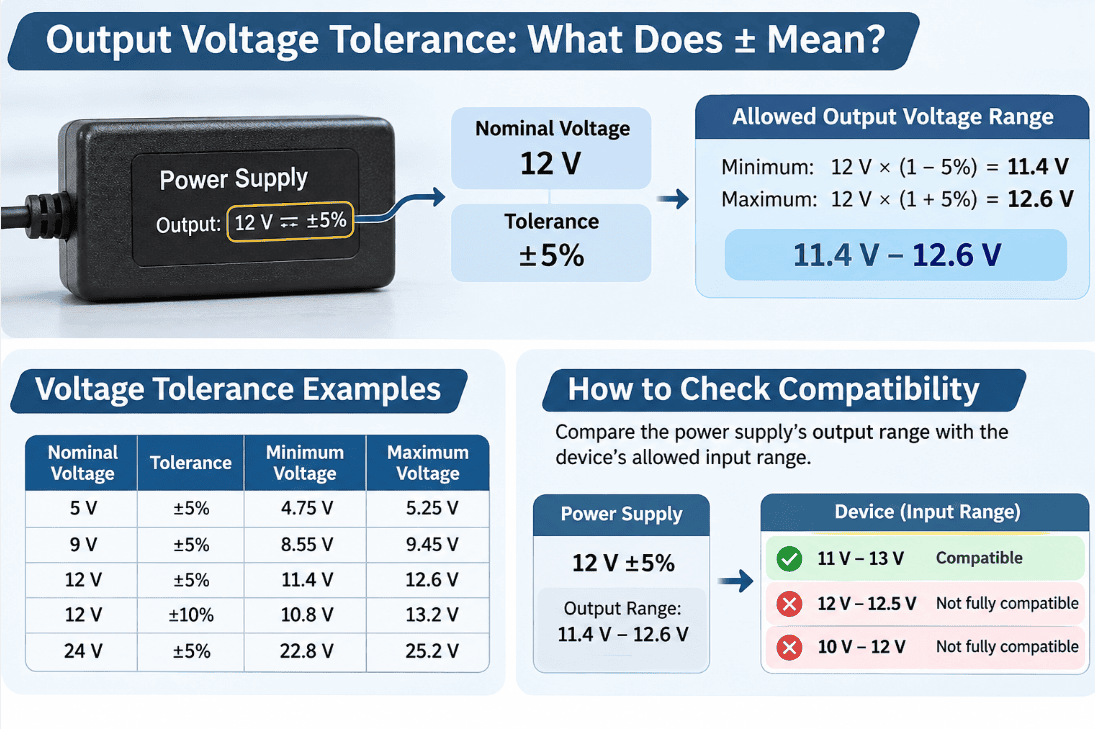
Output voltage tolerance describes how far the actual output voltage is allowed to deviate from its specified nominal value under defined conditions.
For example, a 12 V power supply with an output voltage tolerance of ±2% may be permitted to operate within a voltage range of 11.76 V to 12.24 V under the conditions covered by that specification.
A separate load regulation rating of 1% describes the permitted voltage variation associated with changing the load, not the total deviation from exactly 12 V.
A power supply can therefore have good load regulation while its output voltage is slightly above or below the nominal value.
It is also important to distinguish load regulation from line regulation. Line regulation describes changes in output voltage caused by variations in the input voltage rather than the output load.
What Affects Load Regulation Measurements?
Load regulation figures are meaningful only when the test conditions are understood.
The input voltage should normally remain constant while the load changes. Measurements should also be taken at clearly defined load levels, with attention to temperature and the location where the output voltage is measured.
Some power supplies require a minimum load to maintain their specified performance. For these designs, the published load regulation range may begin at a specified minimum current rather than at zero load.
Load regulation should not be confused with load transient response, which describes how the output behaves immediately after a sudden change in load current.
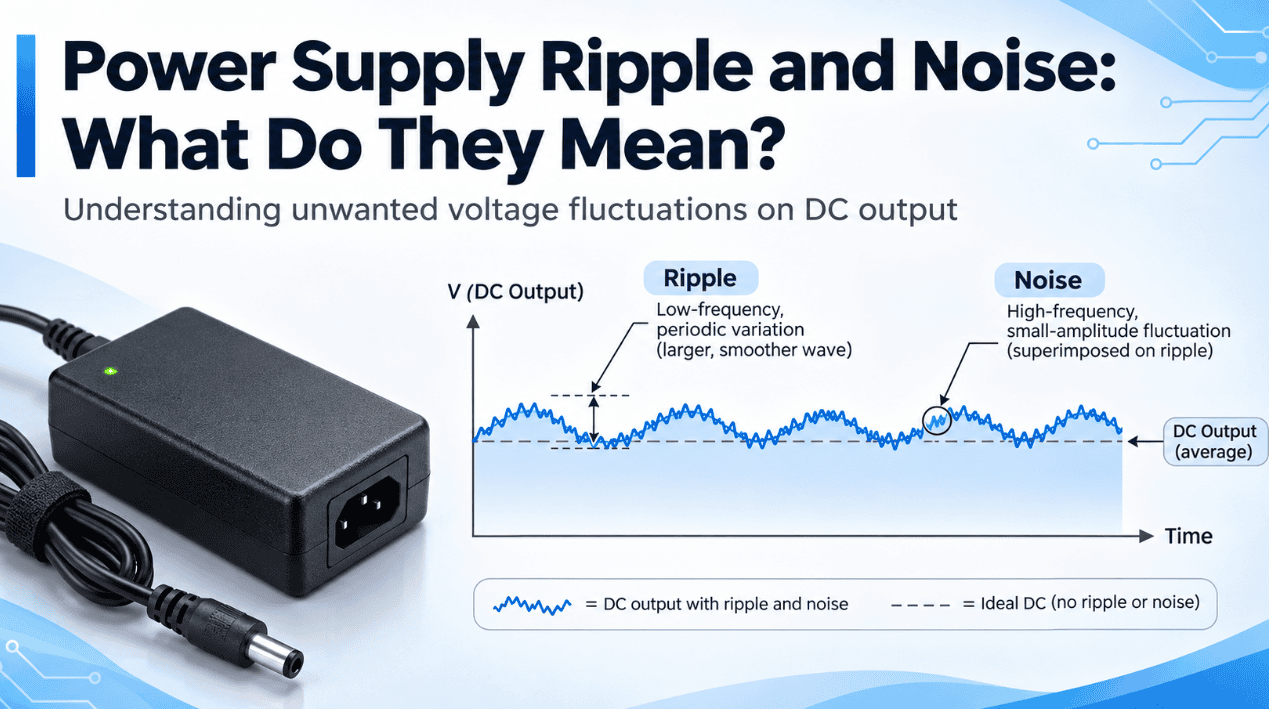
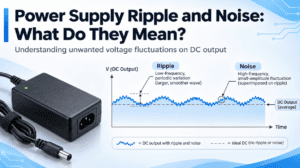
Similarly, power supply ripple and noise concerns unwanted voltage fluctuations superimposed on the DC output. These fluctuations are different from the steady-state voltage shift measured in load regulation testing.
Why Does Load Regulation Matter?
Good load regulation helps maintain a predictable supply voltage across different operating loads.
This is especially useful for sensitive electronic circuits, precision analog systems, communication equipment, and devices with varying current demands.
However, a lower load regulation percentage does not automatically mean a power supply is better for every application. The complete output voltage range, ripple and noise, transient response, and the equipment’s allowable input voltage should also be considered.
In short, load regulation tells you how stable a power supply’s output voltage remains as its load changes—not how close the output is to the nominal voltage in absolute terms. Understanding this distinction makes it easier to interpret power supply specifications and compare designs under equivalent conditions.