A DC barrel connector may look like a minor component in a power adapter, but its dimensions can determine whether an electronic device receives reliable power. Two connectors with nearly identical external appearances can have different internal diameters, insertion lengths, or contact configurations. Choosing the wrong one can lead to loose connections, intermittent operation, or an adapter that cannot be used at all.
For equipment manufacturers, engineers, distributors, and bulk purchasing teams, selecting the correct connector is therefore an important part of power supply specification. The connector must match the device’s mechanical interface while supporting its electrical requirements.
This DC barrel connector size guide explains common connector dimensions, how to identify and measure a barrel plug, which specifications matter beyond diameter, and how to avoid compatibility problems when sourcing power adapters for commercial applications.

1. How DC Barrel Connector Sizes Are Measured
DC barrel connectors are cylindrical connectors commonly used to deliver low-voltage DC power to electronic equipment. They consist of a plug attached to the power cable and a corresponding socket installed in the device.
Connector dimensions are generally expressed in millimeters using the following format:
Outer diameter × inner diameter
For example, a 5.5 × 2.1mm DC barrel plug has an outer barrel diameter of 5.5mm and an inner opening diameter of 2.1mm.
The outer diameter describes the plug’s external cylindrical surface. The inner diameter describes the opening that accommodates the mating socket’s center contact.
Both dimensions are important. Measuring only the outside of a connector is insufficient because multiple connector types can share the same outer diameter.
Some manufacturers also specify the plug length, contact-pin dimensions, and other mechanical features. These details may be essential when replacing an existing adapter or developing a customized power supply.
2. Common DC Barrel Connector Sizes
There is no single barrel connector size that fits every electronic device. Different manufacturers select connectors according to their equipment design, required current, available space, and mechanical interface.
The following table lists several commonly encountered dimensions. Applications are illustrative rather than universal standards; the equipment manufacturer’s specification should always take priority.
| DC barrel plug size | Typical application examples | Key consideration |
|---|---|---|
| 5.5 × 2.1mm | Routers, CCTV equipment, LED devices, and electronics | Frequently confused with 5.5 × 2.5mm |
| 5.5 × 2.5mm | Monitors, networking equipment, and electronic devices | Same outer diameter as 5.5 × 2.1mm |
| 4.0 × 1.7mm | Selected compact electronics and networking products | Confirm both dimensions carefully |
| 3.5 × 1.35mm | Small electronic devices and compact equipment | Smaller dimensions require precise identification |
| 4.8 × 1.7mm | Selected proprietary or model-specific equipment | Verify the exact mating interface |
| Other custom sizes | Industrial equipment and specialized electronic products | Drawings or reference samples may be necessary |
These examples are useful starting points, but they should not be treated as a universal compatibility chart. A device’s application alone cannot establish its connector size.
For example, two routers from different manufacturers may require different barrel connectors even when both operate at 12V DC.
The safest approach is to check the original adapter label, equipment manual, connector drawing, or manufacturer’s technical documentation before ordering a replacement.

3. 5.5 × 2.1mm vs. 5.5 × 2.5mm: What Is the Difference?
The 5.5 × 2.1mm and 5.5 × 2.5mm connectors are especially easy to confuse because they share the same 5.5mm outer diameter.
Their inner diameters, however, differ by 0.4mm.
| Specification | 5.5 × 2.1mm | 5.5 × 2.5mm |
|---|---|---|
| Outer diameter | 5.5mm | 5.5mm |
| Inner diameter | 2.1mm | 2.5mm |
| External appearance | Very similar | Very similar |
| Compatibility | Depends on the socket specification | Depends on the socket specification |
| Identification method | Verify the inner diameter | Verify the inner diameter |
The difference is small, but it can affect the quality of the electrical connection.
If the plug opening does not match the socket’s center contact, the connector may fail to mate correctly or may provide insufficient contact pressure. Depending on the design, this can cause intermittent power, increased contact resistance, or localized heating.
A connector that can be inserted into a socket is not necessarily a compatible connector.
For a more detailed dimensional comparison, see Szjialu’s 5.5 × 2.1mm vs. 5.5 × 2.5mm DC plug technical guide.
4. How to Identify and Measure a DC Barrel Connector
When the original connector specification is unavailable, several inspection methods can help identify the correct size.
Check the original power adapter
Start by examining the adapter label, product datasheet, packaging, or equipment manual. Some manufacturers provide the exact DC connector dimensions or a part number that can be used to identify the interface.
This is generally more reliable than estimating the size from a photograph.
Measure the plug’s outer diameter
A digital caliper can measure the external diameter of the cylindrical barrel. This helps narrow down the possible connector types.
However, an outer measurement of approximately 5.5mm does not distinguish between 5.5 × 2.1mm and 5.5 × 2.5mm plugs.
Verify the inner diameter
The internal opening requires a separate measurement or a suitable connector gauge. Because the opening is small, ordinary calipers may not provide a sufficiently reliable measurement in every situation.
For engineering validation or production inspection, dedicated gauges and dimensional drawings are preferable.
Check the insertion length
Measure the barrel length that enters the device socket. A plug with the correct diameter may still be incompatible if it is too short, too long, or shaped differently from the original connector.
Compare against a known reference
If the original adapter is unavailable, compare the connector with a verified reference plug or obtain the equipment manufacturer’s connector drawing.
For bulk orders, approve a physical sample before authorizing mass production. This reduces the risk of discovering a connector mismatch after a large quantity of adapters has been manufactured.

5. Connector Compatibility Involves More Than Diameter
A complete DC barrel connector specification should include more than the outer and inner diameters.
Plug length: The insertion depth must match the device socket. An unsuitable length can prevent full engagement or interfere with the device enclosure.
Center contact design: Some sockets use different center-pin configurations. The plug must match the actual mating interface.
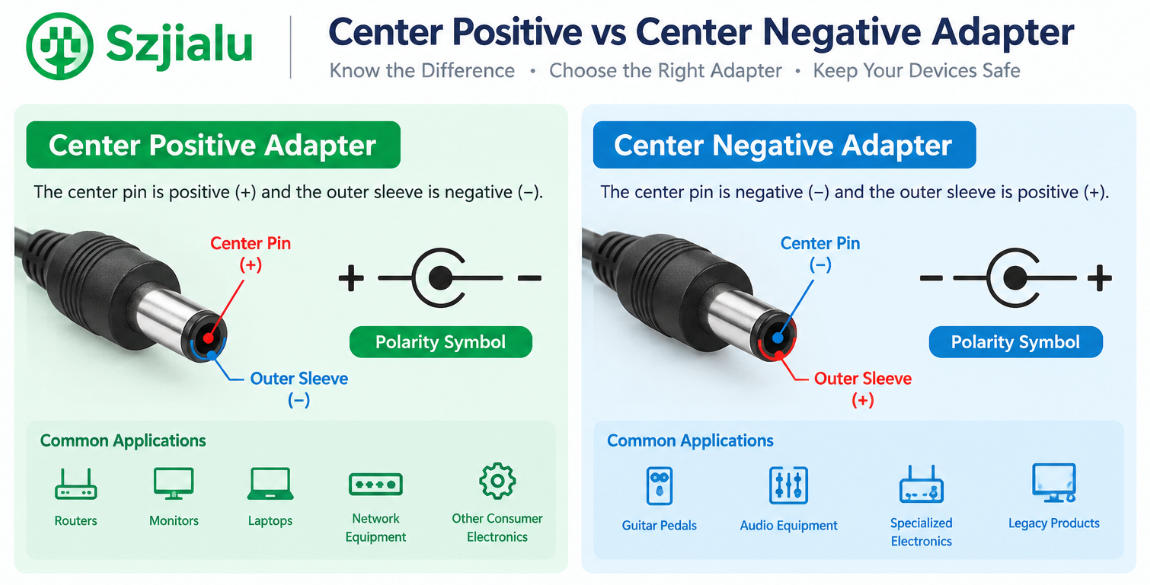
Polarity: A common arrangement is center-positive and outer-negative, but this must never be assumed. Always verify the polarity symbol or equipment documentation.
Straight or right-angle design: A straight plug may suit open spaces, while a right-angle connector can reduce cable protrusion in compact installations. The orientation must fit the equipment enclosure.
Cable length and wire gauge: These affect installation flexibility and electrical performance. Cable resistance becomes more relevant as current and cable length increase.
Retention and mechanical strength: Equipment subject to vibration, frequent handling, or cable movement may require a connector with appropriate retention characteristics.
These factors are especially important when sourcing a replacement power supply for equipment that must operate continuously, such as networking devices, commercial displays, and industrial controllers.
A useful starting point is Szjialu’s AC/DC power adapter selection guide, which explains how connector selection fits into the broader electrical and mechanical specification.
6. Match the Connector to the Power Adapter’s Electrical Requirements
Correct connector dimensions do not guarantee that an adapter is electrically suitable.
Before selecting a replacement, confirm the required output voltage, current, and polarity.
For example, a device requiring 12V DC at 2A needs a compatible 12V output and a power supply capable of delivering at least the required current under the specified operating conditions. Its nominal power requirement is 24W.
A 12V adapter with a 5.5 × 2.1mm plug is not automatically suitable for every 12V device. The connector, polarity, and other electrical requirements must also match.
Likewise, a power supply with a higher current rating is not a substitute for checking the required voltage and connector configuration.
When evaluating a replacement adapter, follow this sequence:
- Confirm the device’s required DC output voltage.
- Confirm its current requirement and operating power.
- Verify connector dimensions and insertion length.
- Match the polarity and center-contact configuration.
- Check cable requirements and applicable safety certifications.
- Test the complete adapter-and-device combination before deployment.
For equipment using a 12V input, Szjialu’s 12V power adapter buying guide provides additional guidance on output ratings and connector compatibility.
7. Selecting DC Barrel Connectors for OEM and Bulk Purchasing
For equipment manufacturers and distributors, connector selection should be finalized before power adapter production begins.
A vague purchasing description such as “5.5mm DC plug” leaves important details undefined. It may identify the approximate outer diameter but does not establish the inner diameter, plug length, polarity, or mechanical design.
A more complete request for quotation (RFQ) could specify:
| Parameter | Example requirement |
|---|---|
| Output voltage | 12V DC |
| Rated output current | 3A |
| Nominal output power | 36W |
| DC barrel connector | 5.5 × 2.1mm |
| Polarity | Center-positive, subject to equipment specification |
| Plug style | Straight |
| Cable length | 1.5m |
| Cable construction | To be confirmed for the application |
| Compliance | Required destination-market certifications |
| Customization | Connector, cable, labeling, and packaging as needed |
These values are an illustrative specification, not a universal recommendation. The final configuration must match the actual equipment requirements.
For OEM and ODM projects, the buyer should provide a connector drawing, verified part number, or physical reference sample whenever possible. The adapter manufacturer can then confirm the proposed interface before samples and production units are approved.
Changing the connector late in the project can affect cable assemblies, molded components, labels, packaging, testing, and inventory. Defining it early helps reduce avoidable engineering revisions and purchasing risks.
Szjialu supplies AC/DC power adapters in different power ranges and supports customized power supply configurations. Buyers evaluating wall-mounted models can review the wall-mount power adapter range as a starting point for discussing output ratings and connector requirements.
8. A Practical Checklist Before Ordering
Before purchasing a replacement adapter or placing a bulk order, verify the following items.
Mechanical compatibility
- Outer diameter and inner diameter
- Plug insertion length
- Center-contact configuration
- Straight or right-angle design
- Retention requirements
Electrical compatibility
- Required output voltage
- Rated output current
- Output power
- DC polarity
- Regulation and protection requirements
Cable and production requirements
- Cable length and wire gauge
- Jacket and strain-relief requirements
- Connector drawing or approved reference sample
- Sample approval and production inspection
- Required certifications and destination markets
- Minimum order quantity, lead time, and packaging
This checklist is particularly useful when purchasing adapters for multiple equipment models. Maintaining a separate, verified connector specification for each model helps prevent similar-looking plugs from being mixed during sourcing or assembly.
Conclusion
Choosing the correct DC barrel connector requires more than identifying a plug by appearance. Outer diameter, inner diameter, insertion length, center-contact design, and polarity all contribute to compatibility.
The 5.5 × 2.1mm and 5.5 × 2.5mm connectors demonstrate why these details matter: although they share the same outer diameter, their internal dimensions are different and should not be assumed interchangeable.
For replacement adapters, verify the equipment manufacturer’s specifications before connecting a new power supply. For OEM and bulk purchasing, document the complete connector configuration and approve a reference sample before mass production.
With a clearly defined electrical and mechanical specification, manufacturers and purchasing teams can reduce compatibility errors, improve production consistency, and select power adapters that meet the requirements of their intended equipment.
Szjialu supports power adapter sourcing and customized OEM/ODM requirements, helping customers evaluate connector configurations alongside output specifications, cable requirements, and other project needs.
Google SEO Settings
SEO Title: DC Barrel Connector Size Guide: Dimensions & Compatibility
Focus Keyword: DC barrel connector size guide
SEO Keywords: DC barrel connector size guide, DC barrel connector sizes, DC barrel plug dimensions, DC power connector size chart, 5.5 x 2.1mm DC plug, 5.5 x 2.5mm DC plug, power adapter connector compatibility
Meta Description: Use this DC barrel connector size guide to compare common plug dimensions, measure connectors, check compatibility, and specify power adapters for OEM and bulk orders.