

Ripple specifications cannot be compared reliably unless the measurement conditions are comparable. A power supply rated at 50mV peak-to-peak (mVp-p) ripple is not necessarily quieter than one rated at 80mVp-p. Differences in oscilloscope bandwidth, probe connections, and load conditions can change the reported result. Before comparing two power supplies, check how each ripple value was measured, not just the number printed in the datasheet.
What Does a Ripple Specification Actually Tell You?
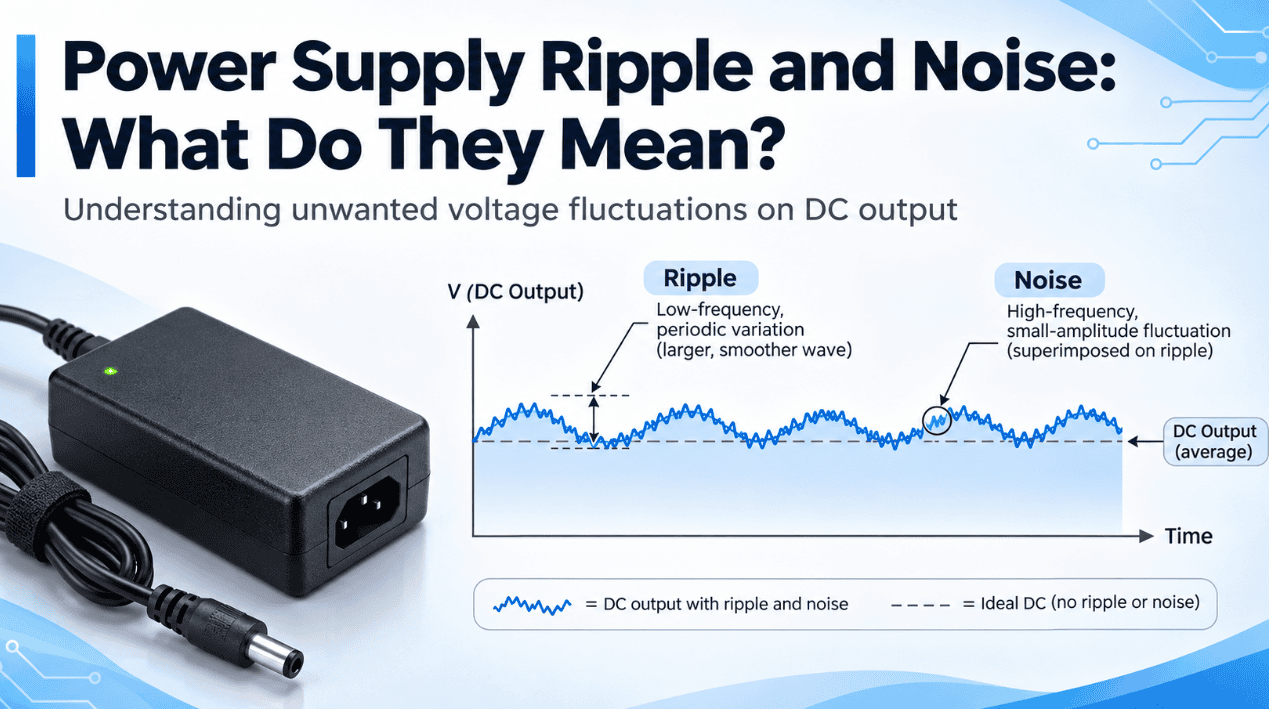
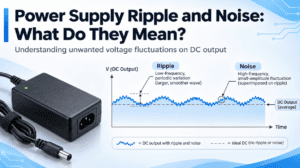
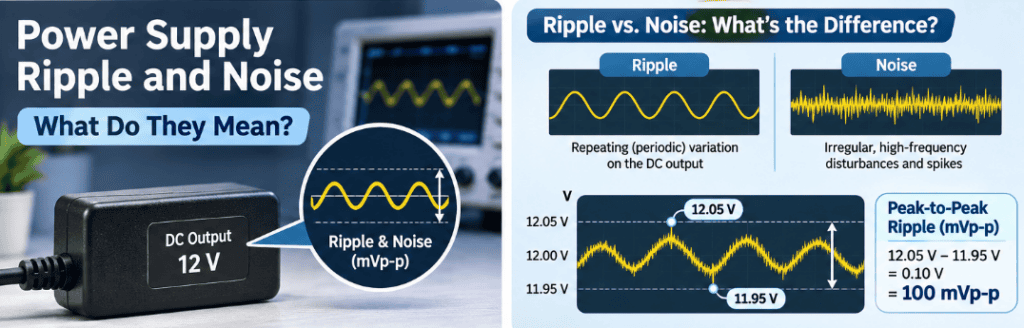
Output ripple is the unwanted AC voltage variation that remains on a power supply’s DC output. Manufacturers commonly express it in millivolts peak-to-peak (mVp-p), representing the difference between the highest and lowest measured voltage within the observed waveform.
For example, a specification of 100mVp-p indicates a measured peak-to-peak variation of 100mV under the stated test conditions.
However, the number alone does not describe the complete measurement. Two datasheets may report different ripple values simply because their manufacturers used different testing methods.
For a broader explanation of ripple itself, see our guide to power supply ripple and noise.
1. Why Oscilloscope Bandwidth Matters
Measurement bandwidth determines which frequency components are included in the ripple reading.
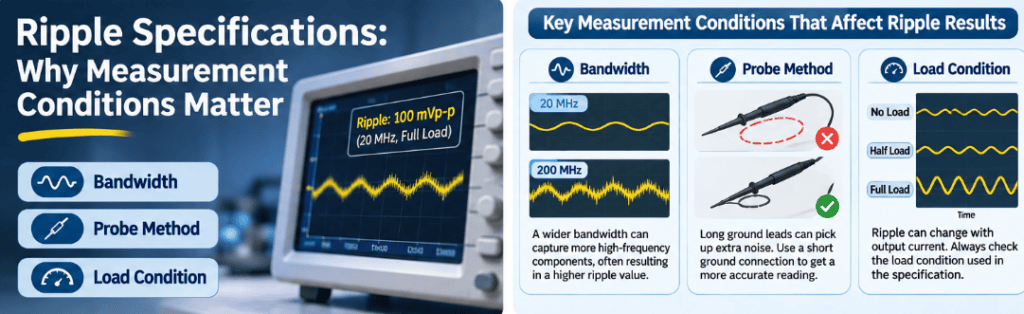
Power supply outputs can contain relatively low-frequency ripple as well as high-frequency switching noise and spikes. An oscilloscope with a wider measurement bandwidth can capture more of these high-frequency components.
For example, imagine testing the same power supply using two oscilloscope settings:
| Measurement setting | What the oscilloscope captures |
|---|---|
| 20MHz bandwidth | Lower-frequency ripple and noise components within the limited bandwidth |
| 200MHz bandwidth | A wider frequency range, potentially including additional switching spikes |
The 200MHz measurement may show a higher peak-to-peak value because it includes frequency components that the 20MHz setting filters out.
This does not necessarily mean the power supply’s actual performance has changed. Only the measurement bandwidth has changed.
A 20MHz bandwidth limit is commonly used for power supply ripple measurements, but it is not a universal requirement. Some applications need wider-band measurements to evaluate high-frequency noise.
When comparing datasheets, look for statements such as “Ripple and Noise: 100mVp-p, 20MHz bandwidth.” If another manufacturer specifies 100mVp-p at a different bandwidth, the two figures are not directly equivalent.
2. How Probe Connections Affect Ripple Measurements
Even with the same oscilloscope settings, the way the probe connects to the power supply can significantly affect the reading.
A standard oscilloscope probe often includes a long ground lead. This lead creates a larger measurement loop that can pick up electromagnetic interference, particularly around switching power supplies.
As a result, the oscilloscope may display additional spikes that are partly caused by the measurement setup rather than the power supply output itself.
For more reliable measurements, engineers often use:
- Short ground connections to reduce unwanted noise pickup.
- Tip-and-barrel probing to minimize the loop between the probe tip and ground.
- Properly terminated coaxial connections for suitable low-noise, high-frequency measurements.
The location of the measurement also matters. A reading taken directly across an output capacitor may differ from one taken at a distant connector because the intervening wiring and PCB traces introduce additional effects.
Therefore, two ripple measurements should ideally use comparable probe methods and measurement locations.
3. Why Load Conditions Change Ripple Results
Output ripple can vary depending on how much current the connected device draws.
A power supply tested at full load may produce a different ripple waveform from the same unit operating at half load or with almost no load.
For example, a 12V, 3A power supply might be tested under the following conditions:
| Load condition | Output current |
|---|---|
| No load | Approximately 0A |
| Half load | 1.5A |
| Full load | 3A |
These conditions do not necessarily produce identical ripple measurements.
Some switching regulators change their operating modes at light loads to improve efficiency. Others exhibit different ripple characteristics as output current increases.
Consequently, a ripple specification measured at full load should not automatically be treated as equivalent to one measured at half load.
When reviewing a datasheet, check whether the ripple figure applies to rated load, a particular output current, or a defined range of operating conditions.
For additional context on how electrical loading affects power supply behavior, see load regulation in power supplies.
How to Compare Ripple Specifications Fairly
When evaluating two power supplies, use the following checklist:
- Bandwidth: Were both ripple values measured using the same bandwidth limit?
- Probe method: Were similar probe connections and grounding techniques used?
- Measurement location: Were readings taken at comparable output points?
- Load condition: Were the supplies operating at comparable percentages of rated load?
- Measurement definition: Do both specifications describe peak-to-peak ripple and noise over the same stated conditions?
For example, comparing 50mVp-p measured at 20MHz and full load with 80mVp-p measured at 200MHz and half load does not establish which supply has lower ripple under identical conditions.
If the test conditions are missing, request the measurement details before drawing conclusions.
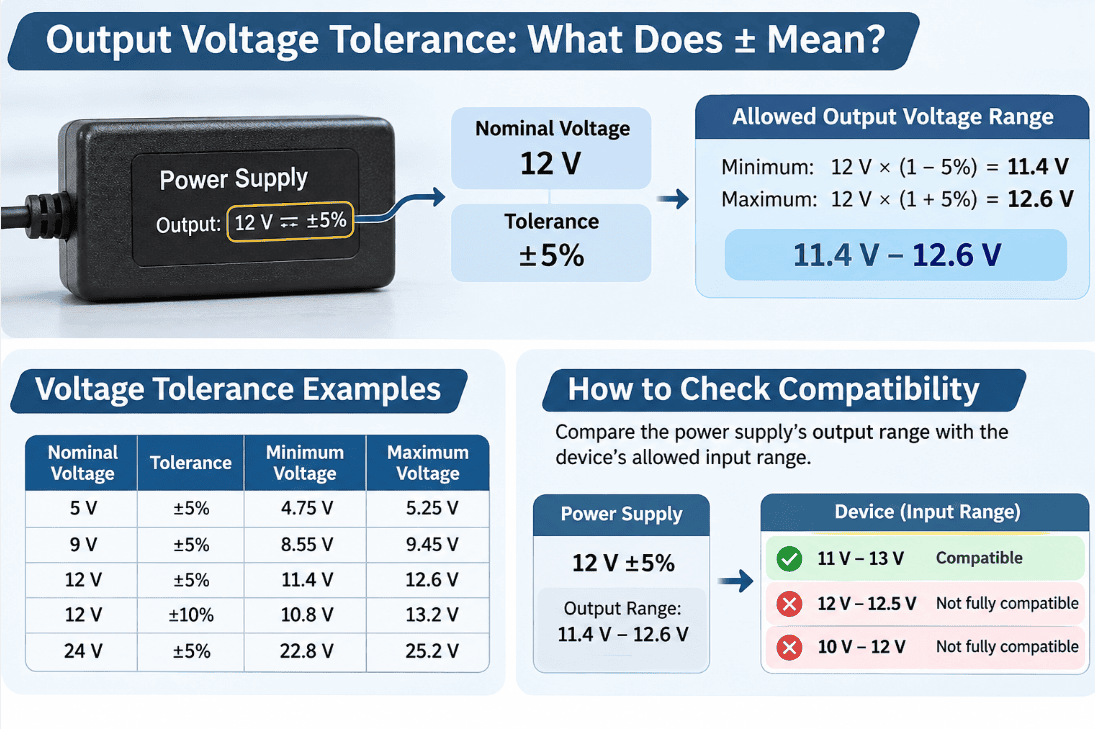
Is Ripple Specification the Same as Output Voltage Tolerance?
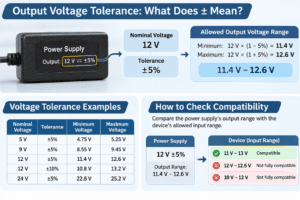
No. Ripple describes AC fluctuations superimposed on the DC output, while output voltage tolerance describes permitted deviation from the nominal DC voltage under specified conditions.
A power supply can maintain an acceptable nominal output voltage and still exhibit measurable ripple.
Our article on output voltage tolerance explains how to interpret those permitted DC voltage variations.
Final Takeaway
A ripple specification is meaningful only when its measurement conditions are understood. Bandwidth determines which frequency components are captured, probe connections affect measurement accuracy, and load conditions influence the power supply’s behavior.
To compare ripple performance fairly, compare values measured under equivalent conditions—not simply the lowest mVp-p number in a datasheet.