USB technology has played a critical role in powering and connecting electronic devices for more than two decades. From computers and smartphones to industrial equipment and consumer electronics, USB connectors have become one of the most widely adopted interfaces worldwide.
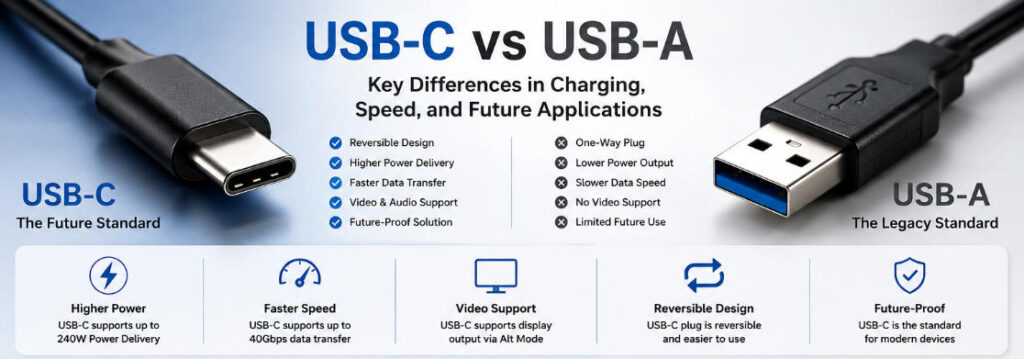
Among the different USB connector types, USB-A and USB-C remain the two most recognized standards. While USB-A continues to support millions of existing devices, USB-C has quickly become the preferred choice for modern electronics because of its higher power capability, faster data transfer, and greater flexibility.
For consumers, the difference between USB-C vs USB-A affects charging speed and device compatibility. For manufacturers and product developers, choosing the right connector directly impacts product design, market competitiveness, and long-term compatibility.
This article explains the key differences between USB-C and USB-A, including charging performance, data transfer capability, applications, and why USB-C is becoming the future standard for charging solutions.
What Is USB-A?
USB Type-A, commonly known as USB-A, is the original USB connector introduced in the late 1990s.
Because of its reliability and low manufacturing cost, USB-A quickly became the standard interface for computers and electronic accessories.
Typical USB-A applications include:
- Desktop computers
- Older laptops
- Keyboards and mice
- Printers
- External storage devices
- USB hubs
- Traditional chargers
The biggest advantage of USB-A is compatibility. Since it has existed for decades, countless devices still rely on USB-A connections.
However, USB-A was designed during a time when electronic devices required much less power than today’s laptops, tablets, and smartphones.
Its main limitations include:
- Larger connector size
- Non-reversible design
- Limited power delivery capability
- Reduced support for advanced technologies
Although USB-A can support faster USB standards such as USB 3.0, it was not designed for the high-power charging requirements of modern devices.
What Is USB-C?
USB Type-C, commonly called USB-C, is the latest generation of USB connector technology.
Unlike USB-A, USB-C features a compact and reversible design, allowing users to connect the cable in either direction. More importantly, USB-C was developed to support modern power delivery and high-speed communication requirements.
USB-C supports advanced technologies including:
- USB Power Delivery (PD)
- PPS charging
- USB4
- Thunderbolt compatibility
- DisplayPort Alt Mode
- High-speed data transfer
Today, USB-C is widely used in:
- Smartphones
- Tablets
- Ultrabooks
- Gaming devices
- Portable monitors
- Power banks
- Professional workstations
For businesses developing new electronic products, USB-C provides a more flexible platform because one connector can handle charging, data transmission, and video output.
USB-C vs USB-A: Main Differences
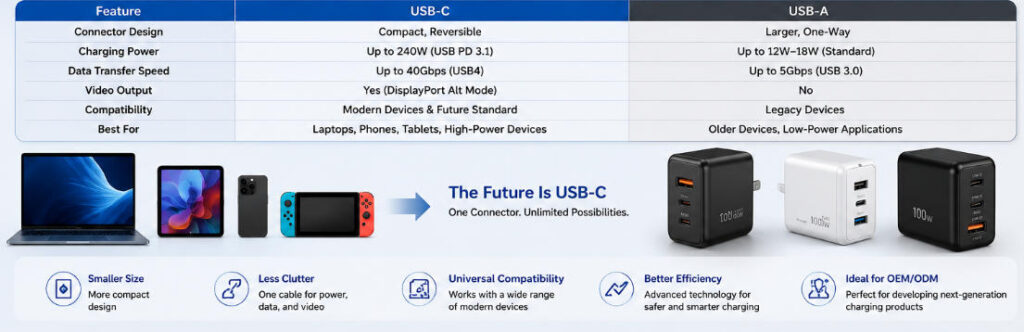
The difference between USB-C and USB-A is not only the connector shape. They represent two different generations of USB technology.
| Feature | USB-A | USB-C |
|---|---|---|
| Connector Design | Rectangular | Compact reversible |
| Plug Direction | One-way | Reversible |
| Charging Capability | Limited | High-power charging |
| Data Speed | Up to USB 3.x | Supports USB4 |
| Video Support | No native support | Display and video capable |
| Future Compatibility | Legacy devices | Modern electronics |
For manufacturers, USB-C provides more design flexibility because smaller ports allow thinner products while supporting more functions.
Charging Performance: USB-C vs USB-A
Charging performance is one of the biggest advantages of USB-C.
Traditional USB-A chargers were mainly designed for low-power devices. Typical USB-A charging outputs include:
- 5V/1A
- 5V/2A
- 5V/2.4A
This is sufficient for basic accessories and older smartphones, but it is not ideal for today’s power-hungry devices.
Modern laptops and tablets require much higher charging power. USB-C solves this problem through USB Power Delivery technology.
USB-C PD chargers can support:
- 20W smartphone charging
- 45W tablet charging
- 65W laptop charging
- 100W professional laptop charging
- Higher power levels with USB PD 3.1
More importantly, USB PD allows intelligent communication between the charger and device. The system automatically adjusts voltage and current to provide efficient and safer charging.
For a deeper explanation of charging protocols, readers can explore our guide on USB Power Delivery (PD), which explains how PD, PPS, and GaN technology improve modern charging performance.
Data Transfer and Connectivity Comparison
USB-C also provides significant advantages in data transmission.
While USB-A can support USB 3.x speeds, USB-C was designed for the latest communication standards.
Depending on the supported protocol, USB-C can achieve:
- 10Gbps with USB 3.2 Gen 2
- 20Gbps with USB 3.2 Gen 2×2
- Up to 40Gbps with USB4 and Thunderbolt
This makes USB-C suitable for professional applications such as:
- Video production
- Large file transfer
- External SSD storage
- Multi-monitor workstations
In addition, USB-C can transmit video signals through DisplayPort Alt Mode, allowing users to connect monitors and docking stations with a single cable.
USB-A cannot provide the same level of integration because it was designed primarily for data communication rather than multifunction connectivity.
Why USB-C Is Becoming the Industry Standard
The transition from USB-A to USB-C is driven by several important market trends.
1. Growing Demand for Fast Charging
Consumers increasingly expect faster charging for smartphones, laptops, and portable devices.
USB-C enables manufacturers to provide higher-power charging without increasing product size.
2. Smaller and More Efficient Product Design
Modern electronics continue becoming thinner and lighter.
The compact USB-C connector allows engineers to create slimmer products while maintaining powerful charging capabilities.
3. One Connector for Multiple Applications
USB-C reduces complexity by combining:
- Power delivery
- Data transfer
- Video output
- Peripheral connection
This makes it especially attractive for laptops, docking stations, and professional devices.
USB-C vs USB-A for OEM and Business Buyers
For consumers, choosing between USB-C and USB-A is mainly about convenience and compatibility. However, for OEM manufacturers, distributors, and technology brands, connector selection is a strategic product decision.
When developing new charging products, USB-C provides several advantages:
1. Better Compatibility With Modern Devices
The global electronics market is rapidly moving toward USB-C adoption. Smartphones, laptops, tablets, and professional equipment increasingly rely on USB-C as the primary charging interface.
For brands developing new products, choosing USB-C helps ensure compatibility with current and future devices.
A USB-C-based product portfolio can support a wider range of applications, including:
- Mobile accessories
- Laptop chargers
- Industrial electronics
- Smart devices
- Portable power solutions
2. Higher Product Value and Market Competitiveness
Consumers and businesses increasingly expect charging products to support fast charging technologies.
A standard USB-A charger may still work for basic applications, but USB-C chargers provide stronger market positioning because they support:
- Higher power output
- Faster charging speeds
- Multi-device charging
- Advanced charging protocols
For example, modern 100W PD Charger solutions can power laptops, tablets, and smartphones through a single compact charging platform.
3. Better Long-Term Product Planning
Electronic product development requires considering future market trends.
Although USB-A will continue to exist because of legacy applications, USB-C is clearly becoming the mainstream solution for new product development.
For companies planning long-term product lines, investing in USB-C charging technology can reduce redesign costs and improve future compatibility.
Why GaN Technology Is Accelerating USB-C Adoption
Another important trend supporting USB-C growth is the increasing adoption of GaN semiconductor technology.
Traditional silicon-based chargers often become larger when higher power output is required. GaN technology allows chargers to operate more efficiently while reducing size and heat generation.
Combined with USB-C Power Delivery, GaN chargers can provide:
- Higher power density
- Smaller product dimensions
- Improved energy efficiency
- Better thermal performance
This combination has made compact high-power chargers possible, including solutions designed for laptops and professional users.
For companies looking for advanced charging products, GaN charger solutions provide opportunities to develop smaller, more efficient, and more competitive products.
USB-C vs USB-A: Which Connector Should Businesses Choose?
The answer depends on the product application.
Choose USB-A When:
USB-A may still be suitable for:
- Legacy equipment
- Industrial systems
- Existing accessories
- Low-power applications
For products targeting older ecosystems, USB-A remains a practical option.
Choose USB-C When:
USB-C is the better choice for:
- New consumer electronics
- Laptop chargers
- Fast charging products
- Portable devices
- Professional equipment
- Future product development
For most new charging solutions, USB-C provides greater flexibility, stronger performance, and better long-term market potential.
How to Choose a Reliable USB-C Charger Manufacturer
For businesses sourcing USB-C charging products, selecting the right manufacturing partner is as important as choosing the connector itself.
A reliable supplier should have experience in:
- Power electronics engineering
- USB PD protocol development
- Safety certification compliance
- Thermal management design
- Mass production quality control
- OEM and ODM customization
Manufacturers should also evaluate:
- Product testing capabilities
- International certifications
- Production capacity
- Engineering support
- Supply chain reliability
As an experienced USB charger manufacturer, Szjialu focuses on developing reliable charging solutions, including USB-C PD chargers and GaN fast chargers for global customers.
With professional engineering capabilities and manufacturing experience, Szjialu supports businesses from product development to mass production.
Conclusion
The comparison of USB-C vs USB-A shows a clear difference between legacy connectivity and future-ready charging technology.
USB-A remains useful for existing devices and traditional applications, but its limitations in power delivery, connector design, and advanced functionality make it less suitable for modern electronics.
USB-C offers significant advantages through:
- Higher charging power
- Faster data transfer
- Reversible design
- Video support
- Better compatibility with future devices
For consumers, USB-C provides a more convenient and powerful charging experience.
For manufacturers and businesses, USB-C represents a more competitive and future-proof solution for developing next-generation electronic products.
As the global electronics industry continues moving toward higher efficiency and smarter charging systems, USB-C will remain a key technology shaping the future of power delivery.