Thermal receipt printers are widely used in POS systems, retail stores, restaurants, supermarkets, logistics terminals, and self-service kiosks. Although these printers appear simple, they have specific power requirements that are different from many low-power electronic devices.
A common mistake buyers make is selecting a power adapter based only on the printer’s voltage label. In reality, thermal printers create short but significant power spikes when the print head heats up and the motor starts feeding paper. If the power supply cannot handle these peak current demands, users may experience printing interruptions, paper feeding problems, random resets, or reduced printer lifespan.
Choosing the correct thermal printer power adapter requires understanding voltage, current capacity, regulation performance, connector compatibility, and especially peak current during printing.
As a professional power adapter manufacturer, Szjialu provides reliable AC DC power solutions for industrial equipment, POS terminals, communication devices, and commercial electronics, helping customers select stable power solutions for different applications.
Why Thermal Receipt Printers Need a Specialized Power Adapter
A thermal receipt printer works by using a thermal print head that generates heat to transfer images and text onto thermal paper. During printing, the printer does not consume a constant amount of power.
The power demand changes depending on:
- Print density
- Printing speed
- Paper feeding operation
- Cutter operation
- Communication activity
- Printer model design
When the printer starts printing, the heating elements inside the print head activate rapidly. This creates a temporary increase in current consumption known as peak current demand.
For example:
A printer may normally operate at:
- Voltage: 12V
- Average current: 1.5A
However, during printing startup, it may briefly require:
- Peak current: 3A or higher
If the adapter can only provide 2A, the voltage may drop when printing begins, causing:
- Printer rebooting
- Blurry or incomplete printing
- Communication errors
- Motor stopping
- System instability
Therefore, selecting a thermal printer AC adapter requires checking both normal operating current and peak printing current.
1. Check the Printer Voltage Requirement First
The first specification buyers should confirm is output voltage.
Most thermal receipt printers commonly use:
- 5V
- 9V
- 12V
- 24V
Among them, 12V and 24V models are widely used in commercial POS environments.
The adapter output voltage must match the printer requirement exactly.
For example:
A printer labeled:
DC 12V 3A
requires:
12V DC output
A 15V or 9V adapter should never be substituted because incorrect voltage can damage internal circuits.
For stable operation, buyers should choose regulated power supplies that maintain consistent voltage under changing loads.
Szjialu offers various regulated AC DC adapter solutions suitable for different electronic devices. Related products can be found here:
2. Understand Peak Current During Printing
For thermal printers, current rating is one of the most important specifications.
Many buyers only check:
“How many amps does the printer normally use?”
However, this does not represent the real power requirement.
Thermal printers have two different current conditions:
Standby Current
When the printer is idle:
- Print head is inactive
- Motor is stopped
- Communication circuits remain powered
Power consumption is relatively low.
Printing Peak Current
During printing:
- Thermal elements heat rapidly
- Paper motor operates
- Cutter mechanism may activate
Current demand increases significantly.
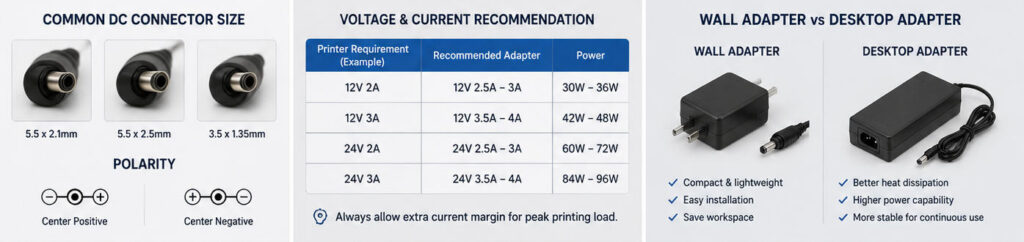
A suitable thermal printer power adapter should provide enough current headroom.
A common recommendation is:
Printer requirement:
12V 2A
Recommended adapter:
12V 2.5A-3A
This additional margin helps the adapter handle temporary load changes without voltage instability.
3. Calculate Power Capacity Correctly
Adapter power is calculated using:
Voltage × Current = Wattage
Example:
12V × 3A = 36W
A 36W adapter can continuously provide 36 watts under normal conditions.
However, thermal printer applications require considering:
- Startup load
- Continuous printing duration
- Environmental temperature
- Adapter efficiency
Choosing an adapter with insufficient wattage may cause overheating and premature failure.
For industrial and commercial customers, Szjialu recommends selecting adapters with sufficient safety margin rather than operating near maximum capacity.
Related:
Internal Link Suggestion:
4. Choose a Regulated Power Adapter for Printer Applications
Thermal printers require stable voltage because the print controller and communication circuits are sensitive to power fluctuations.
An unregulated power supply may produce:
- Higher voltage without load
- Voltage drops under load
- Electrical noise
These issues can affect:
- Print quality
- USB or serial communication
- Printer motherboard reliability
A regulated POS printer power adapter maintains stable output voltage even when printing conditions change.
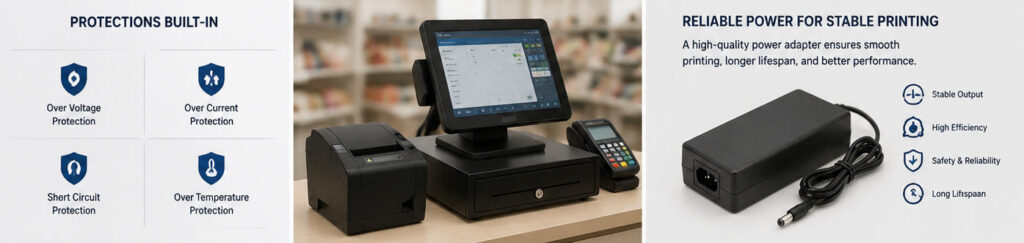
Important features include:
- Over voltage protection
- Over current protection
- Short circuit protection
- Thermal protection
These protections help prevent damage caused by abnormal operating conditions.
5. Check Connector Size and Polarity
Even if voltage and current are correct, the adapter may not work if the connector does not match.
Before purchasing, buyers should confirm:
DC Plug Size
Common barrel connector sizes include:
- 5.5 × 2.1mm
- 5.5 × 2.5mm
- 3.5 × 1.35mm
Polarity
Most thermal printers use:
- Center positive (+)
But some models use different configurations.
Always verify:
- Connector diameter
- Plug length
- Polarity direction
For OEM customers, customized DC connectors are often required.
Szjialu supports customized adapter solutions for different applications, including connector selection, cable length, and label requirements.
6. Consider Printer Working Environment
Thermal receipt printers are often installed in demanding commercial environments.
Examples:
- Restaurant counters
- Retail checkout systems
- Warehouse terminals
- Transportation stations
The adapter may operate continuously for many hours.
Buyers should consider:
Operating Temperature
High temperature environments require better thermal design.
Continuous Operation
Heavy printing workloads require reliable components.
Safety Certification
Depending on the market, customers may require:
- CE
- FCC
- UL
- RoHS
A quality receipt printer power supply should provide reliable operation throughout long working hours.
7. Wall Adapter vs Desktop Adapter for Thermal Printers
Different installation environments require different adapter designs.
Wall Mount Adapter
Advantages:
- Compact
- Easy installation
- Saves workspace
Suitable for:
- Small POS terminals
- Retail counters
- Small receipt printers
Desktop Adapter
Advantages:
- Better heat dissipation
- Higher power capability
- More stable for continuous operation
Suitable for:
- High-speed receipt printers
- Commercial POS systems
- Industrial terminals
For higher-power thermal printers, desktop-style adapters are often preferred because they provide better thermal performance.
8. Avoid These Common Buying Mistakes
Mistake 1: Choosing the Lowest Price Adapter
Low-cost adapters may use:
- Poor quality capacitors
- Weak protection circuits
- Insufficient thermal design
They may fail during continuous printing.
Mistake 2: Matching Only Voltage
Correct voltage does not guarantee compatibility.
Current capability is equally important.
Mistake 3: Ignoring Peak Current
This is the most common problem.
A printer may work during testing but fail during actual printing because the adapter cannot support peak demand.
Mistake 4: Using Universal Chargers
Universal adapters may have:
- Incorrect connector
- Unstable output
- Poor regulation
Dedicated printer power solutions are safer.
How Szjialu Supports Thermal Printer Power Solutions
Selecting the right thermal printer power adapter is critical for reliable POS and commercial printing systems.
At Szjialu, we focus on providing stable AC DC adapter solutions for global customers.
Our capabilities include:
- Multiple voltage options
- Different power ranges
- Customized connectors
- OEM/ODM support
- Safety-certified designs
- Bulk production capability
Whether customers need a compact 12V adapter for small receipt printers or higher-power solutions for commercial POS systems, Szjialu helps optimize power performance and reliability.
Conclusion: Select a Thermal Printer Power Adapter Based on Real Printing Demand
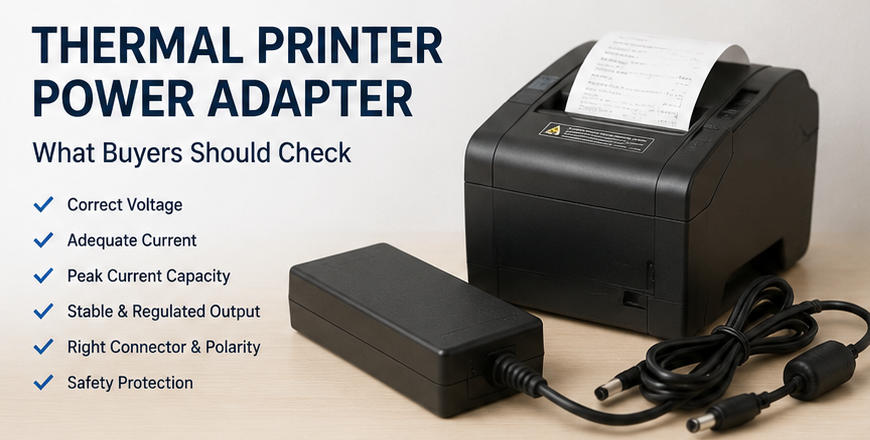
A thermal receipt printer power adapter should not be selected only by checking voltage specifications.
The most important factors include:
- Correct output voltage
- Enough current capacity
- Peak current handling capability
- Stable regulation
- Proper connector compatibility
- Reliable safety protection
Because thermal printers experience frequent power fluctuations during printing, choosing an adapter with sufficient current margin ensures better performance and longer equipment life.
For businesses, distributors, and OEM customers, working with an experienced manufacturer like Szjialu can provide reliable and customized power solutions for modern printing applications.