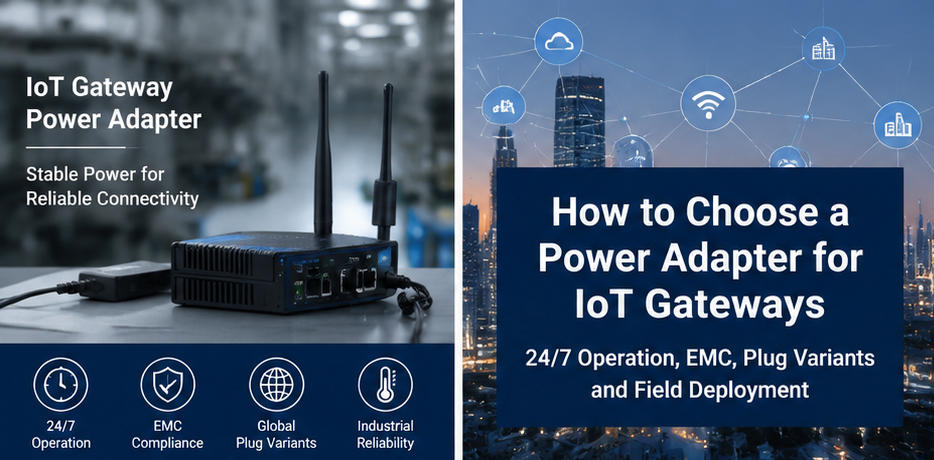
IoT gateways act as the communication bridge between sensors, edge devices, industrial equipment, and cloud platforms. Unlike consumer electronics, IoT gateway systems are often installed in remote locations and expected to operate continuously for years. A stable power solution is therefore not just an accessory—it is a critical component that determines system uptime, data reliability, and maintenance costs.
Choosing the right IoT gateway power adapter requires more than matching voltage and connector size. Engineers and procurement teams must consider continuous operation requirements, electromagnetic compatibility (EMC), plug standards for different regions, environmental conditions, and long-term field deployment challenges.
A poorly selected adapter can lead to unexpected shutdowns, communication interruptions, overheating, or electromagnetic interference that affects connected devices. For industrial IoT applications, smart buildings, automation systems, and remote monitoring networks, selecting a reliable power adapter is essential.
Szjialu specializes in AC DC power solutions designed for various electronic applications, providing stable and efficient adapters for industrial devices, communication equipment, IoT systems, and embedded platforms.
1. Understand the Power Requirements of IoT Gateways
Before selecting an adapter, the first step is understanding the gateway’s electrical requirements. Most IoT gateways require a regulated DC output, commonly including 5V, 9V, 12V, 15V, or 24V depending on the hardware architecture.
A suitable IoT gateway power adapter should provide:
- Stable output voltage
- Sufficient current capacity
- Low ripple and noise
- Protection against overload and short circuits
- Reliable performance under continuous operation
For example, if an IoT gateway requires 12V 2A power input, selecting a 12V adapter with only 1A output capacity may cause voltage drops when the gateway communicates through cellular, Wi-Fi, or Ethernet modules.
A general recommendation is to select an adapter with additional power margin. A 20%-30% reserve capacity helps compensate for:
- Peak communication activity
- Temperature variations
- Component aging
- Future hardware expansion
2. Prioritize 24/7 Continuous Operation Reliability
Unlike consumer devices that are powered on occasionally, many IoT gateways operate continuously throughout the year.
Typical applications include:
- Smart energy monitoring
- Industrial automation
- Environmental monitoring stations
- Security systems
- Smart agriculture
- Transportation tracking systems
For these environments, the power adapter must support 24/7 operation.
Thermal Management
Heat is one of the biggest factors affecting adapter lifespan. Continuous operation increases internal temperature, which accelerates component aging.
A reliable IoT power adapter should include:
- High-quality components rated for long operation
- Efficient power conversion design
- Proper heat dissipation structure
- Stable performance at elevated temperatures
A lower-quality adapter may work normally during initial installation but experience voltage instability after months of continuous use.
Long-Term Electrical Stability
IoT gateways often store and transmit important data. A short power interruption can result in:
- Lost sensor information
- Communication failure
- System reboot cycles
- Remote maintenance requirements
Therefore, professional IoT deployments typically choose regulated AC DC adapters rather than basic unregulated power supplies.
Szjialu designs regulated power adapter solutions focused on stable output performance for industrial and commercial electronic equipment.
3. Consider EMC Performance for Industrial IoT Environments
Electromagnetic compatibility (EMC) is a key factor when choosing an IoT gateway power adapter.
IoT gateways are often installed near:
- Motors
- Industrial controllers
- Wireless communication equipment
- Power distribution systems
- Automation machinery
These environments may contain electrical noise that can affect system performance.
A quality adapter should minimize:
- Electromagnetic interference (EMI)
- Radio frequency noise
- Voltage fluctuations
- Conducted disturbances
Poor EMC performance may cause:
- Network instability
- Sensor communication errors
- False data readings
- Unexpected gateway resets
When deploying IoT gateways in industrial environments, engineers should verify that the adapter meets relevant safety and EMC requirements, including standards required for the target market.
For applications requiring stable and compliant power solutions, Szjialu provides AC DC adapters designed for global electronic equipment applications.
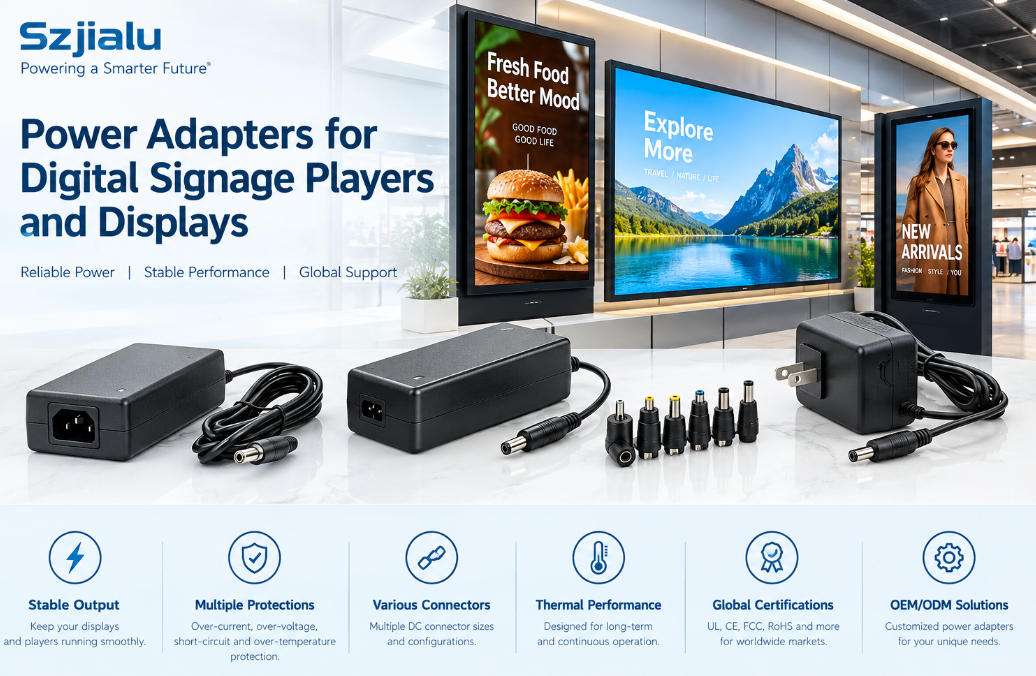
4. Select the Correct Plug Variant for Global Deployment
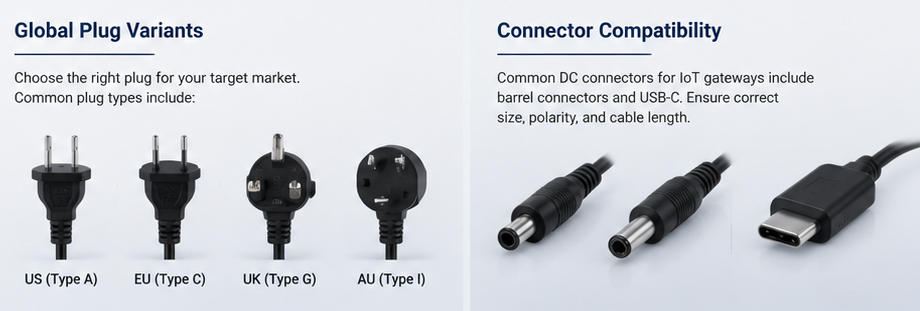
IoT gateway manufacturers often deploy products across multiple countries. A gateway installed in North America may require a different AC plug compared with one deployed in Europe or Asia.
Common plug variants include:
- US Type A plug
- EU Type C plug
- UK Type G plug
- AU Type I plug
For international projects, using interchangeable plug systems can simplify logistics and reduce inventory requirements.
Important considerations include:
Regional Certification Requirements
Different markets have different requirements for power adapters.
Examples include:
- UL certification for North America
- CE requirements for Europe
- PSE requirements for Japan
- RCM requirements for Australia
Choosing a supplier familiar with global compliance can reduce project delays.
Replaceable Plug Designs
For IoT gateway manufacturers shipping internationally, adapters with interchangeable AC plugs provide several advantages:
- Easier global distribution
- Lower inventory complexity
- Faster deployment
- Reduced logistics costs
Szjialu supports different plug configurations and customization options for customers requiring adapters for international markets.
5. Connector Compatibility and Custom Cable Options
The DC connector is another important consideration when selecting an IoT gateway power adapter.
Common connector types include:
- 5.5mm x 2.1mm barrel connector
- 5.5mm x 2.5mm barrel connector
- USB-C connector
- Custom DC cables
Before ordering, confirm:
- Connector diameter
- Polarity
- Cable length
- Locking requirements
- Installation environment
For fixed industrial installations, longer cables or customized connectors may improve installation flexibility.
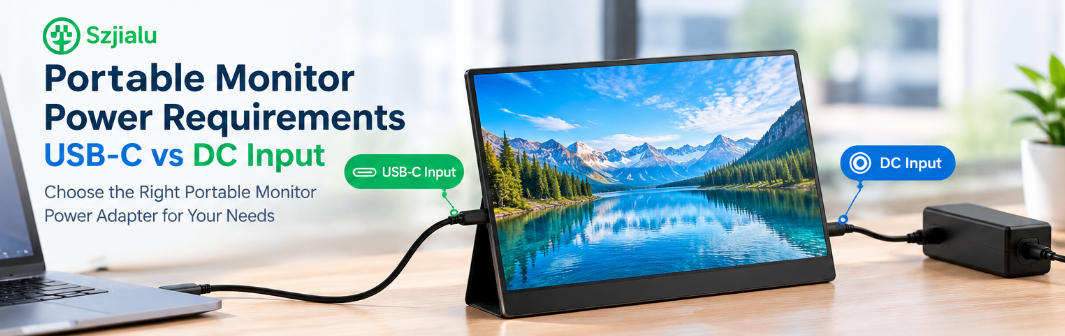
USB-C power delivery has also become increasingly popular for modern IoT gateways because it supports compact designs and higher power output.
However, traditional barrel connectors remain widely used in industrial gateways because they provide:
- Simple connection
- Mechanical reliability
- Easy replacement
- Compatibility with existing hardware
6. Evaluate Field Deployment Conditions
IoT gateways are frequently installed in challenging environments. The selected adapter should match the actual deployment conditions.
Consider factors such as:
Indoor vs Outdoor Installation
Indoor applications may only require standard adapters, while outdoor or semi-industrial installations may require:
- Higher temperature tolerance
- Better protection design
- More durable housing
Temperature Range
Remote monitoring systems may operate in:
- Cold warehouses
- Outdoor cabinets
- Industrial facilities
- High-temperature locations
The adapter should maintain stable output across the expected temperature range.
Dust and Humidity
Although the adapter itself may not be exposed directly to harsh environments, installation location matters.
A suitable solution may require:
- Enclosed installation
- Additional protection
- Industrial-grade design
Understanding deployment conditions before purchasing helps prevent premature failures.
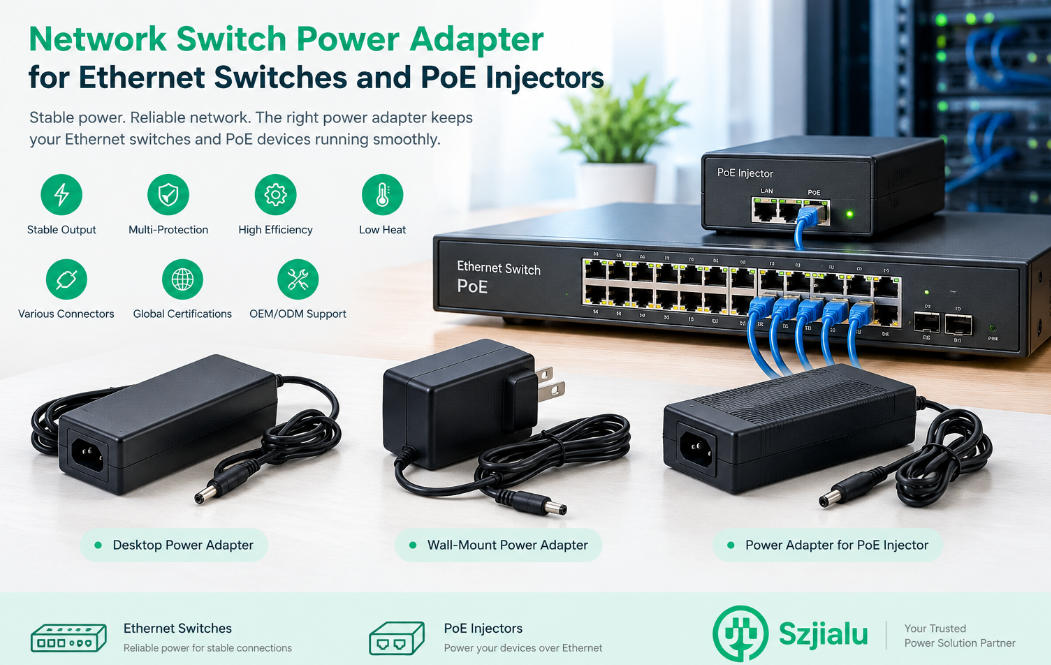
7. Wall Adapter vs Desktop Adapter for IoT Applications
IoT gateway projects typically choose between wall-mounted adapters and desktop-style adapters.
Wall Power Adapter
Advantages:
- Compact design
- Easy installation
- Space-saving
- Suitable for small gateways
Typical applications:
- Smart home hubs
- Wireless gateways
- Small monitoring devices
Desktop Power Adapter
Advantages:
- Better thermal performance
- Higher power capability
- More stable for industrial devices
Typical applications:
- Industrial IoT gateways
- Edge computing devices
- Communication controllers
For higher-power gateways operating continuously, desktop adapters may provide better thermal management and reliability.
8. Why Working With the Right Power Adapter Supplier Matters
For IoT manufacturers and system integrators, the power adapter supplier should provide more than standard products.
Important supplier capabilities include:
- Custom voltage and current requirements
- Cable customization
- Plug selection
- Certification support
- Production consistency
- Quality control
A reliable supplier helps ensure that every deployed IoT gateway receives stable and safe power.
Szjialu provides professional AC DC power adapter solutions for different electronic applications, supporting customers with customized requirements and global deployment needs.
Conclusion: Choosing the Right IoT Gateway Power Adapter
Selecting an IoT gateway power adapter requires careful evaluation of electrical performance, continuous operation capability, EMC characteristics, connector compatibility, and deployment environment.
For 24/7 IoT applications, the adapter must provide stable output, reliable thermal performance, and long-term durability. Global deployments also require attention to plug variants, certification requirements, and customization options.
Whether used for industrial automation, smart buildings, remote monitoring, or edge computing systems, the right power adapter helps ensure reliable communication and reduces maintenance costs.
With experience in AC DC power solutions, Szjialu supports businesses looking for dependable adapters designed for modern IoT and electronic applications.