The rapid adoption of USB-C has transformed the charging experience for smartphones, tablets, laptops, gaming consoles, and many other electronic devices. However, terms like Power Delivery (PD), Programmable Power Supply (PPS), and GaN technology often create confusion because they describe different aspects of modern charging.
Some people mistakenly believe that GaN is a charging protocol, while others think PPS replaces PD. In reality, these technologies complement one another to deliver faster, safer, and more efficient charging.
Whether you’re a consumer looking for the best USB-C charger or an OEM brand sourcing reliable charging solutions, understanding these technologies is essential.
As an experienced manufacturer, Szjialu develops and manufactures a complete range of USB-C PD chargers, GaN chargers, power adapters, and customized OEM/ODM charging solutions for customers worldwide, backed by ISO-certified manufacturing and international safety certifications.
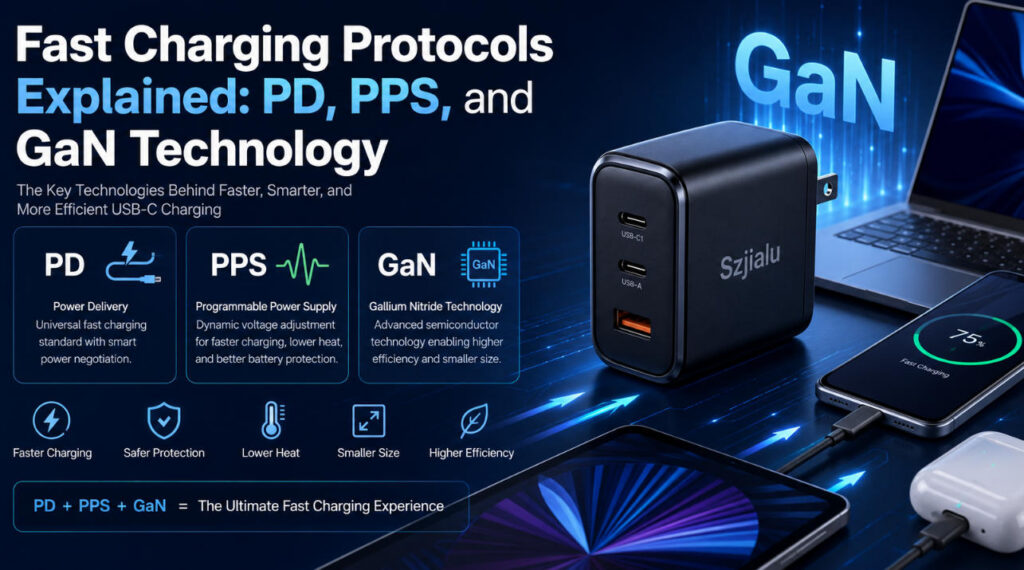
Understanding Fast Charging Protocols
A charging protocol is essentially the communication language between a charger and a connected device.
Instead of continuously supplying one fixed voltage, modern chargers negotiate the most appropriate voltage and current before power delivery begins.
This intelligent communication provides several benefits:
- Faster charging speeds
- Lower heat generation
- Higher charging efficiency
- Better battery protection
- Improved compatibility across devices
Without standardized protocols, every manufacturer would require proprietary chargers, creating significant compatibility problems.
Today, USB-C Power Delivery has become the dominant universal charging standard across laptops, smartphones, tablets, and many other USB-powered devices.
If you’re exploring professional charging products, you can browse the complete range of GaN Chargers here:
USB Power Delivery (PD): The Universal Charging Standard
USB Power Delivery (USB PD) is currently the world’s most widely adopted fast charging protocol.
Unlike traditional USB charging, PD allows devices and chargers to negotiate different voltage profiles according to the power requirements.
Typical PD power profiles include:
- 5V
- 9V
- 12V
- 15V
- 20V
- Extended Power Range (PD 3.1)
This flexibility enables one charger to safely power:
- Smartphones
- Tablets
- Ultrabooks
- MacBooks
- Gaming handhelds
- Portable monitors
- USB-C accessories
Modern PD chargers can deliver anywhere from 20W to over 140W depending on the design and USB PD specification. Recent USB PD revisions also introduced Extended Power Range (EPR), enabling significantly higher power levels for demanding devices.
What Is PPS Charging?
PPS stands for Programmable Power Supply.
Rather than supplying only fixed voltage levels, PPS allows the charger to adjust voltage and current dynamically in extremely small increments.
For example:
Traditional PD may switch between:
- 5V
- 9V
- 15V
- 20V
PPS continuously fine-tunes the output to exactly match the battery’s charging requirements.
This dynamic adjustment offers several advantages:
- Lower charging temperature
- Higher energy conversion efficiency
- Faster battery charging
- Reduced battery stress
- Longer battery lifespan
Many flagship Android smartphones—including models from Samsung and Google—use PPS to achieve maximum charging performance. PPS is an optional feature within the USB PD ecosystem and enables much finer voltage and current control than fixed PD profiles.
PD vs PPS: What’s the Difference?
Although closely related, PD and PPS are not competitors.
| Feature | USB PD | PPS |
|---|---|---|
| Technology Type | Charging protocol | Advanced feature within PD |
| Voltage Output | Fixed voltage levels | Continuously adjustable voltage |
| Charging Speed | Fast | Faster under supported conditions |
| Heat Generation | Low | Even lower |
| Battery Protection | Excellent | Superior |
| Device Compatibility | Very broad | Supported devices only |
Think of USB PD as the highway, while PPS is an intelligent navigation system that continuously optimizes the journey.
What Is GaN Technology?
Unlike PD and PPS, GaN (Gallium Nitride) is not a charging protocol.
Instead, it is an advanced semiconductor material used inside power electronics.
Traditional chargers use silicon transistors.
GaN replaces silicon with Gallium Nitride, allowing switching at much higher frequencies while generating significantly less heat.
The result includes:
- Smaller chargers
- Higher efficiency
- Higher power density
- Better thermal performance
- Lower energy loss
This explains why today’s 100W chargers can be small enough to fit into a pocket while replacing much larger laptop power adapters. GaN devices operate more efficiently than conventional silicon-based designs, enabling compact, high-power chargers.
How PD, PPS, and GaN Work Together
Many users mistakenly compare these technologies.
In reality, they work together.
Here’s the relationship:
- PD manages communication between charger and device.
- PPS optimizes voltage regulation during charging.
- GaN improves the efficiency of the charger’s internal hardware.
A modern premium charger combines all three technologies:
- USB-C Power Delivery
- PPS support
- GaN power conversion
This combination delivers:
- Maximum charging speed
- Higher efficiency
- Better temperature control
- Smaller charger size
- Excellent compatibility
For example, the Szjialu 45W USB-C PD Charger supports both USB PD and PPS, making it suitable for laptops, tablets, and smartphones that benefit from adaptive charging.
Why GaN Chargers Are Becoming the Industry Standard
The charger industry has shifted rapidly toward GaN over the past several years.
Compared with conventional silicon chargers, GaN chargers offer measurable improvements.
Smaller Size
GaN components require fewer supporting components and operate more efficiently, enabling significantly more compact charger designs.
Higher Efficiency
More electrical energy reaches the connected device rather than being lost as heat.
Better Thermal Performance
Lower operating temperatures improve reliability and long-term durability.
Higher Power Output
Manufacturers can build:
- 65W chargers
- 100W chargers
- 140W chargers
while maintaining compact dimensions.
These benefits make GaN especially attractive for professionals, travelers, and OEM brands seeking premium charging solutions.
Choosing the Right Fast Charging Solution
When selecting a charger, buyers should evaluate several key factors beyond wattage.
Protocol Compatibility
Look for chargers supporting:
- USB PD
- PPS
- Multiple USB-C profiles
Safety Certifications
Reliable chargers should carry recognized certifications such as:
- CE
- FCC
- ETL
- PSE
- UKCA
- KC
- RoHS
Protection Systems
Professional chargers include:
- Over-voltage protection
- Over-current protection
- Short-circuit protection
- Over-temperature protection
- Overload protection
Manufacturing Quality
For OEM or wholesale purchasing, choose suppliers with:
- ISO9001-certified quality systems
- Automated testing
- Aging tests
- Traceable production
- International compliance
Szjialu states that it operates ISO9001 and ISO14001 certified manufacturing, BSCI compliance, automated testing and aging systems, and supports OEM/ODM customization for global customers.
Fast Charging Trends in 2026
The fast-charging industry continues evolving rapidly.
Several trends are shaping the next generation of USB-C charging:
- Wider adoption of USB PD 3.1
- Increased PPS compatibility
- More compact 100W–240W GaN chargers
- Multi-port intelligent power allocation
- Improved thermal management
- Universal USB-C charging ecosystems
These developments reduce charger fragmentation and simplify charging across laptops, phones, tablets, and accessories.
Why Businesses Choose Szjialu for OEM Fast Charging Solutions
For brands looking to develop reliable charging products, manufacturing capability is just as important as technology.
Szjialu offers:
- USB-C PD Chargers
- GaN Chargers
- Power Adapters
- Power Banks
- OEM & ODM customization
- International certifications
- Large-scale manufacturing capacity
- Global export experience
With automated production lines, engineering expertise, and comprehensive quality control, Szjialu helps brands bring certified fast-charging products to market efficiently.
Conclusion
USB-C charging has evolved far beyond simply increasing wattage. Modern fast charging depends on three complementary technologies: USB Power Delivery (PD) provides the communication framework, PPS enables intelligent real-time voltage optimization, and GaN technology delivers the hardware efficiency that makes compact, high-power chargers possible.
Understanding how these technologies work together helps consumers choose better chargers and enables businesses to source products that meet the growing demand for performance, safety, and compatibility.
As a trusted OEM/ODM manufacturer, Szjialu continues to develop advanced USB-C PD and GaN charging solutions that align with international standards, helping global brands deliver reliable fast-charging products to markets worldwide.