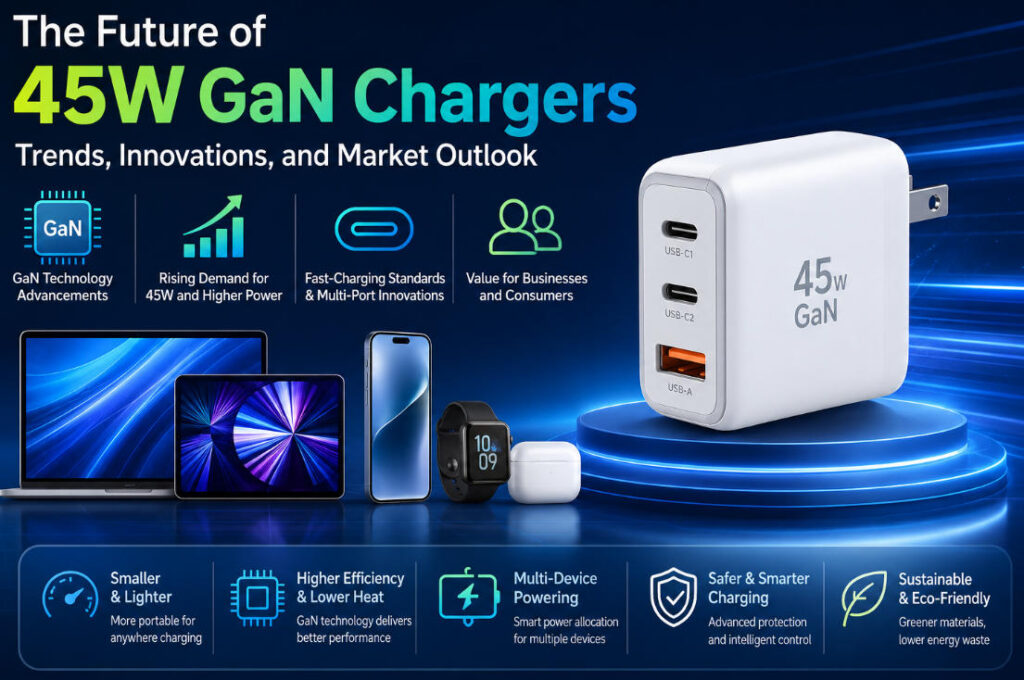
As modern devices become more powerful and users expect faster charging in smaller form factors, the charging industry is rapidly evolving. Among the most important innovations driving this transformation is Gallium Nitride (GaN) technology. Over the past few years, 45W GaN chargers have emerged as one of the most practical and versatile charging solutions for smartphones, tablets, ultrabooks, gaming handhelds, and other USB-C powered electronics.
Looking ahead, the future of 45W GaN chargers is not only about faster charging speeds. It is also about smarter power management, higher energy efficiency, multi-device compatibility, sustainable manufacturing, and enterprise-grade customization opportunities. As USB-C and Power Delivery (PD) standards continue to mature, the next generation of GaN chargers is expected to play a central role in both consumer electronics and commercial applications.
This article explores the future trends, technological innovations, and market outlook shaping the next wave of 45W GaN chargers.
Why 45W GaN Chargers Have Become a Mainstream Choice
45W charging has become a “sweet spot” in the market because it balances portability, charging speed, thermal efficiency, and broad device compatibility.
Unlike traditional silicon-based chargers, GaN chargers use gallium nitride semiconductors that can operate at higher frequencies with lower energy loss. This allows manufacturers to design chargers that are:
- Smaller and lighter
- More energy efficient
- Faster charging
- Better at heat management
- Suitable for multi-port charging systems
For many users, a 45W GaN charger is powerful enough to charge:
- Smartphones
- Tablets
- Nintendo Switch and gaming handhelds
- Ultrabooks and lightweight laptops
- Wireless earbuds
- Portable accessories
Because of this flexibility, 45W chargers are increasingly replacing multiple single-purpose adapters in homes, offices, and travel environments.
Key Trends Shaping the Future of 45W GaN Chargers
1. Increasing Demand for Compact High-Power Charging
Consumers and businesses are demanding smaller chargers without sacrificing performance. Modern work environments rely heavily on portable devices, remote collaboration, and hybrid workstations. This creates strong demand for compact chargers that can handle multiple devices efficiently.
Future 45W GaN chargers are expected to become:
- Even more compact through advanced PCB layouts
- Lighter for travel-friendly applications
- Better optimized for thermal dissipation
- More efficient under continuous load
Manufacturers are also experimenting with stackable internal architectures and higher-density power components to further reduce charger size.
For travelers and enterprise users, portability will remain one of the biggest competitive advantages of GaN charging technology.
2. USB-C and Universal Charging Expansion
The global transition toward USB-C is accelerating rapidly. Smartphones, tablets, laptops, monitors, gaming devices, and even accessories are increasingly adopting USB-C interfaces.
As universal charging becomes standard, 45W GaN chargers will benefit from:
- Wider device compatibility
- Reduced need for proprietary adapters
- Simplified charging ecosystems
- Increased adoption in corporate and educational environments
The implementation of USB Power Delivery (USB PD) and Programmable Power Supply (PPS) standards will also improve charging optimization for different device categories.
Future chargers will likely support intelligent voltage negotiation that automatically adjusts power delivery based on device requirements, battery condition, and temperature.
Innovation in Multi-Port GaN Charger Design
Smarter Power Distribution Systems
One of the biggest innovations in next-generation GaN chargers is intelligent power allocation.
Traditional multi-port chargers often split power inefficiently. However, future 45W GaN chargers are expected to use dynamic power management systems that can:
- Detect connected devices automatically
- Prioritize charging based on device type
- Optimize charging efficiency in real time
- Prevent overheating during simultaneous charging
For example, a future dual-port 45W charger may intelligently allocate:
- 30W to a laptop
- 15W to a smartphone
Then dynamically rebalance output as charging requirements change.
This creates a better user experience while improving energy efficiency.
Integration of AI-Based Charging Management
Artificial intelligence is beginning to influence power electronics and charging systems.
Future enterprise-grade GaN chargers may incorporate AI-assisted charging optimization that can:
- Learn charging behavior patterns
- Predict peak charging demand
- Reduce unnecessary heat generation
- Extend battery lifespan
- Improve long-term charging stability
For commercial deployments such as hotels, schools, retail kiosks, and office workstations, intelligent charging systems may also include remote monitoring capabilities.
This opens new opportunities for OEM and ODM charger manufacturers focused on smart infrastructure integration.
Higher Efficiency and Sustainability Goals
Energy Efficiency Will Become a Major Competitive Factor
As governments introduce stricter energy regulations, charger manufacturers will face increasing pressure to improve efficiency standards.
Future 45W GaN chargers are expected to deliver:
- Lower standby power consumption
- Reduced energy waste
- Higher conversion efficiency
- Improved eco-friendly packaging
- Longer product lifespan
Compared with traditional silicon chargers, GaN technology already offers significant efficiency improvements. The next generation will likely push efficiency even further through:
- Advanced controller ICs
- Improved transformer materials
- Better thermal interface solutions
- High-frequency switching optimization
For enterprise procurement teams, energy-efficient charging solutions can also help reduce operational costs at scale.
Sustainable Manufacturing and Material Innovation
Environmental sustainability is becoming increasingly important across the electronics supply chain.
Future GaN charger manufacturing may focus on:
- Recyclable materials
- Halogen-free components
- Reduced plastic usage
- Sustainable packaging
- Carbon footprint reduction
Large retailers and global brands are already prioritizing suppliers that meet environmental compliance requirements such as:
- RoHS
- REACH
- Energy Star
- ERP standards
Manufacturers that invest in green production processes may gain stronger long-term competitive advantages.
Fast-Charging Standards Will Continue to Evolve
Wider Support for PPS and Advanced Power Delivery
Future 45W GaN chargers will likely support more advanced fast-charging protocols, including:
- USB PD 3.1
- PPS fast charging
- QC compatibility
- Multi-voltage adaptive charging
Programmable Power Supply (PPS) technology is especially important because it enables more precise voltage and current control.
Benefits include:
- Reduced heat generation
- Faster charging speeds
- Improved battery protection
- Better compatibility with flagship smartphones
As battery technologies improve, chargers must also evolve to deliver power more intelligently rather than simply increasing wattage.
Multi-Device Ecosystem Charging
Future consumers increasingly own multiple connected devices:
- Smartphone
- Tablet
- Smartwatch
- Earbuds
- Portable gaming console
- Laptop
This creates demand for chargers that support complete device ecosystems.
Future 45W GaN chargers may include:
- Dual USB-C outputs
- USB-C + USB-A hybrid ports
- Foldable plugs
- Modular charging accessories
- Magnetic cable management systems
Manufacturers that focus on ecosystem-friendly design will likely see stronger growth opportunities.
Market Outlook for 45W GaN Chargers
Strong Global Growth Expected
The GaN charger market is projected to continue expanding due to:
- Increasing mobile device usage
- Growth in remote work
- Rising adoption of USB-C laptops
- Demand for portable charging
- Consumer preference for compact accessories
45W remains one of the most commercially attractive power ranges because it serves both mobile devices and lightweight laptops efficiently.
Compared with lower-power chargers, 45W models offer better versatility without significantly increasing size or cost.
Enterprise and Commercial Applications Will Expand
Beyond consumer electronics, future growth will also come from enterprise-grade deployments such as:
- Hotels
- Airports
- Smart offices
- Education environments
- Self-service kiosks
- Retail POS systems
- Shared workspaces
Businesses increasingly require reliable charging infrastructure that supports multiple device types while maintaining safety and efficiency.
This creates opportunities for OEM and ODM manufacturers offering:
- Custom branding
- Regional certifications
- Multi-port solutions
- Industrial-grade reliability
- Private-label charging products
Challenges Facing the Future GaN Charger Industry
Although the future outlook is strong, manufacturers still face several challenges:
Thermal Management
As chargers become smaller and more powerful, heat management remains a critical engineering challenge.
Future innovation will focus on:
- Better internal airflow design
- Advanced thermal materials
- Intelligent temperature control
- Higher-quality GaN power ICs
Supply Chain and Cost Pressure
GaN components are still more expensive than traditional silicon components in some market segments.
Manufacturers must balance:
- Performance
- Reliability
- Production cost
- Certification compliance
As production scales increase globally, GaN component costs are expected to decline over time.
Market Competition
The rapid growth of the GaN charger market has attracted many brands and manufacturers.
Future competition will likely focus on:
- Charging efficiency
- Safety certifications
- Smart features
- Industrial design
- OEM/ODM capabilities
- Brand trust
Companies that combine engineering quality with strong supply chain management may gain significant long-term advantages.
Conclusion
The future of 45W GaN chargers looks exceptionally promising. As charging technology evolves, next-generation GaN chargers will become smaller, smarter, safer, and more energy efficient.
Driven by the expansion of USB-C ecosystems, intelligent power management, AI-assisted charging optimization, and sustainable manufacturing, 45W GaN chargers are positioned to become a standard solution across both consumer and commercial markets.
For consumers, this means more convenient and efficient charging experiences. For enterprises and manufacturers, it creates new opportunities in customization, infrastructure deployment, and global charging solutions.
As the industry moves forward, companies that invest in innovation, safety, and high-efficiency design will likely lead the next phase of the GaN charging market.