Choosing a power adapter involves more than matching the output voltage, current rating, and connector size. One specification that is easy to overlook—but can have serious consequences—is DC output polarity.
When comparing a center positive vs center negative adapter, the key difference is the electrical connection between the center pin and the outer sleeve of the DC barrel connector. These configurations may look identical physically, yet they deliver power with opposite polarities.
For electronics manufacturers, equipment distributors, repair technicians, and procurement teams, understanding this distinction helps prevent compatibility problems, product damage, and unnecessary replacement costs.
This guide explains how center-positive and center-negative adapters work, how to identify their polarity symbols, what happens when the wrong adapter is used, and which specifications should be confirmed before ordering replacement or customized power supplies.

1. What Does Center-Positive or Center-Negative Mean?
DC barrel connectors commonly have two electrical contact areas: a central pin and an outer conductive sleeve. The adapter’s polarity determines which contact carries positive voltage and which carries negative voltage.
Center-positive power adapters
A center-positive adapter connects the center pin to the positive output and the outer sleeve to the negative output.
- Center pin: Positive (+)
- Outer sleeve: Negative (−)
This configuration is widely used in consumer electronics, networking equipment, routers, monitors, and many other DC-powered devices.
Center-negative power adapters
A center-negative adapter reverses these connections.
- Center pin: Negative (−)
- Outer sleeve: Positive (+)
Some audio equipment, specialized electronic devices, and legacy products use this arrangement. The exact requirements depend on the equipment design, so the polarity must always be verified rather than inferred from the application.
Key differences at a glance
| Specification | Center-positive | Center-negative |
|---|---|---|
| Center pin | Positive (+) | Negative (−) |
| Outer sleeve | Negative (−) | Positive (+) |
| Physical appearance | Often identical | Often identical |
| Typical applications | Routers, monitors, and many consumer electronics | Some guitar pedals and specialized electronics |
| Interchangeability | Only when the equipment specifies compatibility | Only when the equipment specifies compatibility |
The important point is that polarity is an electrical specification, not a physical connector feature. Two adapters can use the same barrel plug dimensions and output voltage while remaining electrically incompatible.
2. How to Identify Power Adapter Polarity
The most reliable approach is to check the adapter label and the equipment manufacturer’s documentation before connecting a power supply.
Method 1: Read the polarity symbol
Most barrel-type DC adapters display a small polarity diagram on the product label. The symbol usually includes a central dot, a surrounding C-shaped ring, and positive and negative signs connected to the corresponding contacts.
To interpret the diagram:
- If the positive sign is connected to the central dot, the adapter is center-positive.
- If the negative sign is connected to the central dot, the adapter is center-negative.
The other sign indicates the polarity of the outer sleeve.
Do not confuse the polarity diagram with the DC output voltage symbol or the AC input information. These markings communicate different electrical characteristics.
If the label is damaged, unclear, or missing, consult the original product documentation or the adapter manufacturer. Do not guess based on the appearance of the connector.
Method 2: Check the device’s input label
The device itself may specify its required input voltage, current, and polarity.
For example, a device might indicate:
- Input: 12V DC
- Required current: 2A
- Polarity: Center-positive
A suitable replacement must satisfy these requirements while also matching the connector dimensions and other relevant electrical specifications.
If the equipment label conflicts with an old adapter label, stop and confirm the correct specification with the equipment manufacturer before connecting either supply.
Method 3: Verify the electrical output
For engineering validation or quality control, polarity can be checked using a suitable digital multimeter and an appropriate test procedure.
A qualified technician can measure the adapter’s DC output and determine the polarity from the meter reading, provided the probes contact the correct terminals and the test is performed safely.
However, measuring an adapter’s output does not replace verification of the device’s required input polarity. Both specifications must agree.
For procurement teams sourcing adapters for multiple product models, it is better to maintain an approved specification sheet than to rely on repeated manual checks.
3. What Happens If You Use the Wrong Polarity?
Connecting a center-positive adapter to equipment designed exclusively for center-negative input can reverse the voltage presented to the device’s power input. The reverse situation can produce the same problem.
The outcome depends on the equipment’s internal circuit design and protection features.
Possible consequences include:
Failure to start: The device may not power on because its input circuitry receives the wrong polarity.
Damage to electronic components: Reverse polarity can damage input protection components, capacitors, integrated circuits, or other parts of the power circuit.
Blown fuses or activated protection: Some devices include reverse-polarity protection that limits damage, but this feature should never be assumed.
Intermittent or abnormal operation: In some circumstances, incorrect power connections may cause unexpected behavior or repeated protection shutdowns.
A device that appears unaffected after a brief connection is not necessarily safe to continue using. Disconnect an adapter if the polarity is uncertain, and inspect the equipment according to the manufacturer’s guidance.
For businesses supplying electronic products, polarity errors can lead to troubleshooting costs, product returns, warranty claims, and avoidable customer dissatisfaction.
4. Can Center-Positive and Center-Negative Adapters Be Interchanged?
In ordinary replacement applications, the answer is no—not unless the equipment manufacturer explicitly confirms that the device supports both polarities or an approved conversion arrangement.
Matching the voltage alone does not make an adapter compatible.
Consider a device requiring 9V DC with center-positive polarity. A 9V center-negative adapter may have the correct voltage and fit the same connector, but it still presents the wrong electrical arrangement.
Similarly, an adapter rated at 12V DC and 3A is not automatically suitable for every 12V device. Connector dimensions, polarity, current requirements, and other electrical characteristics must also be checked.
Some equipment uses a bridge rectifier, specialized protection circuit, or other input design that permits more than one polarity. Such compatibility must be confirmed from the manufacturer’s documentation rather than assumed.
For a deeper explanation of the other specifications involved, read Szjialu’s 12V power adapter buying guide.
5. Polarity Is Only One Part of Adapter Compatibility
Even after identifying whether a device requires a center-positive or center-negative adapter, several additional specifications must be checked.
Output voltage
The adapter’s rated output voltage must match the equipment’s required input voltage unless the manufacturer specifies an acceptable range.
Using a higher voltage without approval can damage the device. A lower voltage may prevent reliable startup or normal operation.
Current capacity
The adapter must provide sufficient current for the equipment’s operating requirements.
For a compatible, regulated DC supply, an adapter with a higher available current rating can generally be used when the voltage, polarity, connector, and other requirements match. The equipment draws the current it needs.
However, a supply with insufficient current capacity may overheat, shut down, or cause unstable operation.
Connector dimensions
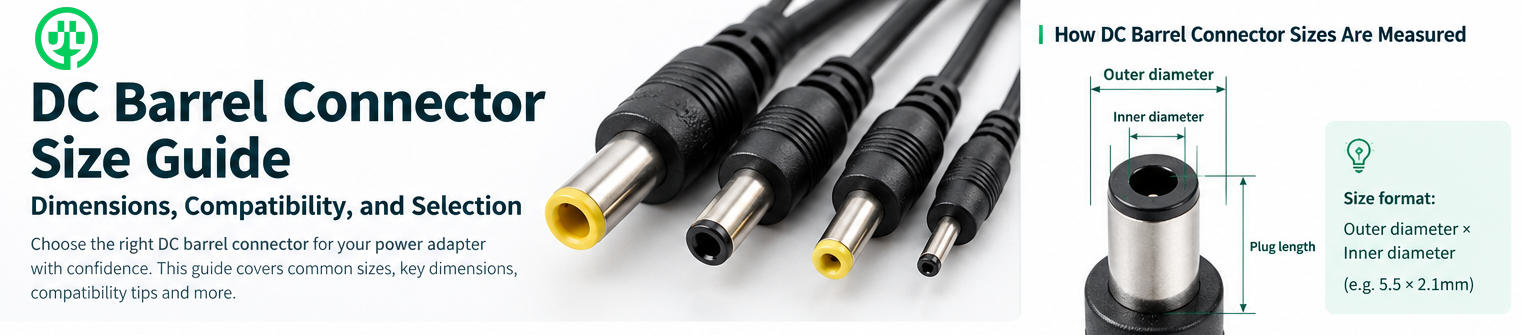
Barrel connectors come in different outer diameters, inner diameters, and lengths. A plug that appears to fit may not establish a reliable electrical connection.
For example, 5.5 × 2.1mm and 5.5 × 2.5mm connectors share the same outer diameter but have different inner diameters.
Read Szjialu’s DC barrel connector size guide to understand why connector measurements matter when selecting a replacement.
Regulation and operating requirements
Some devices require a regulated DC supply, low ripple and noise, or specific startup characteristics. Industrial and specialized equipment may also have defined temperature, duty-cycle, or electromagnetic compatibility requirements.
For these applications, compatibility should be evaluated against the complete equipment specification rather than a single label value.
6. A Practical Checklist for Selecting the Correct Adapter
Before purchasing a replacement adapter or approving a new component for production, verify the following items:
- Output voltage: Confirm the required DC voltage.
- Current rating: Ensure the adapter can supply the equipment’s maximum required current.
- Polarity: Verify center-positive or center-negative from the equipment documentation or polarity symbol.
- Connector size: Confirm the outer diameter, inner diameter, and insertion length.
- Connector configuration: Check whether a straight, right-angle, locking, or other connector is required.
- Electrical performance: Confirm regulation, ripple, startup behavior, and other requirements where applicable.
- Input compatibility: Check the adapter’s AC input range against the destination market’s mains supply.
- Safety and compliance: Verify the certifications and regulatory requirements applicable to the product and target market.
- Cable and installation details: Confirm cable length, routing, strain relief, and available installation space.
- Documentation: Record the approved adapter model and its full electrical specification.
This checklist is especially useful when purchasing replacement supplies for equipment fleets or approving adapters for a new product launch.
7. What OEM Buyers Should Specify When Ordering Power Adapters
For OEM and ODM projects, polarity should be included explicitly in the technical drawing, approved bill of materials, or adapter specification sheet.
A purchasing request that states only “12V DC adapter with a barrel plug” leaves several important details undefined. Different suppliers may interpret the connector, polarity, cable length, and output configuration differently.
A complete specification should include:
- Rated output voltage and current
- Maximum output power
- Center-positive or center-negative polarity
- DC connector dimensions and type
- Cable length and wire requirements
- AC input range and regional plug type
- Required safety certifications
- Environmental and operating requirements
- Labeling, packaging, and customization requirements
For example, Szjialu’s 36W wall-mount power adapter lists a 12V, 3A output and a default 5.5 × 2.1mm DC connector. For an actual order, buyers should also confirm the required polarity and exact configuration for the intended equipment rather than assume that connector size alone establishes compatibility.
Szjialu supports power adapter manufacturing and customization for commercial supply projects. Clearly documented requirements help align engineering review, sample evaluation, production approval, and repeat orders.
8. How Szjialu Can Support Power Adapter Selection
Selecting a suitable adapter requires a combination of electrical compatibility, connector specification, safety requirements, and manufacturing considerations.
Szjialu, a power adapter and charging solution manufacturer based in Shenzhen, China, supplies AC/DC power adapters and supports customization for different equipment requirements.
For projects involving replacement adapters, new product development, or bulk purchasing, buyers should prepare the device’s input specifications and identify any special requirements for polarity, connector configuration, cable length, and regional compliance.
Where the existing adapter label is unavailable, providing the equipment model and manufacturer documentation can help clarify the required configuration before samples or production orders are approved.
The goal is not simply to find an adapter that fits. It is to select a power supply that meets the device’s electrical requirements and can be supplied consistently for the intended market.
Frequently Asked Questions
Is center-positive the same as positive voltage?
Not exactly. Center-positive describes how the positive output is assigned to the center pin of a barrel connector. The adapter’s output voltage is a separate specification. A center-positive adapter can supply different DC voltages depending on its design.
Are most DC barrel adapters center-positive?
Many commonly used DC barrel adapters are center-positive, but this is not universal. Certain audio products, specialized electronics, and other equipment use center-negative configurations. Always verify the actual requirement.
Can I use a center-negative adapter if the plug fits?
Not unless the device manufacturer confirms compatibility. A physically compatible connector can still have the wrong polarity, potentially preventing operation or damaging the device.
Can a multimeter identify the polarity of an adapter?
Yes. A suitable digital multimeter can help determine the DC output polarity when used correctly by someone familiar with electrical testing. The result must then be compared with the equipment’s required polarity.
Should polarity be specified for bulk adapter orders?
Yes. Polarity should be documented alongside output voltage, current, connector dimensions, and cable configuration. This reduces ambiguity during sourcing, sample approval, production, and repeat purchasing.
Conclusion
Understanding center positive vs center negative adapter polarity is essential when selecting, replacing, or manufacturing DC power supplies. Although the two configurations may look identical, their electrical connections are different and should not be treated as interchangeable.
Before connecting an adapter, verify the polarity symbol, output voltage, current capacity, connector dimensions, and equipment documentation. For OEM projects and bulk purchases, record these requirements in an approved technical specification and confirm the final configuration before production.
With careful specification and compatibility checks, businesses can reduce preventable equipment failures and build a more reliable power supply sourcing process. Szjialu can support commercial power adapter projects where clearly defined electrical requirements and customized configurations are important.