In the era of USB-C and GaN technology, charger selection is no longer about “will it charge?”—it’s about how efficiently, how fast, and how many devices at once.
The comparison between 65W vs 100W GaN chargers is often oversimplified. In reality, the difference is not just peak wattage, but power distribution behavior, load stability, and long-term usability across device ecosystems.
This guide takes a more technical, real-world approach to help you choose the right wattage—especially if you are building a multi-device charging setup.
Understanding Wattage Beyond the Label
A charger labeled “65W” or “100W” does not continuously output that power in all scenarios.
Instead, it operates based on:
- USB Power Delivery (PD) negotiation
- Dynamic load allocation across ports
- Thermal and efficiency constraints
This means:
A 100W charger is not just “faster”—it is more flexible under complex load conditions.
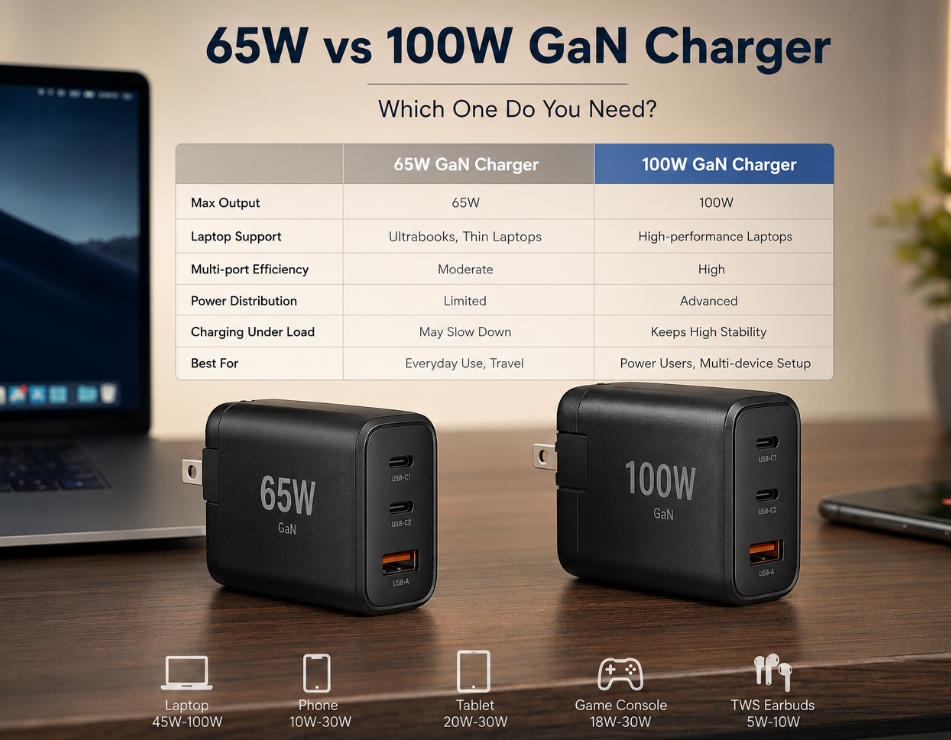
65W vs 100W GaN Charger: Technical Comparison Table
| Parameter | 65W GaN Charger | 100W GaN Charger |
|---|---|---|
| Maximum Output | 65W | 100W |
| Typical Laptop Support | Ultrabooks, thin laptops | High-performance laptops, MacBook Pro |
| Multi-Port Efficiency | Moderate (power throttling likely) | High (better distribution under load) |
| Power Allocation Flexibility | Limited | Advanced (dynamic balancing) |
| Charging Under Load | May slow down | Maintains higher stability |
| Thermal Headroom | Lower | Higher (more overhead capacity) |
| Future-Proofing | Medium | Strong |
| Size (GaN) | Compact | Slightly larger, still portable |

Power Distribution Behavior (The Real Differentiator)
The biggest difference between 65W and 100W chargers appears when multiple devices are connected simultaneously.
Example: Dual-Port Charging Scenario
| Scenario | 65W Charger | 100W Charger |
|---|---|---|
| Laptop + Phone | 45W + 18W | 65W + 30W |
| Laptop + Tablet | 45W + 20W | 65W + 35W |
| 3 Devices | Significant throttling | Stable distribution |
Insight:
A 65W charger quickly reaches its limit and must redistribute power aggressively, while a 100W charger operates with buffer capacity, maintaining performance across ports.
Is 65W Enough for a Laptop? (A More Precise Answer)
The common answer is “yes”—but that depends on power draw vs workload.
Matching Charger Output to Laptop Demand
| Laptop Type | Typical Power Draw | 65W Suitability |
|---|---|---|
| Ultrabooks (13″) | 30–60W | Ideal |
| Business Laptops | 45–65W | Suitable |
| MacBook Pro 14″ | 60–90W | Conditional |
| Gaming Laptops | 90–140W | Not sufficient |
Key Insight:
- Idle / light usage → 65W is sufficient
- Sustained CPU/GPU load → 65W may result in battery drain while plugged in
When Does 100W Actually Make a Difference?
A 100W GaN charger becomes essential in scenarios where:
1. Load Variability is High
Modern laptops dynamically adjust power consumption. A 100W charger ensures:
- No throttling under peak demand
- Stable charging during rendering / compiling / editing
2. Multi-Device Charging is Frequent
If your daily setup includes:
- Laptop
- Smartphone
- Tablet / accessories
Then 100W provides consistent parallel charging, not just sequential compromise.
3. You Want a Single-Charger Ecosystem
Instead of carrying:
- Laptop adapter
- Phone charger
- Tablet charger
A single 100W GaN charger replaces all—without performance sacrifice.
Efficiency and Thermal Considerations
GaN technology improves:
- Switching frequency
- Energy conversion efficiency
- Heat dissipation
However, wattage still affects thermal behavior.
| Aspect | 65W | 100W |
|---|---|---|
| Efficiency at Low Load | High | Slightly lower |
| Efficiency at High Load | Limited | Optimized |
| Heat Under Stress | Higher relative load | Lower relative load |
Conclusion:
A 100W charger often runs cooler under the same workload, because it operates below its maximum capacity.
Strategic Recommendation: Choosing Based on Usage Profile
Choose 65W if:
- You primarily use ultrabooks or tablets
- You charge 1–2 devices at a time
- Portability is your top priority
Choose 100W if:
- You use high-performance laptops
- You rely on multi-port charging daily
- You want a future-proof, single-charger solution
The Overlooked Factor: Upgrade Cycles
Most users underestimate how quickly their power needs evolve.
Ask yourself:
- Will your next laptop require 90W+?
- Will you add more USB-C devices?
If yes, a 100W charger is not overkill—it is capacity planning.
Industry Perspective: Why 100W is Becoming the New Standard
Manufacturers (including companies like SZJialu) are increasingly focusing on:
- 100W multi-port GaN chargers
- Intelligent power distribution chips
- Compact designs replacing traditional adapters
This shift reflects a broader trend:
Charging is no longer device-specific—it is ecosystem-oriented.
Internal Resource (Recommended Reading)
To better understand how to calculate your exact power needs, refer to this detailed guide:
https://szjialu.com/news/how-many-watts-do-you-need-for-a-charger/
This will help you align charger wattage with real device consumption patterns, not just labels.
Final Verdict
The choice between 65W vs 100W GaN chargers is not about “more vs less”—it’s about margin vs limitation.
- 65W operates efficiently within a narrow range
- 100W provides operational headroom, which translates to:
- Better multitasking
- Stable performance
- Longer usability lifecycle
For most users, 65W is sufficient today.
For demanding or evolving setups, 100W is the more strategic investment.