As USB-C Power Delivery (PD) technology becomes the global charging standard, two power levels dominate the market: 65W GaN chargers and 100W GaN chargers. While both are widely used in laptops, tablets, and smartphones, they serve slightly different user needs.
Choosing the right one is not just about “more wattage is better”—it depends on device type, usage scenario, and long-term scalability, especially for business and OEM buyers.
This article breaks down the differences in a practical, SEO-optimized, and engineering-focused way.
1. Power Output Difference Explained
The most fundamental difference between a 65W charger and a 100W GaN charger is the maximum power they can deliver.
What does wattage actually mean?
Wattage = Voltage × Current
A higher wattage means the charger can supply more energy to power-hungry devices or multiple devices at the same time.
Typical output profiles:
| Charger Type | Max Output | Common Use Case |
|---|---|---|
| 65W GaN Charger | 65 watts | Ultrabooks, tablets, smartphones |
| 100W GaN Charger | 100 watts | High-performance laptops, multi-device charging |
Practical difference:
- 65W charger is optimized for efficiency and portability
- 100W charger is designed for higher performance and multi-device output
In real-world usage, the difference becomes noticeable when charging:
- Gaming laptops
- Workstations
- Multiple devices simultaneously
2. Charging Speed Comparison
Charging speed is not only determined by charger wattage but also by the device’s maximum supported input.
Example scenarios:
Smartphone (20–30W input limit)
- 65W charger → No speed advantage over 100W
- 100W charger → Still limited to device max
Ultrabook (45–65W input limit)
- 65W charger → Fully sufficient
- 100W charger → No major speed increase
High-performance laptop (90–100W input limit)
- 65W charger → Slower charging or battery drain under load
- 100W charger → Full-speed charging + stable performance
Key takeaway:
- For most phones and mid-range laptops, charging speed difference is minimal
- For high-power laptops, 100W is significantly better
3. Device Compatibility Differences
Compatibility is where users often make the wrong decision.
65W GaN Charger Compatibility:
- MacBook Air / MacBook Pro 13”
- Dell XPS 13 / 15 (light usage)
- Lenovo ThinkPad X1 Carbon
- iPad Pro / iPad Air
- Android flagship phones
100W GaN Charger Compatibility:
- MacBook Pro 14” / 16”
- Gaming laptops (ASUS ROG, MSI, Lenovo Legion)
- USB-C monitors
- Docking stations
- Multi-device charging setups
Important technical note:
Modern GaN chargers support PD 3.0 / PD 3.1 protocols, which allow dynamic power negotiation. This means:
- A 100W charger can safely charge a 30W phone
- Devices only draw what they need
So compatibility is generally not a risk—oversizing is safe, undersizing is the limitation
4. Which One Is Better for Business Users?
For OEM manufacturers, distributors, and enterprise buyers, the decision is more strategic than personal.
Choose 65W GaN chargers if:
- Target market is mass smartphone/laptop users
- Focus is on portability and cost efficiency
- Retail positioning is mid-range consumer electronics
- Priority is high-volume sales
Choose 100W GaN chargers if:
- Target customers include professionals and gamers
- Product is positioned as premium or high-performance
- Multi-device charging stations are required
- You want future-proof product lines (USB-C ecosystem expansion)
Business insight:
The market trend is clearly shifting toward higher wattage:
- Laptops are increasing power demand
- Users carry multiple devices (phone + tablet + laptop)
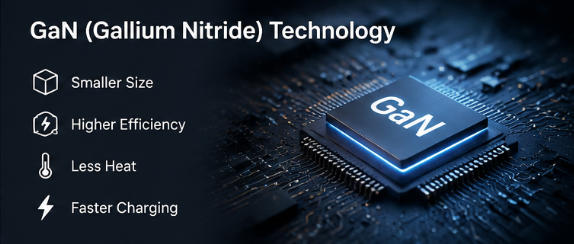
- GaN efficiency allows smaller 100W designs without overheating
For manufacturers and B2B buyers, 100W GaN chargers are becoming the strategic flagship product, while 65W remains the mainstream volume driver.
5. Additional Factors to Consider
5.1 Size and Portability
Thanks to GaN technology:
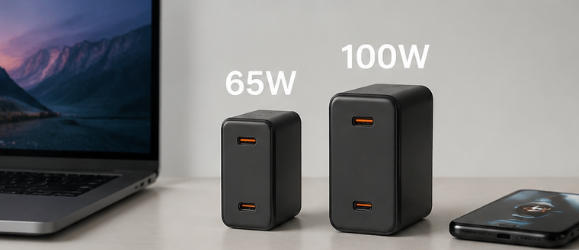
- 100W chargers are now only slightly larger than 65W models
- The gap in portability is shrinking rapidly
5.2 Heat Management
- 65W: lower heat, easier thermal design
- 100W: requires advanced GaN chip efficiency and better heat dissipation
5.3 Cost Difference
- 65W: lower BOM cost, better for mass market
- 100W: higher cost, but better perceived value
5.4 Future Compatibility
- 100W chargers are more future-proof
- USB-C ecosystem is trending toward higher power devices (up to 140W+ PD 3.1)
6. Final Verdict: 65W vs 100W GaN Charger
Choose 65W if you want:
- Affordable pricing
- Everyday laptop + phone charging
- Compact travel charger
- High-volume consumer market
Choose 100W if you want:
- Maximum performance
- Future-proof compatibility
- Multi-device charging capability
- Premium product positioning
In short:
- 65W = mainstream efficiency
- 100W = premium power solution