The global demand for fast charging solutions has changed significantly in recent years. As laptops, smartphones, and tablets continue to rely on USB-C as the universal interface, power requirements have also increased.
Among current charging solutions, the 100W class USB-C charger has become one of the most widely adopted standards for both consumer electronics and professional devices. It offers enough power to support high-performance laptops while still maintaining portability and efficiency.
At the same time, GaN (Gallium Nitride) technology has reshaped how modern chargers are designed. Compared with traditional silicon-based power adapters, GaN chargers are smaller, more efficient, and generate less heat under the same power output.
For manufacturers and global brands, the combination of 100W power delivery and GaN technology has become a key product direction in the USB-C charging market.
This article explains the technology behind 100W GaN chargers, their real-world applications, and what buyers should consider when selecting an OEM/ODM manufacturing partner.
1. Understanding the 100W GaN Charger
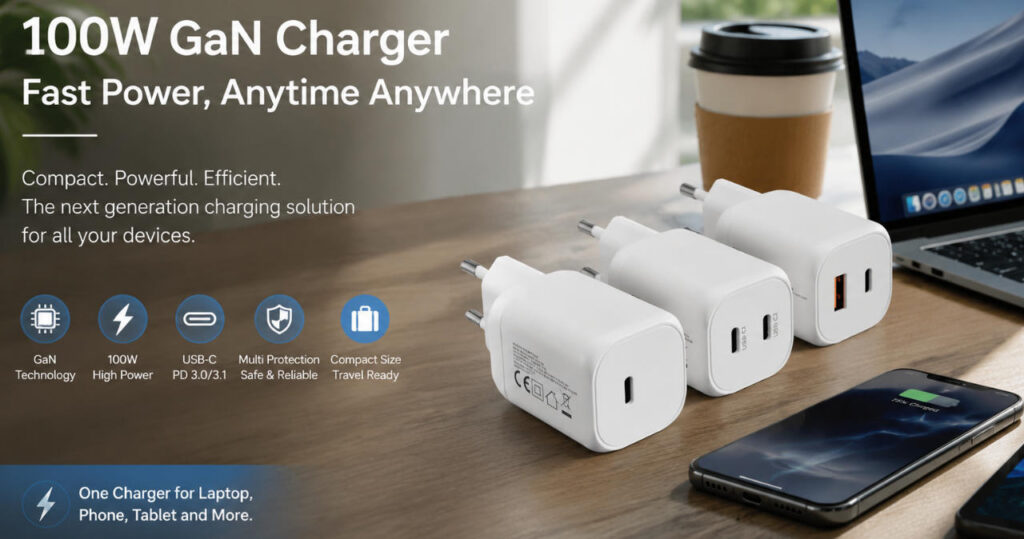
A 100W GaN charger is a high-efficiency USB-C power adapter designed to deliver up to 100 watts of output using Gallium Nitride semiconductors.
Unlike traditional chargers, which rely on silicon components, GaN-based designs allow higher switching frequencies and improved energy conversion efficiency. This results in a smaller charger size without sacrificing performance.
In practical terms, a 100W charger can comfortably power most modern laptops, including high-performance ultrabooks and professional devices, while also supporting fast charging for smartphones and tablets.
1.1 Why GaN Technology Matters
The main advantage of GaN lies in its electrical efficiency.
Compared with silicon, GaN components:
- Generate less heat during operation
- Allow faster switching speeds
- Reduce energy loss
- Enable more compact internal structures
These improvements make it possible to design chargers that are significantly smaller than traditional power adapters while maintaining or even improving performance.
For end users, this means a lighter and more portable charging solution. For manufacturers, it enables more flexible product design and multi-port configurations.
1.2 The Role of 100W in USB-C Charging
100W is an important power level in the USB-C ecosystem because it supports a wide range of devices without requiring multiple chargers.
It is commonly used for:
- Professional laptops
- High-performance tablets
- Multi-device charging setups
As USB Power Delivery standards evolve, 100W has become a practical “upper mainstream” level for everyday computing needs.
2. Key Characteristics of Modern 100W PD Chargers
A well-designed 100W USB-C charger is not defined by power alone. It is also shaped by efficiency, safety, and compatibility.
2.1 USB Power Delivery Compatibility
Most modern chargers support USB Power Delivery protocols such as PD 3.0 and PD 3.1. This allows the charger to automatically adjust output based on the connected device.
Instead of delivering fixed power, the charger communicates with the device and provides the most suitable voltage and current combination.
This intelligent power negotiation helps improve charging speed while protecting device battery health.
2.2 Compact and Travel-Friendly Design
One of the most noticeable advantages of GaN-based chargers is size reduction.
By improving internal efficiency, manufacturers can significantly reduce component size and heat dissipation requirements. As a result, 100W GaN chargers are often small enough to fit in a pocket or travel pouch.
This makes them particularly suitable for business travelers and mobile professionals.
2.3 Multi-Device Charging Capability
Many modern users no longer rely on a single device. A typical workspace may include a laptop, smartphone, tablet, and wireless accessories.
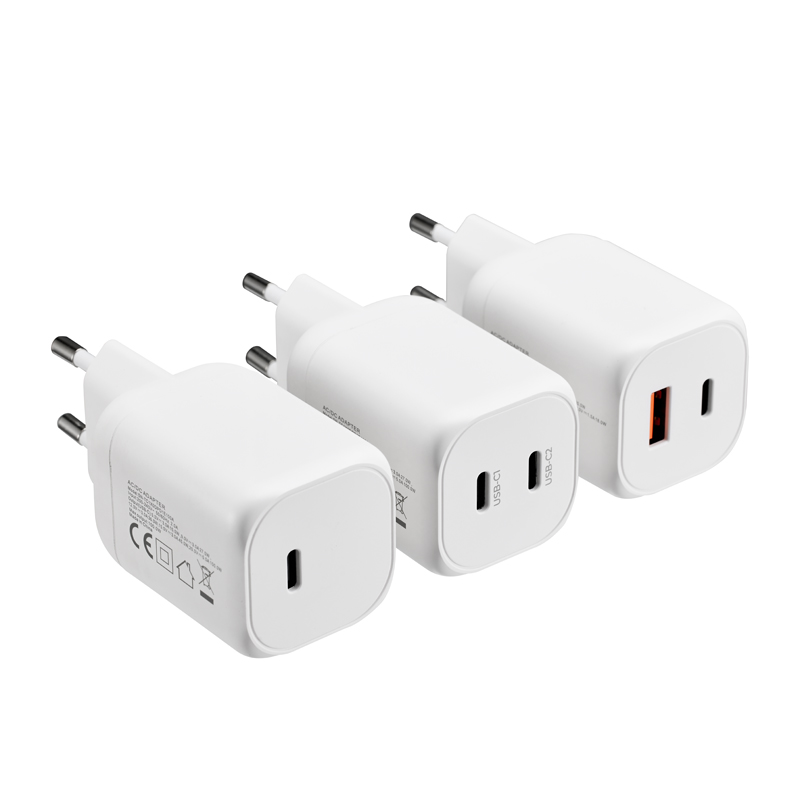
To support this, many 100W chargers now include multiple USB-C ports, allowing users to distribute power across devices simultaneously.
The internal power management system ensures that energy is allocated safely and efficiently.
2.4 Built-In Safety Mechanisms
Safety remains a core requirement in high-power charging design.
A reliable 100W charger typically includes:
- Over-voltage protection
- Over-current protection
- Short-circuit protection
- Temperature control
These systems work together to ensure stable operation under different load conditions.
3. Comparison with Traditional Charging Solutions
To understand the value of a 100W GaN charger, it is useful to compare it with older charging technologies.
3.1 100W vs 65W Chargers
A 65W charger is sufficient for many standard laptops, but it may struggle with high-performance devices or multi-device setups.
In contrast, a 100W charger provides additional power headroom, making it more future-proof and versatile.
It is especially useful when multiple devices are being charged at the same time.
3.2 GaN Chargers vs Traditional Silicon Chargers
Traditional silicon chargers tend to be larger and less efficient because they generate more heat during operation.
GaN chargers solve this limitation by improving energy conversion efficiency, which results in:
- Smaller physical size
- Lower operating temperature
- Higher overall efficiency
This difference is one of the main reasons GaN technology is rapidly replacing older charger designs.
3.3 Apple 96W Charger vs 100W GaN Alternatives
Apple’s 96W charger is widely used in MacBook systems, but it is based on traditional silicon design.
Many GaN-based alternatives offer similar or higher output while being more compact and flexible in terms of port configuration and international compatibility.
4. Real-World Applications of 100W GaN Chargers
The flexibility of 100W USB-C chargers makes them suitable for a wide range of use cases.
4.1 Laptop Charging
Most modern laptops can be powered through USB-C, including:
- MacBook Pro and MacBook Air
- Dell XPS series
- Lenovo ThinkPad
- HP business laptops
A 100W charger ensures stable performance even under heavy workloads.
4.2 Mobile Devices and Tablets
In addition to laptops, 100W chargers can efficiently charge:
- iPhones (fast charging supported)
- Android flagship devices
- iPads and other tablets
4.3 Office and Remote Work Environments
For users working in hybrid or remote environments, a single 100W charger can often replace multiple adapters, reducing cable clutter and improving workspace efficiency.
4.4 Travel Use Cases
Compact GaN chargers are particularly valuable for travel due to their:
- Lightweight design
- Universal voltage support
- Multi-device capability
5. OEM and ODM Manufacturing in China
China plays a central role in global charger production, especially in the OEM and ODM segments.
5.1 OEM vs ODM Models
In OEM production, brands provide design specifications while manufacturers handle production.
In ODM production, manufacturers provide existing designs that can be customized and branded.
Both models are widely used in the charger industry depending on brand strategy.
5.2 Customization Options
Typical customization options include:
- Logo branding
- Housing design
- Plug types for different regions
- Packaging and labeling
- Cable configurations
5.3 Production Capacity and Flexibility
A mature manufacturing partner should be able to support:
- Small pilot orders for market testing
- Scalable mass production
- Stable long-term supply chains
5.4 Compliance and Export Standards
For international markets, chargers must meet certifications such as:
- CE for Europe
- FCC for the United States
- UKCA for the United Kingdom
These certifications ensure both safety and market access.
6. How to Evaluate a Reliable Supplier
For B2B buyers, selecting the right manufacturing partner is more important than the product itself.
6.1 Engineering Capability
A strong supplier should have in-house engineering support for:
- Circuit design optimization
- Thermal management
- PD protocol tuning
6.2 Quality Control System
Reliable manufacturers implement multi-stage testing, including:
- Component inspection
- Production line testing
- Aging and stress tests
- Final product verification
6.3 Stability and Consistency
Consistency in production quality is essential for global distribution. Buyers should evaluate long-term defect rates and supply stability.
6.4 Export Experience
Manufacturers with international experience can better handle:
- Logistics coordination
- Compliance documentation
- Market-specific requirements
7. Szjialu Manufacturing Capability Overview
Szjialu is a professional manufacturer specializing in USB-C power adapters and fast charging solutions.
The company focuses on OEM and ODM production of GaN and PD chargers designed for global markets.
With strong engineering support and production capability, Szjialu provides customized solutions for brands looking to develop competitive charging products.
8. Future Outlook of 100W Charging Technology
The charging industry continues to evolve toward higher efficiency and greater standardization.
Key trends include:
- Wider adoption of USB-C as a universal standard
- Increased use of GaN across all charger categories
- Smarter power distribution systems
- Greater emphasis on portability and energy efficiency
As devices continue to become more powerful, demand for 100W charging solutions is expected to grow steadily.
Conclusion
The 100W GaN charger represents a practical balance between performance, efficiency, and portability. It has become a key product category in the modern USB-C ecosystem, serving both consumer and professional needs.
For brands and distributors, working with an experienced OEM/ODM manufacturer is essential to ensuring product quality, compliance, and long-term competitiveness in global markets.