If you’re sourcing power adapters for your business, you’ve probably come across terms like OEM power adapter and ODM power supply. At first glance, they sound technical—maybe even interchangeable. But in reality, choosing between OEM and ODM can shape your product, your brand, and even your long-term growth.
So let’s break it down in a clear, human way. No unnecessary jargon. Just what you actually need to know.
1. OEM vs ODM: What’s the Real Difference?
Let’s start simple.
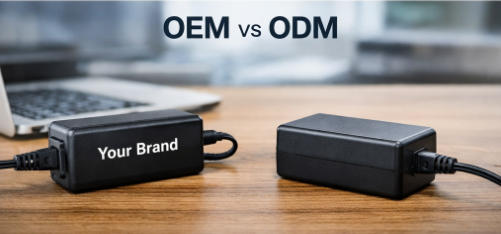
- OEM (Original Equipment Manufacturer)
You bring the design, specs, and requirements. The factory builds it for you. - ODM (Original Design Manufacturer)
The factory already has a design. You customize branding or minor features.
Say it plainly:
OEM = your idea, their production
ODM = their idea, your brand
Why it matters
If you’re building a unique product ecosystem—maybe a medical device, POS system, or smart hardware—OEM gives you full control.
If you just need a reliable, ready-to-market charger with your logo on it? ODM is faster and cheaper.
2. When Should You Choose OEM Power Adapter Manufacturing?
Let’s be honest—OEM isn’t for everyone. But when it makes sense, it really makes sense.
Go with OEM if:
- You need specific voltage/current outputs (e.g., 12V 5A, 24V 2.5A)
- Your product has strict certification requirements (UL, CE, FCC, etc.)
- You want full control over design, PCB, casing, and performance
- You’re building a long-term branded product line
Example:
A company producing industrial equipment may require a highly stable custom power adapter manufacturer to match their device’s exact load profile. Off-the-shelf simply won’t cut it.
The trade-off
- Higher development cost
- Longer lead time
- More communication required
But in return? You get differentiation. And in B2B markets, that’s everything.
3. When ODM Power Supply Is the Smarter Choice
Now let’s flip it.
ODM is often underrated. People assume it’s “generic.” That’s not entirely fair.
ODM works best when:
- You need to launch fast
- Your product doesn’t require complex customization
- Budget is limited
- You still want private label power adapter options
Say it bluntly:
If speed and cost matter more than uniqueness—ODM wins.
Many power adapter OEM factory China suppliers actually offer strong ODM catalogs with certified designs ready to go.
You just pick:
- Output specs
- Plug type (US/EU/UK/AU)
- Branding (logo, packaging)
Done.
4. How to Choose the Right Adapter Manufacturer
This is where most buyers make mistakes. Not because they don’t care—but because everything looks similar on paper.
So how do you actually choose?
1. Certifications (Non-negotiable)
Look for:
- UL (for US market)
- CE (Europe)
- FCC
- RoHS
No certification? Walk away. Seriously.
2. Engineering Capability
If you’re going OEM, this is critical.
Ask:
- Do they have an in-house R&D team?
- Can they customize PCB design?
- Do they support thermal testing and safety validation?
A real custom power adapter manufacturer should talk engineering, not just pricing.
3. Production Capacity
You don’t want a supplier who:
- Delays delivery
- Struggles with scale
- Can’t maintain consistency
Ask about:
- Monthly output
- Lead time
- Automation level
4. Quality Control System
This is where things get real.
Check if they have:
- Aging tests (full load burn-in)
- 100% functional testing
- Incoming material inspection
Because… let’s be honest. A cheap adapter that fails? Costs you way more in the long run.
5. Communication & Transparency
You’d be surprised how important this is.
A good supplier:
- Replies clearly and quickly
- Explains technical details simply
- Doesn’t avoid tough questions
A bad one?
Vague answers. Delayed responses. Overpromising.
You can guess how that ends.
5. OEM vs ODM: Cost Breakdown (Real Talk)
Let’s not dance around it—cost matters.
OEM Cost Structure
- Tooling & design fees
- Engineering support
- Certification costs
- Higher MOQ
ODM Cost Structure
- Minimal upfront cost
- Lower MOQ
- Faster ROI
So yeah…
If you’re testing a market → ODM
If you’re building a brand → OEM
6. Private Label Power Adapter: A Growing Trend
Here’s something interesting.
More and more companies are going for private label power adapter solutions.
Why?
Because it hits a sweet spot:
- Faster than OEM
- More brand control than generic ODM
You get:
- Your logo
- Custom packaging
- Possibly minor design tweaks
And from a customer’s perspective?
It feels like your product.
7. Working with a Power Adapter OEM Factory in China
Let’s address the elephant in the room.
China is still the global hub for power adapter manufacturing. No surprise there.
But working with a power adapter OEM factory China supplier requires some strategy.
What works well:
- Competitive pricing
- Mature supply chain
- Strong engineering talent
What to watch out for:
- Quality inconsistency (if not vetted properly)
- Communication gaps
- Hidden costs (certification, tooling)
Pro tip:
Always request samples. Always test them. Don’t skip this step.
8. Common Mistakes Buyers Make
You’d think these are obvious—but they happen all the time.
- Choosing based on price only
- Ignoring certification requirements
- Not clarifying technical specs
- Skipping sample validation
- Underestimating lead time
Say it honestly:
A power adapter looks simple. But getting it wrong? Expensive.
9. Final Thoughts: What Should You Actually Do?
If you’re still unsure, here’s a simple way to decide:
- Need speed + low cost → ODM power supply
- Need uniqueness + long-term value → OEM power adapter
And most importantly—choose the right partner.
Because at the end of the day, you’re not just buying a product.
You’re building part of your brand’s reliability.