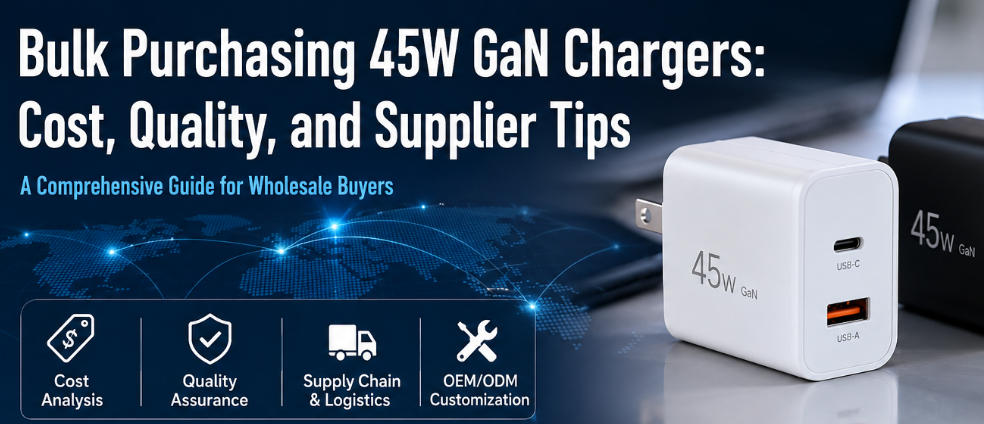
As USB-C fast charging becomes the global standard for smartphones, tablets, ultrabooks, gaming handhelds, and accessories, demand for compact and high-efficiency power adapters continues to rise. Among the most popular categories, the 45W GaN charger has become a preferred solution for businesses seeking portable, reliable, and fast charging products.
For distributors, retailers, corporate buyers, and brand owners, bulk purchasing 45W GaN chargers involves much more than comparing unit prices. Product quality, certification compliance, OEM customization capability, logistics efficiency, and long-term supplier stability all directly affect profitability and customer satisfaction.
This guide explains how to evaluate wholesale 45W GaN charger suppliers, understand pricing structures, optimize procurement costs, and build a reliable sourcing strategy.
Why 45W GaN Chargers Are in High Demand
Gallium Nitride (GaN) technology allows chargers to deliver higher power efficiency in a smaller form factor compared with traditional silicon-based chargers. A 45W GaN charger can typically support:
- Smartphones with fast charging
- Tablets and iPads
- Ultrabooks and lightweight laptops
- Nintendo Switch and gaming devices
- Earbuds and wearable accessories
The combination of portability, high-speed charging, and multi-device compatibility makes 45W GaN chargers highly attractive across multiple sales channels.
Key Advantages of 45W GaN Chargers
| Feature | Traditional Charger | 45W GaN Charger |
|---|---|---|
| Size | Larger | Compact |
| Heat Management | Moderate | Improved |
| Charging Efficiency | Standard | Higher |
| Power Density | Lower | Higher |
| Multi-Device Support | Limited | Excellent |
| Travel Convenience | Average | Very High |
Because of these advantages, wholesalers and enterprise buyers increasingly choose GaN-based products for private-label programs and large-scale deployments.

Understanding Bulk 45W GaN Charger Cost Structure
One of the biggest questions buyers ask is:
“How much should a wholesale 45W GaN charger cost?”
The answer depends on several manufacturing and procurement variables.
Main Factors Affecting Pricing
1. GaN Chipset Quality
Premium GaN components from reputable semiconductor suppliers typically improve:
- Thermal performance
- Charging stability
- Product lifespan
- Safety reliability
Lower-cost chargers may use less efficient components that reduce manufacturing cost but increase product failure risk.
2. Certification Requirements
Different target markets require different compliance certifications.
| Market | Common Certifications |
|---|---|
| United States | UL, FCC |
| Europe | CE, RoHS |
| United Kingdom | UKCA |
| Japan | PSE |
| Australia | SAA |
Certified products usually cost more but significantly reduce import risks and improve buyer trust.
3. Housing Material and Design
Factors influencing enclosure cost include:
- Fire-resistant PC material
- Surface finish quality
- Foldable plug design
- Compact internal structure
- Scratch resistance
Premium industrial design can increase perceived product value and retail competitiveness.
4. Packaging Customization
Custom retail packaging affects overall procurement cost, including:
- Color boxes
- User manuals
- Barcode labels
- Branded packaging
- Eco-friendly materials
For enterprise procurement, packaging quality can strongly influence brand image.
Typical Wholesale Price Ranges
The following table provides estimated market pricing for reference.
| Order Quantity | Estimated Unit Price |
|---|---|
| 100–500 pcs | Higher sample pricing |
| 500–2,000 pcs | Moderate wholesale pricing |
| 2,000–10,000 pcs | Competitive factory pricing |
| 10,000+ pcs | Best OEM procurement pricing |
Actual prices vary depending on:
- Port configuration
- Certification requirements
- Packaging complexity
- Plug type
- Shipping method
- Branding requirements
Buyers should avoid selecting suppliers based solely on the lowest quotation.
How to Evaluate a Reliable Wholesale GaN Charger Supplier
A reliable supplier is essential for long-term procurement success.
Manufacturing Capability
Before placing large orders, verify whether the supplier has:
- In-house R&D capabilities
- SMT production lines
- Aging test systems
- Automated assembly processes
- QC inspection procedures
Factories with stronger manufacturing infrastructure generally provide better consistency and faster lead times.
Quality Control System
Professional suppliers usually implement multiple testing stages.
Common Reliability Tests
| Test Type | Purpose |
|---|---|
| Aging Test | Long-term stability |
| Drop Test | Structural durability |
| Temperature Test | Heat resistance |
| Short Circuit Test | Safety verification |
| Power Cycling Test | Charging reliability |
Ask suppliers for testing reports and quality inspection procedures before confirming orders.
OEM and ODM Customization Process
Many enterprise buyers require customized charging products for branding or market differentiation.
OEM Customization
OEM services typically include:
- Logo printing
- Custom packaging
- User manual customization
- Cable bundling
- Plug configuration
OEM projects are usually faster and more cost-effective.
ODM Development
ODM projects involve deeper customization, including:
- Industrial design modification
- PCB redesign
- Port configuration changes
- New mold development
- Custom firmware tuning
ODM projects require longer lead times and higher minimum order quantities.
Standard OEM/ODM Procurement Workflow
Step 1: Requirement Discussion
Buyers define:
- Target market
- Certification requirements
- Charging protocols
- Branding details
- Packaging expectations
Step 2: Product Evaluation
Suppliers provide:
- Samples
- Datasheets
- Certification files
- Testing reports
Step 3: Sample Confirmation
The buyer verifies:
- Charging performance
- Build quality
- Compatibility
- Packaging details
Step 4: Mass Production
Factories begin:
- Material procurement
- PCB production
- Assembly
- Aging tests
- Final QC
Step 5: Shipping and Delivery
Products are shipped via:
- Air freight
- Sea freight
- Railway transport
- Express logistics
Supply Chain and Logistics Considerations
Bulk purchasing involves more than manufacturing.
Logistics efficiency directly affects inventory management and delivery timelines.
Lead Time Planning
Typical production timelines include:
| Process | Estimated Time |
|---|---|
| Sample Production | 3–7 days |
| Packaging Design | 5–10 days |
| Mass Production | 15–35 days |
| Sea Shipping | 20–40 days |
Planning procurement schedules early helps avoid seasonal shipping delays.
Inventory Risk Management
Professional buyers often:
- Split orders into phases
- Maintain safety stock
- Diversify suppliers
- Forecast seasonal demand
These strategies help reduce supply chain disruption.
How to Choose High Value 45W GaN Chargers
High value does not necessarily mean the lowest price.
The best procurement strategy balances:
- Quality
- Safety
- Cost
- Lead time
- Brand reputation
Important Selection Tips
Prioritize Certification Compliance
Certified chargers reduce:
- Customs clearance risks
- Product return rates
- Safety incidents
Request Real Testing Data
Avoid relying only on marketing materials.
Ask suppliers for:
- Efficiency reports
- Thermal imaging tests
- Compatibility testing
- Aging test reports
Evaluate Communication Efficiency
Professional suppliers should provide:
- Fast response times
- Technical documentation
- Stable project management
- Transparent production updates
Good communication often reflects operational reliability.
Consider Long-Term Cooperation Potential
Stable suppliers can support:
- Future product expansion
- Better pricing over time
- Faster repeat orders
- Joint product development
Long-term partnerships usually create stronger supply chain advantages.
Common Mistakes When Buying Wholesale GaN Chargers
Choosing Only Based on Price
Extremely low quotations may indicate:
- Inferior components
- Incomplete certifications
- Weak QC systems
- Unstable supply capability
Ignoring Compatibility Testing
Different devices may require:
- PD protocol optimization
- PPS support
- Voltage stability tuning
Testing compatibility before mass orders is essential.
Underestimating Packaging Costs
Custom packaging can significantly affect:
- Production cost
- Lead time
- Shipping volume
- Retail presentation
Always include packaging in cost calculations.
Future Trends in the GaN Charger Market
The GaN charging industry continues evolving rapidly.
Emerging trends include:
- Multi-port charging
- Higher power density
- Eco-friendly packaging
- Smart power allocation
- USB-C universal adoption
- AI-powered charging optimization
Enterprise buyers who establish reliable sourcing partnerships early may gain stronger long-term market competitiveness.
Conclusion
Bulk purchasing 45W GaN chargers requires careful evaluation of manufacturing quality, certification compliance, logistics capability, and supplier reliability. While pricing remains important, successful procurement depends on balancing cost efficiency with product stability and long-term partnership value.
For wholesalers, distributors, retailers, and brand owners, selecting the right GaN charger supplier can improve product reputation, reduce operational risk, and create sustainable growth opportunities in the fast-charging market.
As demand for compact USB-C charging solutions continues expanding worldwide, professionally sourced 45W GaN chargers are becoming an increasingly important category for both consumer and enterprise applications.