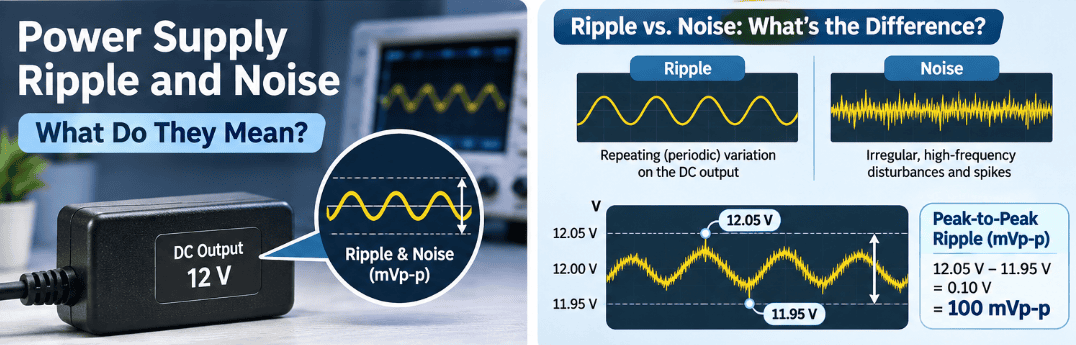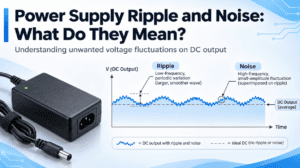


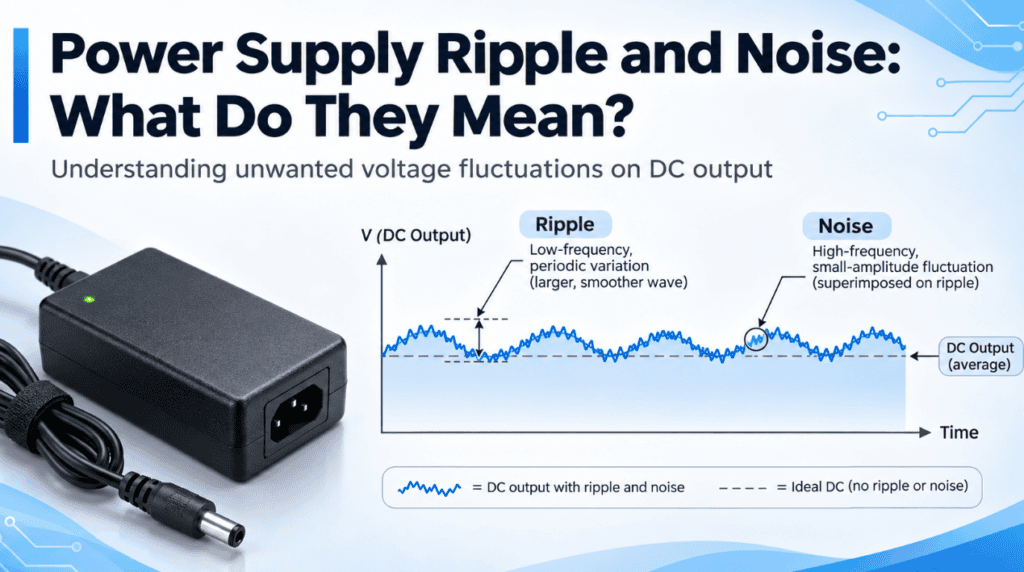
Power supply ripple and noise are unwanted voltage fluctuations present at a power supply’s DC output. Ripple generally refers to periodic voltage variations caused by power conversion, while noise describes irregular or higher-frequency disturbances. Both can appear on top of the intended DC voltage. For example, a 12V power supply may maintain an average output close to 12V while still producing small voltage fluctuations measured in millivolts. Understanding ripple and noise helps explain why a stable nominal voltage does not always mean a perfectly smooth DC output.
What Is Power Supply Ripple?
Ideally, a DC power supply would produce a constant voltage with no fluctuations. In practice, converting and regulating electrical power introduces small variations.
Output ripple is the repeating AC component that remains on the DC output.
In an AC-to-DC power supply, rectification and filtering convert alternating input voltage into DC. Some periodic variation may remain after this process.
Switching power supplies also generate ripple through their high-frequency switching operation. Energy is transferred in repeated switching cycles, and the output filtering components reduce, but do not necessarily eliminate, the resulting voltage variations.
This ripple is usually much smaller than the rated output voltage, but it can still matter for certain electronic devices.
What Is the Difference Between Ripple and Noise?
Although manufacturers often combine the two terms into one specification, ripple and noise are not exactly the same.
| Characteristic | Ripple | Noise |
|---|---|---|
| Typical behavior | Repeating or periodic | Irregular, random, or transient |
| Common sources | Rectification and switching cycles | Switching spikes, component noise, interference |
| Frequency characteristics | Often related to line or switching frequency | Can extend across a wide frequency range |
| Appearance | Repeating waveform | Irregular fluctuations or sharp spikes |
Ripple generally has an identifiable repeating pattern, while noise can be more unpredictable.
However, the distinction is not always perfectly clear. Switching spikes, for instance, may occur periodically but still be grouped with high-frequency noise in a power supply specification.
For this reason, many datasheets use the combined term “Ripple and Noise” rather than reporting the two separately.
What Does mVp-p Mean in a Ripple and Noise Specification?
Power supply ripple and noise are commonly specified in millivolts peak-to-peak (mVp-p).
Peak-to-peak voltage is the difference between the highest and lowest points of the measured voltage waveform.
For example, suppose a 12V power supply produces a waveform that varies between 11.95V and 12.05V during a measurement.
The peak-to-peak variation is:
12.05V − 11.95V = 0.10V = 100mVp-p
This means the measured voltage varies by 100mV from its lowest to highest point.
It does not mean the power supply continuously outputs 100mV, nor does it mean the nominal voltage is incorrect by 100mV.
Also, a 100mVp-p specification does not necessarily mean the output varies symmetrically by ±50mV around exactly 12V.
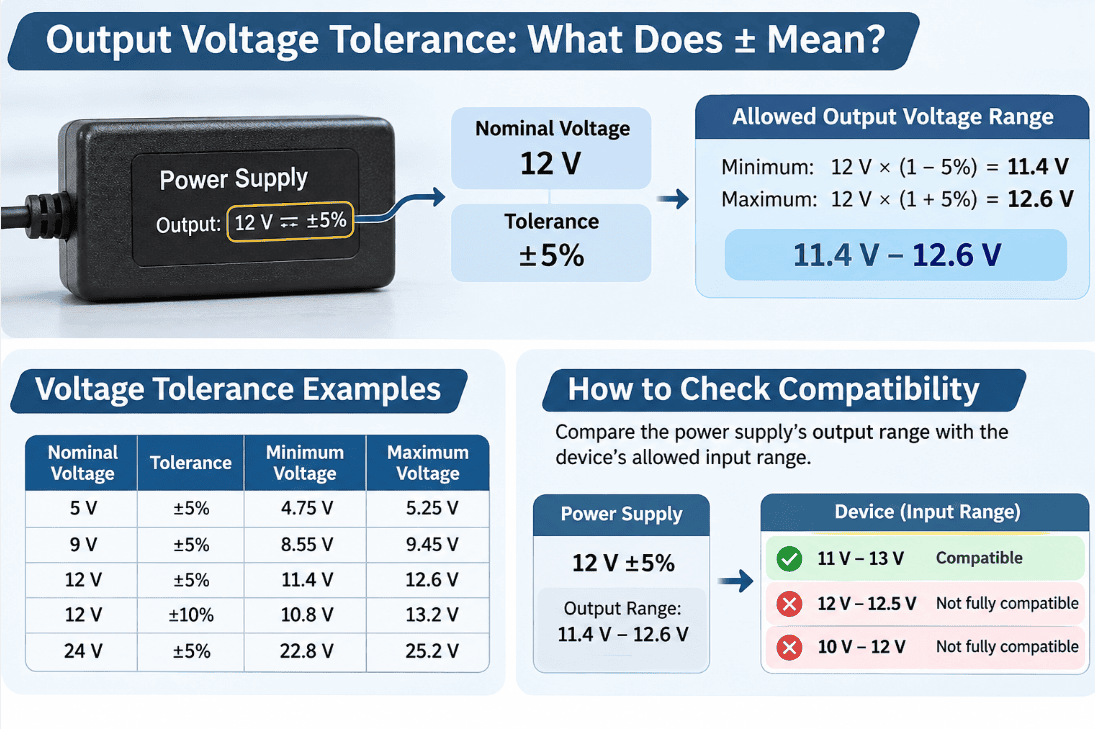
For a separate explanation of permitted DC voltage deviations, see output voltage tolerance.
Why Do Power Supplies Produce Ripple and Noise?
Several factors contribute to unwanted output voltage fluctuations.
1. AC-to-DC conversion
After AC voltage is rectified, filtering is needed to smooth the resulting waveform. Incomplete filtering can leave periodic ripple related to the input line frequency.
2. High-frequency switching
Switch-mode power supplies repeatedly turn electronic switches on and off. This process creates periodic ripple and may introduce high-frequency switching disturbances.
3. Filtering components
Capacitors, inductors, and their electrical characteristics influence how effectively unwanted variations are reduced. Their design and quality affect the resulting output waveform.
4. Electrical interference
Nearby circuits, wiring arrangements, and electromagnetic interference can introduce additional unwanted signals into the output or measurement path.
These effects are normal considerations in power supply design. Their presence does not automatically indicate a defective product.
How Can Ripple and Noise Affect Electronic Devices?
The impact depends largely on the connected device’s sensitivity and the frequency and magnitude of the unwanted voltage components.
For example:
- Audio equipment: Supply disturbances may contribute to audible hum or unwanted sound.
- Sensitive sensors: Noise can interfere with small measurement signals.
- Analog circuits: Ripple and noise may reduce signal accuracy or performance.
- Digital electronics: Excessive supply disturbances can contribute to unreliable operation.
Not every electronic device requires extremely low ripple. Many products include internal filtering or voltage regulation that reduces the effect of disturbances from the external supply.
The key is whether the power supply’s ripple and noise remain within the device’s acceptable limits.
How Are Ripple and Noise Measured?
Ripple and noise are commonly evaluated with an oscilloscope, which displays voltage variations over time.
However, the reported value can change depending on measurement bandwidth, probe connections, measurement location, and load conditions.
For example, a wider measurement bandwidth may include additional high-frequency components that are excluded by a narrower bandwidth setting.
That is why two power supplies with different published ripple values cannot always be compared directly.
Our guide to ripple specifications and measurement conditions explains how these testing details affect datasheet comparisons.
Final Takeaway
Ripple and noise are unwanted AC voltage variations superimposed on a power supply’s DC output. Ripple is generally periodic, while noise includes irregular disturbances and high-frequency components.
The important question is not whether ripple and noise exist, but whether their magnitude and frequency characteristics are acceptable for the connected device.