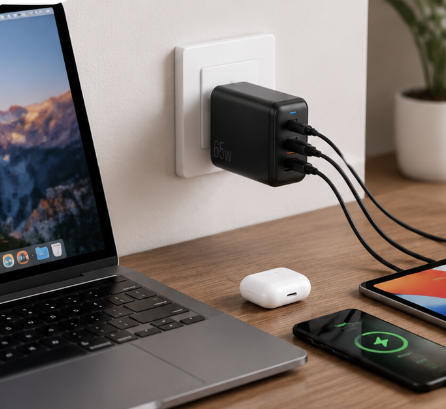
Traveling today often requires managing multiple devices — smartphones, laptops, tablets, and wireless accessories. Instead of carrying multiple bulky adapters, a multi‑port GaN charger provides a compact, efficient solution for powering all devices simultaneously.
In this guide, we explore the technical aspects of multi-port GaN chargers, highlight key selection criteria, and compare them against traditional charging solutions.
Why Multi‑Port GaN Chargers Are Ideal for Travel
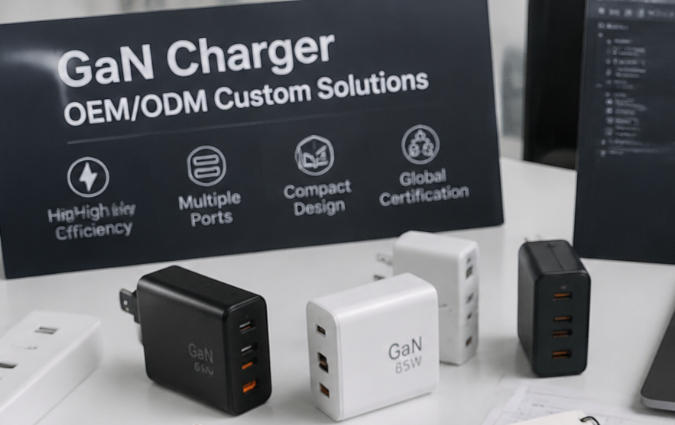
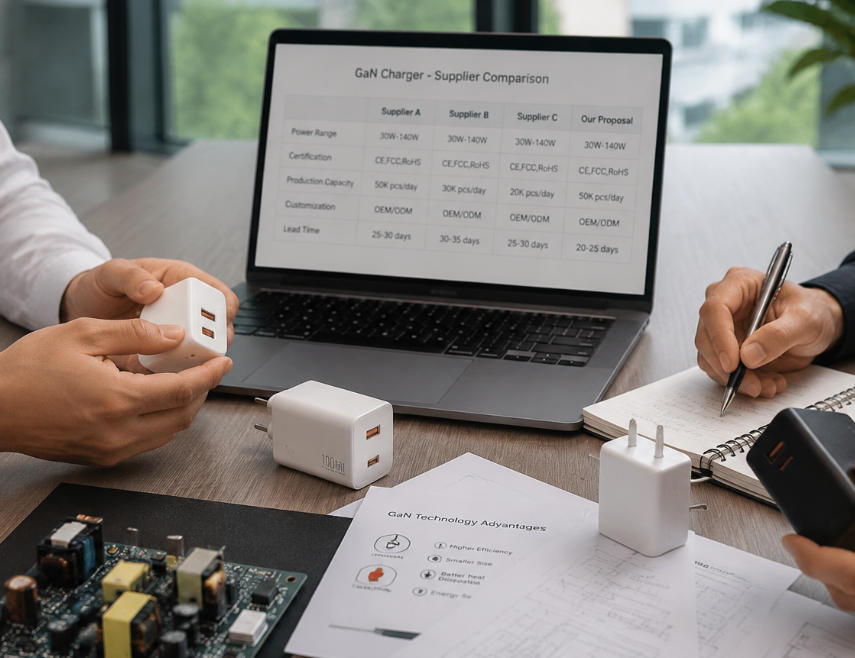
Gallium Nitride (GaN) is a semiconductor material that enables chargers to operate at higher voltages and frequencies with greater efficiency than traditional silicon-based chargers. The main advantages include:
- Compact Design: Smaller heat sinks and higher switching frequency allow for lighter, travel-friendly chargers.
- High Efficiency: Less energy lost as heat, ensuring faster charging for all connected devices.
- Multi‑Device Support: Simultaneous charging of laptops, tablets, and smartphones without thermal throttling.
Technical Comparison: Multi-Port vs Single-Port Chargers
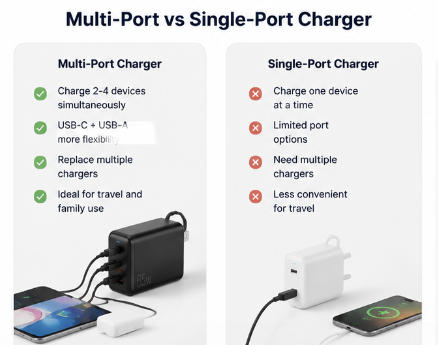
| Feature | Multi-Port GaN Charger | Single-Port Charger |
|---|---|---|
| Number of Devices | 2–4+ simultaneous devices | Only one device |
| Power Distribution | Dynamic allocation across ports | Full power to a single device |
| Size & Portability | Compact but slightly larger than single-port | Usually very small, but requires multiple units for multiple devices |
| Travel Convenience | Reduces clutter and cables | More adapters/cables needed |
| Use Case | Ideal for multi-device travel setups | Best for single-device or stationary use |
Technical Comparison: GaN Chargers vs Traditional PD Chargers
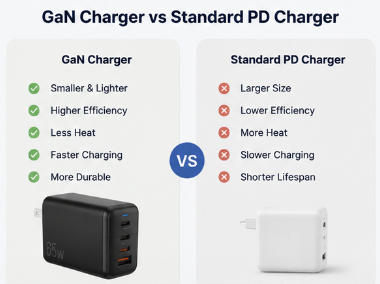
| Feature | GaN Charger | Traditional PD Charger (Silicon) |
|---|---|---|
| Efficiency | >90% typical | 75–85% typical |
| Heat Generation | Low | Moderate to high |
| Size | Small, lightweight | Larger due to heat management |
| Power Density | High (60–100W+ in compact form) | Lower, may require multiple adapters |
| Charging Speed | Faster for laptops & phones | Adequate, slower under load |
| Durability | Longer lifespan due to less heat stress | Shorter lifespan, more prone to overheating |
Key Factors When Selecting a Travel Charger
- Port Variety: Combination of USB‑C PD and USB‑A for maximum flexibility.
- Power Output: Minimum 60W recommended for laptops; 30–65W sufficient for tablets and smartphones.
- Safety Features: Overcurrent, overvoltage, short-circuit, and thermal protection are essential.
- Global Compatibility: Check for universal voltage (100–240V) to support international travel.
- Form Factor: Compact size to fit in carry-on luggage without adding bulk.
Recommended Product: 65W GaN USB‑C PD Fast Charger
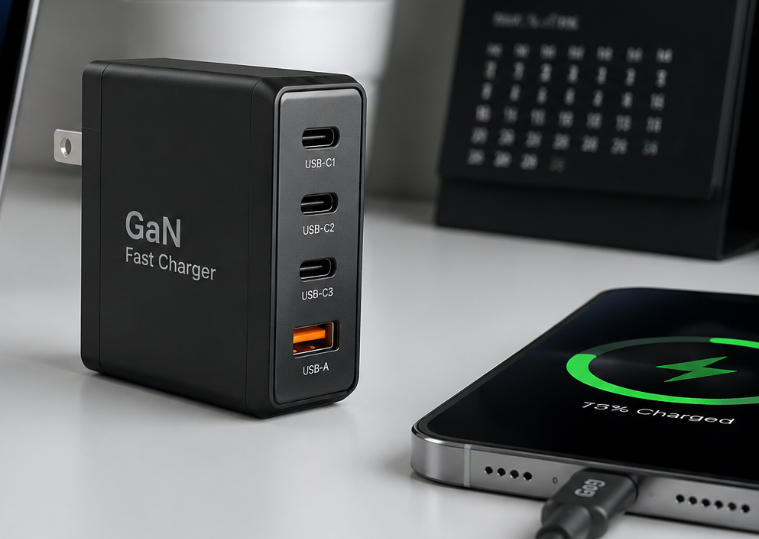
For travelers seeking a reliable and efficient solution, the 65W GaN USB‑C PD Fast Charger is a standout choice:
- Supports simultaneous charging via 2 USB-C ports (PD) + 1 USB-A port (QC).
- Compact GaN design ensures minimal heat generation.
- Ideal for smartphones, tablets, laptops, and other USB-powered devices.
Travel Tips
- Use the right cable: High-quality USB-C cables (E-Marker for 100W) ensure optimal performance.
- Charge smart: Connect high-power devices to primary USB-C ports.
- Avoid overloading: Monitor total output when charging multiple devices.
- Pack light: Pair the charger with a travel adapter and minimize cable clutter.
Conclusion
A multi-port GaN charger is the ideal choice for travelers who need high efficiency, compact size, and multi-device support. By understanding GaN technology, power distribution, and thermal management, travelers can select a charger that delivers consistent performance. The 65W GaN USB‑C PD Fast Charger provides an efficient and portable solution, perfect for modern travel setups.