Walk into any electronics market today, and you’ll notice something interesting: chargers are no longer just accessories. They’ve become a critical part of device performance. Whether it’s a smartphone, tablet, or laptop, users now expect faster charging, lower heat, and better long-term battery health.
This shift is pushing charging technology forward—and one of the most talked-about developments is AVS (Adjustable Voltage Supply).
If you’re a distributor, brand owner, or sourcing manager, you’ve probably already seen AVS mentioned alongside USB-C and next-generation fast chargers. But what exactly does it mean in practical terms? And more importantly, how do you choose the right AVS-compatible charger that actually delivers value?
This guide takes a closer look—without unnecessary jargon—so you can make informed decisions for your product lineup.
What is AVS and Why is it Getting So Much Attention?
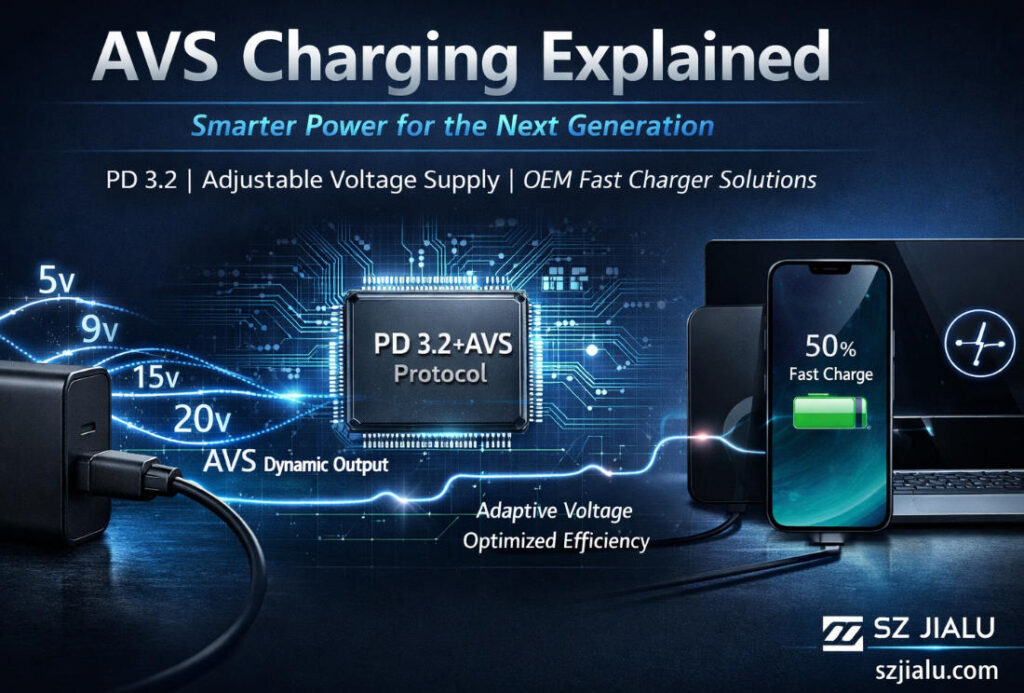
AVS, or Adjustable Voltage Supply, is designed to solve a problem that has existed in fast charging for years: inefficient power delivery caused by fixed voltage steps.
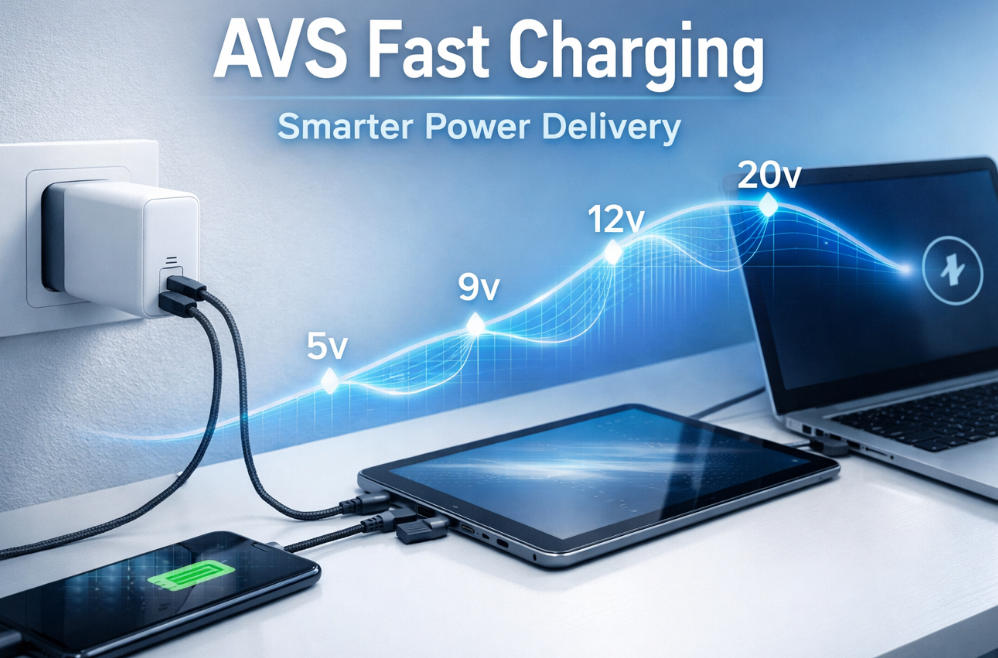
Traditional charging systems work by switching between preset voltage levels—typically 5V, 9V, 12V, and sometimes 20V. While this approach works, it isn’t always precise. Devices often need something in between those levels, which leads to wasted energy, extra heat, and less efficient charging.
AVS changes that.
Instead of jumping between fixed voltages, an AVS-enabled charger can adjust voltage continuously and precisely, matching the exact requirements of the device in real time. Think of it less like a staircase and more like a smooth ramp.
This seemingly small change has a noticeable impact on performance.
How AVS Improves Real-World Charging Performance
On paper, “adjustable voltage” might sound like a minor technical upgrade. In reality, it directly affects how chargers behave in everyday use.
1. More Efficient Power Delivery
Because voltage can be fine-tuned, less energy is wasted during conversion. This is especially important in higher-wattage chargers (like 65W or 100W), where inefficiencies become more noticeable.
2. Lower Heat Output
Heat is one of the biggest enemies of both chargers and batteries. AVS reduces unnecessary voltage drops, which helps keep temperatures under control. For end users, that translates into safer, more reliable charging.
3. Smoother Charging Curves
Instead of abrupt transitions between voltage levels, AVS provides a more stable and consistent charging experience. Devices can maintain optimal charging speed for longer periods.
4. Better Battery Health Over Time
While no charging technology can completely eliminate battery wear, more precise voltage control helps reduce stress on battery cells. Over time, this can contribute to improved longevity.
AVS vs PPS vs Traditional Fast Charging
If you’ve been in the charging industry for a while, AVS might remind you of PPS (Programmable Power Supply). That’s not a coincidence—they’re closely related in concept, but not identical in execution.
Here’s a simplified comparison:
| Feature | Traditional Fast Charging | PPS | AVS |
|---|---|---|---|
| Voltage Adjustment | Fixed steps | Adjustable (limited range) | Continuously adjustable |
| Efficiency | متوسط | High | Higher |
| Heat Control | Moderate | Improved | Best |
| Charging Precision | Low | Medium | High |
In practical terms, AVS builds on the idea of PPS but pushes it further. It offers finer control and smoother transitions, which is particularly useful for modern devices with complex power management systems.
Why AVS Matters for B2B Buyers and Brands
From a consumer perspective, AVS is about faster and safer charging. But for businesses, the implications go further.
1. Product Differentiation
The charger market is crowded. Supporting AVS allows you to position your products as next-generation solutions, rather than just another generic adapter.
2. Higher Perceived Value
Buyers—especially in developed markets—are becoming more educated about charging standards. Features like AVS, GaN, and multi-protocol compatibility can justify premium pricing.
3. Reduced After-Sales Issues
Overheating and inconsistent charging are common causes of returns. More efficient power delivery can help minimize these problems.
4. Future-Proof Product Lines
As more devices adopt advanced power management, AVS compatibility ensures your products remain relevant longer.
Key Factors to Consider When Choosing an AVS Charger
Not all AVS-compatible chargers are created equal. If you’re sourcing products or developing your own brand, here are the factors that actually matter.
1. Output Power Range and Flexibility
Start with the basics: power output.
A good AVS charger should cover multiple use cases. For example:
- 20W–30W for smartphones
- 45W–65W for tablets and ultrabooks
- 100W+ for high-performance laptops
Flexibility is key. A charger that supports a wide range of outputs can serve multiple markets with fewer SKUs.
2. Integration with GaN Technology
If AVS is about smarter power delivery, GaN (Gallium Nitride) is about better hardware.
GaN chargers are:
- Smaller and lighter
- More efficient
- Better at handling high power levels
When combined, AVS and GaN create a strong value proposition: high efficiency in a compact form factor.
For B2B buyers, this combination is quickly becoming the industry standard rather than a premium feature.
3. Multi-Protocol Compatibility
Even though AVS is gaining traction, the market still relies on multiple charging protocols.
A competitive charger should support:
- USB Power Delivery (PD)
- PPS
- Quick Charge (QC)
This ensures compatibility across a wide range of devices—from older smartphones to the latest laptops.
4. Thermal Design and Safety Features
Specifications alone don’t tell the whole story. Internal design matters.
Look for:
- Intelligent temperature control
- Over-voltage, over-current, and short-circuit protection
- Stable output under continuous load
Reliable thermal performance is especially important for high-wattage AVS chargers.
5. Certifications for Global Markets
If your business operates internationally, certifications are non-negotiable.
Common requirements include:
- CE (Europe)
- FCC (United States)
- UL or ETL
- RoHS
Working with a manufacturer that understands compliance can save significant time and cost.
6. OEM/ODM Customization Capabilities
For many brands, the charger itself is only part of the equation. Customization plays a major role.
A capable manufacturer should offer:
- Logo printing and branding
- Housing design options
- Packaging customization
- Firmware optimization for AVS performance
These details can make a significant difference in how your product is perceived in the market.
Where AVS Chargers Are Most Commonly Used
AVS isn’t limited to a single category. Its benefits apply across multiple applications:
- Smartphones – Faster, cooler charging
- Tablets – Improved efficiency for mid-range power needs
- Laptops – Stable high-wattage delivery
- Portable devices – Power banks, handheld electronics
- Multi-device charging stations – Optimized power distribution
As USB-C continues to standardize power delivery, AVS is likely to become more widespread across all of these categories.
A Note on Market Trends
Over the past few years, the charging industry has moved in a clear direction: more power, less size, better efficiency.
AVS fits perfectly into this trend.
At the same time, buyers are becoming more selective. It’s no longer enough to offer “fast charging.” Customers are looking for:
- Verified performance
- Reliable safety
- Long-term durability
This shift is pushing manufacturers to adopt technologies like AVS not just as a feature, but as a baseline expectation.
Our Approach to AVS-Compatible Charging Solutions
As a manufacturer focused on power adapters and fast-charging technologies, we’ve seen firsthand how quickly market expectations evolve.
Our AVS-compatible product lines are designed with practical use in mind:
- Stable and efficient output across different power levels
- Integration with GaN technology for compact designs
- Support for multiple fast-charging protocols
- Compliance with international safety standards
We also support OEM and ODM projects, helping partners adapt products to specific market requirements—whether that means branding, packaging, or performance tuning.
AVS (Adjustable Voltage Supply) may sound like a technical upgrade, but its impact is very real. By enabling more precise voltage control, it improves efficiency, reduces heat, and enhances the overall charging experience.
For businesses, it offers something just as important: a way to stay competitive in a rapidly evolving market.
If you’re planning your next product line or evaluating suppliers, AVS compatibility is worth serious consideration—not as a trend, but as part of a broader shift toward smarter power delivery.