Over the past year, fast charging has quietly entered a new phase. It’s no longer just about higher wattage numbers on the box. Instead, the conversation is shifting toward smarter voltage control, better thermal performance, and tighter device-charger communication.
When Apple introduced support for AVS (Adjustable Voltage Supply) in its latest charging ecosystem, it triggered plenty of debate: Is this another proprietary move? Do users need new chargers? And more importantly for manufacturers and distributors — is AVS the next standard we should be preparing for?
As a power adapter manufacturer working closely with global B2B clients, we see AVS not as a marketing trick, but as a natural evolution of USB Power Delivery. Let’s break it down in practical terms.
AVS Explained — Without the Marketing Gloss
AVS stands for Adjustable Voltage Supply, part of the updated USB PD 3.1 / 3.2 framework.
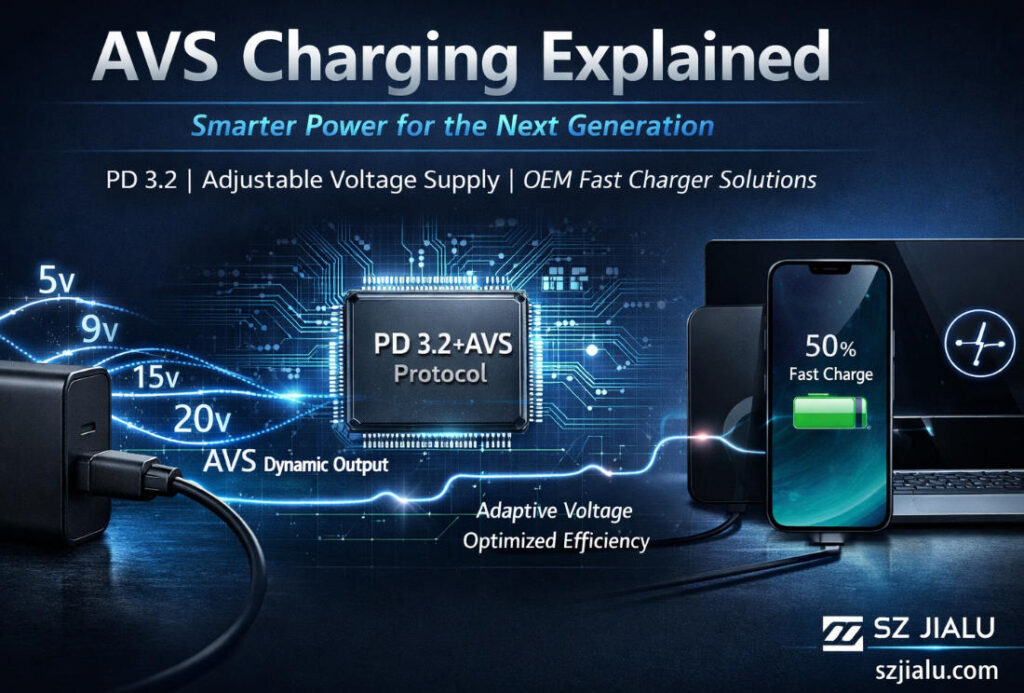
If you’re familiar with PPS (Programmable Power Supply), you already understand the concept: instead of fixed voltage “steps” like 5V, 9V, 15V, or 20V, the charger and device negotiate voltage dynamically.
AVS refines this idea.
Rather than aggressively micro-adjusting voltage in tiny increments under constantly shifting load (as PPS does), AVS is designed to provide:
- More stable voltage delivery
- Wider tolerance for cable resistance
- Better thermal consistency
- Improved system efficiency at higher power ranges
In simple terms, AVS makes fast charging smarter and steadier, not just faster.
And in a market where devices are thinner, batteries are denser, and thermal margins are tighter, stability matters more than raw wattage.
Why This Shift Matters for the Industry
The move toward AVS support by major brands signals something bigger than a single product refresh. It tells us:
- The USB-PD ecosystem is standardizing around more refined voltage negotiation.
- High-efficiency power conversion is becoming a baseline expectation.
- OEM and ODM suppliers must upgrade firmware and control IC design accordingly.
For importers, wholesalers, and private-label charger brands, this is a key moment. Fast charging is no longer defined purely by GaN technology or 65W / 100W labels. Buyers are increasingly asking:
- Does it support PD 3.2?
- Is AVS enabled?
- Can it maintain peak power without overheating?
- Is it future-proof for next-generation smartphones and laptops?
These are the questions we’re hearing directly from clients.
Do End Users Really Need AVS?
From a consumer perspective, the difference might feel subtle. A user upgrading from a standard PD charger may notice:
- Slightly faster charging in the 0–50% range
- Reduced heat during high-power sessions
- More stable performance under heavy device load
But the real advantage is long-term:
Better voltage control means less stress on battery cells and internal power management circuits. Over time, that matters.
For businesses, however, the impact is more immediate. Retailers and distributors who offer AVS-ready products today position themselves ahead of the curve.

How We Approach AVS at SZJialu
At szjialu, we specialize in fast-charging power adapters and desktop power supplies for global B2B clients. As a China-based manufacturer with in-house development and production capability, we have already integrated AVS protocol support into selected PD fast charger models.
Our approach is straightforward:
- Upgrade control chips and firmware to support PD 3.2 + AVS
- Optimize transformer and secondary rectification design for stable output
- Validate real-world thermal performance under continuous load
- Maintain global safety compliance (CE, FCC, RoHS, etc.)
For distributors, OEM brands, and sourcing managers, this means:
- Future-ready USB-C fast chargers
- Customizable wattage platforms (30W–140W and beyond)
- Flexible logo and housing design options
- Stable production capacity in China
We believe protocol evolution should not disrupt your supply chain — it should strengthen your product line.
AVS vs PPS: What Should Buyers Look For?
If you’re sourcing fast chargers in 2026 and beyond, here’s a practical checklist:
✔ Support for PD 3.1 or PD 3.2
✔ Explicit AVS compatibility
✔ Stable high-load thermal test data
✔ High-efficiency conversion (especially in GaN designs)
✔ Reliable cable current handling
Not every device today requires AVS. But forward-looking procurement teams understand this: standards evolve faster than product cycles.
Choosing an AVS-enabled charger today reduces redesign costs tomorrow.

The Bigger Picture: Fast Charging Is Maturing
For years, the industry chased wattage headlines — 45W, 65W, 100W, 140W.
Now the focus is shifting to:
- Intelligent power negotiation
- Heat management
- Long-term battery health
- Cross-brand compatibility
AVS represents this new stage of maturity.
It’s less flashy than a higher number on a box, but far more meaningful in engineering terms.
And for manufacturers like us, it’s a clear signal: innovation in charging is no longer about pushing limits — it’s about refining control.
The introduction of AVS into mainstream charging ecosystems is not a forced upgrade — it’s a structural improvement.
Consumers may debate pricing strategies. Tech enthusiasts may compare protocols.
But for OEM buyers, distributors, and private-label brands, the takeaway is simple:
AVS support is becoming part of the new baseline for premium fast chargers.
If your business depends on staying ahead of charging standards, this is the right time to evaluate your supply chain. At SZJialu, we’re ready.