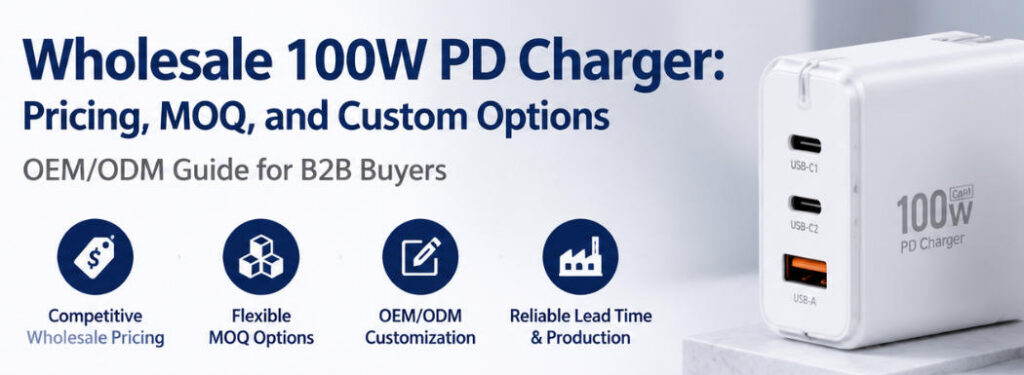
The demand for 100W USB-C PD chargers continues to rise as laptops, tablets, and smartphones increasingly rely on unified fast-charging standards. For B2B buyers—importers, distributors, and private-label brands—the key concerns are usually not just product performance, but also wholesale pricing, MOQ structure, customization flexibility, and production reliability.
This article provides a practical breakdown of how 100W PD charger sourcing works in real OEM/ODM manufacturing environments.
1: What Affects Wholesale Pricing?
Wholesale pricing for 100W PD chargers is influenced by multiple technical and commercial factors. Even small changes in design or certification requirements can significantly impact unit cost.
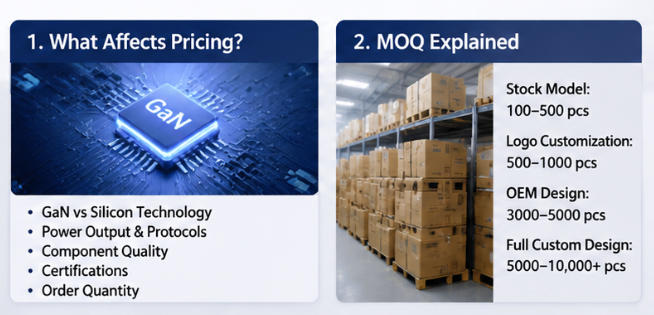
1. GaN vs Traditional Silicon Design
One of the most important cost drivers is the internal charging technology.
- GaN (Gallium Nitride) chargers
- Higher efficiency
- Smaller size
- Better heat control
- Higher material cost
- Silicon-based chargers
- Lower cost
- Larger form factor
- Lower efficiency under high load
Most modern 100W PD chargers now adopt GaN technology due to its balance of size, performance, and branding value.
2. Power Output Configuration
Not all 100W chargers are built the same. Pricing varies depending on:
- Single-port vs multi-port output
- USB-C only vs USB-C + USB-A
- PD 3.0 vs PD 3.1 (EPR support)
- PPS fast charging compatibility
More output flexibility and protocol support increases controller complexity and cost.
3. Internal Component Quality
The cost of a charger is heavily affected by its internal architecture:
- High-frequency transformer design
- PCB layout complexity
- MOSFET and controller IC selection
- Thermal materials and heat dissipation design
Better thermal stability is especially critical for sustained 100W output performance.
4. Certification Requirements
Certifications are essential for entering global markets:
- CE / FCC / UKCA / PSE / KC / CCC
- Energy efficiency standards (DOE Level VI / ERP)
- Safety and reliability testing reports
Certified products cost more, but they reduce market entry risk and improve retail acceptance.
5. Order Quantity and Pricing Tiers
Pricing also depends heavily on production scale:
- 500–1000 pcs: highest unit cost
- 3000–10,000 pcs: optimized pricing
- 10,000+ pcs: factory-direct bulk pricing advantage
2: MOQ (Minimum Order Quantity) Explained
MOQ is a critical concept in OEM/ODM charger sourcing. It defines the minimum number of units required for production.
Standard MOQ Levels
- Stock models (no customization): 100–500 pcs
- Logo customization only: 500–1000 pcs
- OEM housing + branding changes: 3000–5000 pcs
- Fully customized design (new mold): 5000–10,000+ pcs
Why Factories Require MOQ
MOQ is not arbitrary—it reflects real manufacturing costs:
- PCB production setup and tuning
- Injection mold preparation
- Packaging printing setup
- Certification batch testing costs
- Component purchasing scale requirements
Practical Strategy for New Buyers
For new brands or market testing, a staged approach is often more efficient:
- Start with semi-custom models (logo + packaging only)
- Validate demand in target markets
- Scale into full OEM customization later
Many manufacturers, including Szjialu, support flexible MOQ structures depending on product stage and buyer experience.
3: Packaging and Branding Options
In competitive electronics markets, packaging and branding are as important as technical specifications.
1. Branding Methods
Common customization options include:
- Laser engraving on casing
- Silk-screen logo printing
- UV full-color branding
- Molded logo integration for premium OEM models
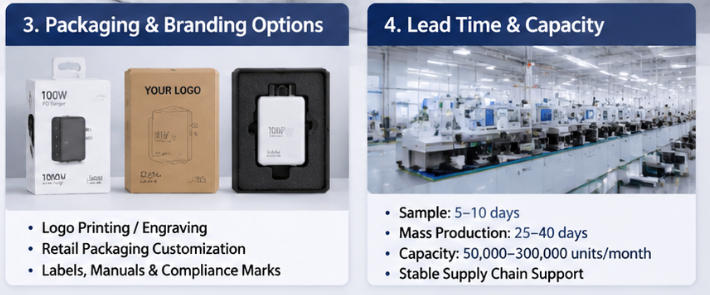
2. Packaging Variations
Packaging plays a key role in retail positioning:
- Neutral brown box (cost-effective, B2B bulk use)
- Full-color retail packaging (Amazon / e-commerce ready)
- Eco-friendly kraft packaging (sustainability-focused brands)
- Premium gift box (high-end product positioning)
3. Compliance Labeling
Depending on target markets, packaging may also include:
- CE / FCC / UKCA markings
- Serial numbers for traceability
- QR codes for product authentication
- Multilingual user manuals
4. OEM vs ODM Branding Approach
- OEM (Original Equipment Manufacturing):
Buyer provides branding, specifications, and design requirements - ODM (Original Design Manufacturing):
Factory provides ready-made designs that can be rebranded
ODM is typically faster and more cost-efficient, while OEM offers stronger differentiation for long-term brand building.
4: Lead Time and Production Capacity
Lead time is a key factor in global electronics supply chains, especially for fast-moving products like PD chargers.
1. Typical Production Timeline
- Sample development: 5–10 days
- Prototype confirmation: 7–15 days
- Mass production: 25–40 days
- Packaging & final testing: 5–10 days
Total lead time: approximately 30–60 days
2. Key Factors Affecting Delivery Speed
Several factors may extend production time:
- Semiconductor chip availability
- Custom mold development requirements
- Certification testing cycles
- Peak season production congestion
3. Manufacturing Capacity Overview
Large-scale charger factories typically offer:
- 50,000–300,000 units/month for standard models
- Lower throughput for fully customized OEM designs
- Multi-line production for mixed product orders
4. Supply Chain Stability Strategies
Professional buyers often reduce risk through:
- Splitting production into multiple batches
- Pre-booking key components (IC, transformer)
- Working with backup production lines
- Partnering with experienced ODM suppliers
Conclusion
Sourcing a 100W PD charger at wholesale level requires more than comparing unit prices. Buyers must also evaluate technology choices (GaN vs silicon), MOQ flexibility, certification readiness, packaging strategy, and production stability.
In practice, successful procurement is about balancing cost, customization, and supply chain reliability. Manufacturers like Szjialu focus on scalable OEM/ODM solutions that allow brands to move from small pilot orders to large-scale distribution without redesigning their supply chain each time.
For B2B buyers, understanding these fundamentals helps reduce risk and build a more sustainable product line in the fast-growing PD charging market.