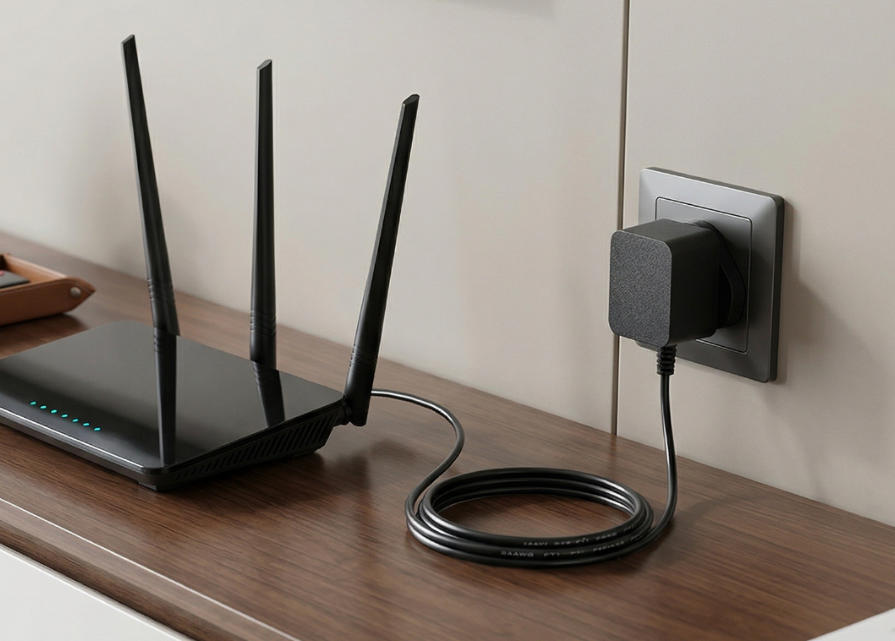
When your WiFi starts acting up—random drops, slow speeds, occasional reconnects—it’s easy to blame your ISP or the router itself. But in many cases, the real issue is much simpler: the router power adapter.
It’s one of those components people rarely think about. Always plugged in, quietly doing its job. Until it doesn’t. An unstable or failing modem power supply can lead to inconsistent performance that feels hard to diagnose. Not completely broken… just unreliable enough to be frustrating.
Understanding Router Power Supply Specs (The Simple Version)
You don’t need to be technical to understand router power supply specs. Just focus on three essentials.
First, voltage. This must match exactly. Most routers use a 12V adapter for router setups, and using anything higher or lower can either damage your device or cause unstable behavior.
Second, current (amps). This is more forgiving. If your router needs 2A, using a 3A adapter is perfectly fine. But if you go lower—say 1A—you may run into issues like random shutdowns or weak signal output.
Finally, the connector. It sounds minor, but it matters. The size and polarity must match your router. Otherwise, the adapter simply won’t work—or worse, could cause damage.
Can You Use a Different Adapter for Your Router?
A very common question is: can I use different adapter for router?
The answer is yes—but only under the right conditions.
As long as the voltage matches, the current is equal or higher, and the connector (including polarity) is correct, you’re generally safe. Miss any of these, and you’re taking unnecessary risks. In real-world use, mismatched adapters are one of the most common causes of unstable router behavior.

How to Fix Unstable Router Power Without Replacing Your Router
Before you consider replacing your router, it’s worth checking the basics. If you’re searching for how to fix unstable router power, start here.
Make sure the adapter is firmly connected. Try plugging it directly into a wall outlet instead of a low-quality power strip. These small changes can eliminate voltage inconsistencies.
If problems continue, replacing the adapter is often the simplest fix. A reliable 12V adapter for router use can immediately stabilize your network. Also, pay attention to heat—if the adapter feels unusually hot, it’s likely degrading and should be replaced.
Choosing the Best Power Adapter for WiFi Router Performance
Finding the best power adapter for WiFi router setups isn’t about picking the most expensive option. It’s about consistency and reliability.
Look for stable output and safety certifications like UL, CE, or FCC. These indicate better design and safer operation. Lower electrical noise (often described as low ripple) also helps maintain steady router performance over time.
From an industry perspective, manufacturers such as szjialu focus on producing adapters with stable output and strict quality control. It’s not something most users think about—until network issues start appearing.
Final Thoughts
A stable internet connection depends on more than just your router or ISP. The router power adapter plays a critical role in keeping everything running smoothly.
If your network has been unreliable, don’t overlook the power source. Sometimes the fix isn’t complicated. Not a new router. Not a new plan. Just better, more stable power.