Choosing the right charger wattage isn’t just about picking the biggest number you can find. It’s about aligning technical capability with real-world user needs, device ecosystems, and strategic business goals. Whether you’re launching your own brand, sourcing products for global distribution, or scaling an OEM/ODM lineup, this decision impacts cost, performance, and customer satisfaction.
At Jialu Technology, we’ve been in the power adapter and USB-C/PD charger business long enough to see trends fade and solid demand patterns emerge — and nothing affects a product’s market fit more than choosing the right output power for the right customers.
Charger Wattage: What It Means and Why It Matters
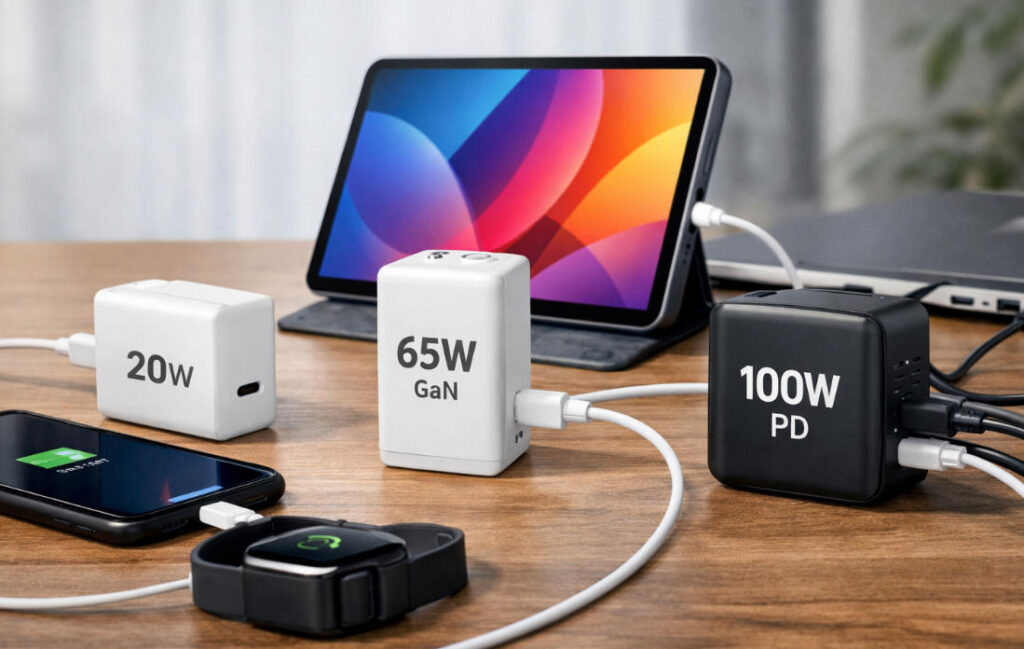
When people talk about charger wattage, they’re really talking about how much power a charger can safely deliver. This is expressed in watts (W), and it determines how fast a device can charge (assuming compatibility with charging standards like PD). A 20W charger can fully handle phone charging, while a 65W or 100W design opens doors to tablets and even laptops.
This is more than a technical label — it’s a market signal. Too little wattage and your charger feels outdated. Too much, and you inflate your manufacturing cost with minimal user benefit. Understanding this balance is the first step in choosing the right product for the right audience.
Start With Your Customer’s Devices
Different devices need different power profiles. Smartphones — including flagship models — often charge best in the range of 18W–30W. Designers and buyers targeting accessories or budget smartphones may find that 20W chargers hit the sweet spot between size, cost, and performance.
For tablets, larger phones, and mainstream laptops, 45W–65W chargers are increasingly the centerpiece of modern power accessory portfolios. These mid-range options are especially effective for multi-device families or business users who want one charger that can handle both phone and laptop duty.
When you’re building products that users feel are future-ready — like GaN PD chargers — power levels of 65W and higher are becoming the norm. They handle laptops, gaming handhelds, and high-capacity tablets with ease.
Understand Market Expectations — Not Just Specs
“Fast charger” has become a shorthand phrase in search queries; long-tail terms like best wattage charger for iPhone and Android and USB-C PD charger for laptop reflect real buying intent. Users searching for these phrases expect compatibility and convenience — something that simply listing “100W PD” won’t satisfy on its own.
That’s why brands must think in terms of use cases:
- A traveler looking for a compact 30W USB-C charger
- A small office needing a multi-device 65W multiport charger
- A tech enthusiast searching for a 100W GaN fast charging station
Matching your product specs with clearly defined user problems — not just technical capabilities — makes your lineup feel relevant, thoughtful, and ready to compete. If your website or listing speaks directly to these real use scenarios, you’re already ahead of 90% of commodity sellers.
Tailor Your Offering to Regional Demand
In some markets, basic USB-A chargers still dominate because users simply need power, not speed. In other regions, fast charging with USB-C PD is expected even on entry-level devices. This variability should shape your SKU strategy.
At Jialu Technology — manufacturers of GaN chargers, PD/USB chargers, and a broad range of adapters — we see demand for 20W–140W products across the world, with different power levels thriving in different segments of the global market.
Understanding local purchasing behavior and device prevalence — whether smartphones, tablets, laptops, or IoT controllers — helps you avoid costly inventory mismatches.
Balance Performance Against Practical Costs
Manufacturers often face pressure to offer the highest wattage possible. But there’s a practical cost to this: higher wattage often means higher component costs, more rigorous safety testing, and sometimes a larger physical footprint. If the market won’t pay a premium for these upgrades, they become an unnecessary cost burden.
A smart product lineup often includes:
- Entry-level chargers (20W–30W) for mass market devices
- Mid-range performance chargers (45W–65W) for tablets and laptops
- High-end, future-proof chargers (100W and above) for creators and prosumers
This tiered approach increases the chances that you’ll meet both budget and performance expectations across customer segments.
Don’t Overlook Safety and Compliance
Wattage isn’t everything — certifications like UL, CE, ETL, and others are critical. A higher-wattage charger that lacks necessary safety marks loses credibility quickly and can’t be repeatedly sold in regulated markets.
Certified products are not optional; they’re checkpoints in your trust and quality equation. When buyers see a charger listed with recognized safety certifications, it reduces hesitation and often increases conversion.
Final Thoughts: Strategically Choose, Not Simply Maximize
The smartest approach to charger wattage is not “the higher the better.” It’s aligning user device needs, market expectations, and business positioning into a coherent product strategy.
Choosing the right charger wattage means:
- Understanding exactly what your customers need
- Building a SKU lineup that speaks to real use cases
- Communicating features — like USB-C PD support and fast charging — clearly
- Balancing performance with cost and safety compliance
When you approach charger sourcing from this strategic angle, you don’t just sell power — you solve problems.