LED strip lights are widely used in architectural lighting, retail displays, furniture, signage, smart homes, offices, hospitality projects, and commercial installations. Although the LED strip is the most visible part of the system, its performance and reliability depend heavily on the power supply behind it.
Choosing the wrong LED 스트립 조명용 전원 어댑터 may cause flickering, uneven brightness, excessive heat, unstable dimming, premature LED failure, or complete damage to the strip. A suitable adapter must provide the correct DC voltage, enough current and wattage, the right connector polarity, and proper compatibility with the selected dimmer or controller.
This guide explains how to select a power adapter for 12V and 24V LED strips, calculate the required wattage, add a practical safety margin, verify polarity, and avoid common dimming compatibility problems.
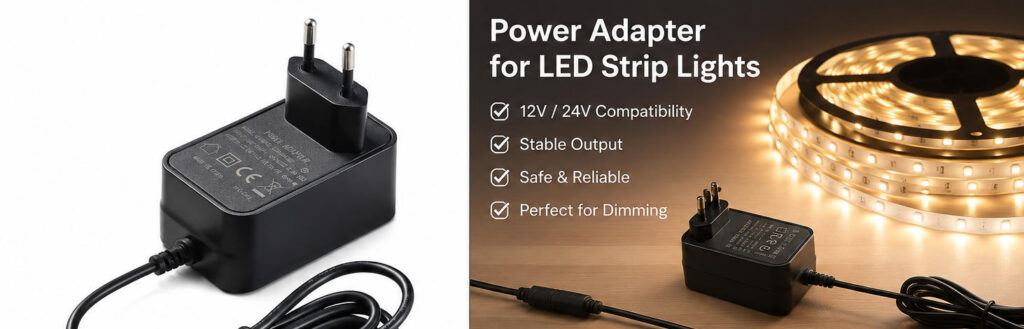
What Does a Power Adapter for LED Strip Lights Do?
Most LED strip lights operate on low-voltage direct current, while household and commercial electrical outlets supply high-voltage alternating current. A power adapter converts the incoming AC electricity into the regulated DC voltage required by the strip.
A typical LED strip lighting system may include:
- An AC wall outlet
- An AC/DC power adapter
- A dimmer, RGB controller, or smart lighting controller
- LED strip lights
- Wiring, connectors, and distribution accessories
The adapter must deliver stable voltage throughout normal operation. When the load changes because of dimming, color mixing, animation, or switching, a properly designed regulated adapter should continue supplying the required voltage without excessive ripple or instability.
Businesses developing lighting products can explore Szjialu’s broader range of AC/DC power adapters for different voltage, current, enclosure, cable, and connector requirements.
1. Match the LED Strip Voltage: 12V or 24V

Voltage matching is the first and most important requirement.
A 12V LED strip normally requires a regulated 12V DC adapter. A 24V strip requires a regulated 24V DC adapter. The output voltage should not be selected only because the connector physically fits.
Connecting a 12V LED strip to a 24V supply can severely overdrive the LEDs and damage the strip within seconds. Connecting a 24V strip to a 12V supply will normally result in very low brightness or no operation.
Always check the printed label on the strip, product specification sheet, packaging, controller, or original power supply before selecting an adapter.
Common LED Strip Voltages
The most common low-voltage strip lighting systems include:
- 5V addressable LED strips
- 12V constant-voltage LED strips
- 24V constant-voltage LED strips
- 36V or 48V specialty lighting systems
This article focuses mainly on 12V and 24V systems because they are widely used in residential, commercial, decorative, signage, and OEM lighting applications.
2. 12V vs 24V LED Strips
Both 12V and 24V strips can provide excellent lighting performance, but they behave differently in longer installations.
Advantages of 12V LED Strips
A 12V LED strip is often suitable for:
- Short lighting runs
- Small signs and display cabinets
- Automotive-style accessories
- Portable lighting products
- Projects where 12V equipment is already available
- Installations requiring shorter cut intervals
Because many compact electronic devices also operate at 12V, sourcing a compatible adapter is usually straightforward. For additional selection guidance, see Szjialu’s guide to choosing the right 12V power adapter.
However, a 12V strip draws approximately twice the current of a comparable 24V strip at the same wattage. Higher current can increase voltage drop in cables and copper traces, particularly in long installations.
Advantages of 24V LED Strips
A 24V LED strip is often preferred for:
- Longer continuous runs
- Architectural lighting
- Commercial display systems
- Cove and ceiling lighting
- Higher-power strip installations
- Projects requiring lower current through the wiring
For the same total wattage, a 24V system draws half the current of a 12V system.
예를 들어:
- A 120W load at 12V draws approximately 10A.
- A 120W load at 24V draws approximately 5A.
The lower current can reduce cable losses, connector heating, and voltage drop. It does not eliminate the need for proper wire sizing or power injection, but it often makes longer installations easier to manage.
Szjialu’s article about the LED 조명에 가장 적합한 전원 공급 장치 provides additional discussion of 12V and 24V lighting architecture.
3. Calculate the LED Strip’s Total Wattage
After confirming voltage, calculate how much power the complete strip installation requires.
LED strips are commonly rated in watts per meter or watts per foot. Multiply the power consumption per unit of length by the installed length.
The basic formula is:
Total strip wattage = wattage per meter × total length
Suppose a 24V LED strip consumes 14.4W per meter and the installation uses 5 meters:
14.4W × 5 = 72W
The strip therefore has a nominal maximum demand of 72W.
To calculate current:
Current = wattage ÷ voltage
For the same 72W, 24V installation:
72W ÷ 24V = 3A
The theoretical minimum is therefore a 24V, 3A supply. In practice, selecting an adapter that operates continuously at its absolute maximum rating is rarely the best approach.
4. Add an Appropriate Wattage Margin
A power adapter should normally have more capacity than the calculated LED load. This additional capacity is commonly called headroom, derating, or a wattage safety margin.
For many LED strip installations, a margin of approximately 20% is a practical starting point.
Using the previous 72W example:
72W × 1.20 = 86.4W
A standard 24V adapter rated around 90W or 100W would therefore provide a more practical operating margin than a supply rated at exactly 72W.
Why Wattage Margin Matters
A suitable margin can help:
- Reduce continuous thermal stress
- Support brief load changes
- Compensate for manufacturing tolerances
- Improve operation in warm environments
- Prevent nuisance shutdown from overload protection
- Support controllers and accessories that also consume power
- Improve long-term reliability
The correct margin depends on the application. An enclosed sign operating outdoors in summer may require more thermal derating than a short decorative strip installed in an air-conditioned room.
Do not use an oversized adapter as a substitute for proper electrical design. Voltage must still match, wiring must be correctly sized, connectors must support the current, and the adapter must be properly ventilated.
5. Remember the Dimmer and Controller Load
The LED strip may not be the only component powered by the adapter.
A system may also contain:
- A single-color PWM dimmer
- An RGB, RGBW, or RGB+CCT controller
- A Wi-Fi, Bluetooth, Zigbee, or RF receiver
- Signal amplifiers or repeaters
- Sensors and control modules
- Illuminated switches or displays
These devices consume some power and may have their own maximum input-current and output-current ratings.
For example, a 24V adapter may be rated for 5A, but the connected controller may support only 3A per channel or 6A total. In this situation, the controller—not the adapter—may become the system bottleneck.
Check both:
- The total current rating of the controller
- The maximum current rating of each output channel
For RGB and tunable-white systems, review how the manufacturer defines total current. Some controllers list a current rating per channel, while others specify a lower combined maximum.
6. Understand Dimming Compatibility
A common mistake is assuming that every power adapter can be connected directly to every type of dimmer. Dimming compatibility depends on where and how the dimming takes place.
DC-Side PWM Dimming
Most constant-voltage LED strip systems use pulse-width modulation, or PWM, on the low-voltage DC side.
A typical arrangement is:
AC outlet → power adapter → PWM dimmer or controller → LED strip
The adapter supplies a stable 12V or 24V output. The dimmer rapidly switches the output delivered to the strip, controlling perceived brightness.
For this design, select:
- A regulated constant-voltage adapter
- A PWM controller that matches the system voltage
- A controller rated for the required current
- Wiring and connectors that support the load
The power adapter itself does not necessarily need a special “dimmable” label when dimming is performed by a compatible controller on the DC side. However, the adapter must remain stable under the controller’s pulsed load.
Poor-quality or unsuitable supplies may produce audible noise, flicker, electromagnetic interference, or shutdown during deep dimming.
AC-Side TRIAC Dimming
Some lighting systems use a wall-mounted TRIAC or phase-cut dimmer on the AC input side.
This arrangement requires a power supply specifically designed and tested for phase-cut dimming. A normal non-dimmable AC/DC adapter should not be assumed to work with an AC wall dimmer.
Possible symptoms of incompatibility include:
- Flickering at low brightness
- Limited dimming range
- Delayed startup
- Sudden turn-off
- Buzzing from the adapter
- Unstable output
- Failure to reach full brightness
If an existing wall dimmer must be used, confirm whether it is leading-edge or trailing-edge and select a compatible dimmable LED driver or power supply.
0–10V, DALI, and Smart-Control Systems
Commercial lighting projects may use 0–10V, DALI, DMX, or other control protocols. These systems normally require dedicated drivers, controllers, or interfaces.
A standard plug-in adapter may provide power to the controller, but it does not automatically provide protocol-level dimming. The complete system architecture must be reviewed before selecting the power supply.
7. Check Connector Type and Polarity
Correct voltage and wattage are not enough if the output connector is incompatible.
Common LED strip power connections include:
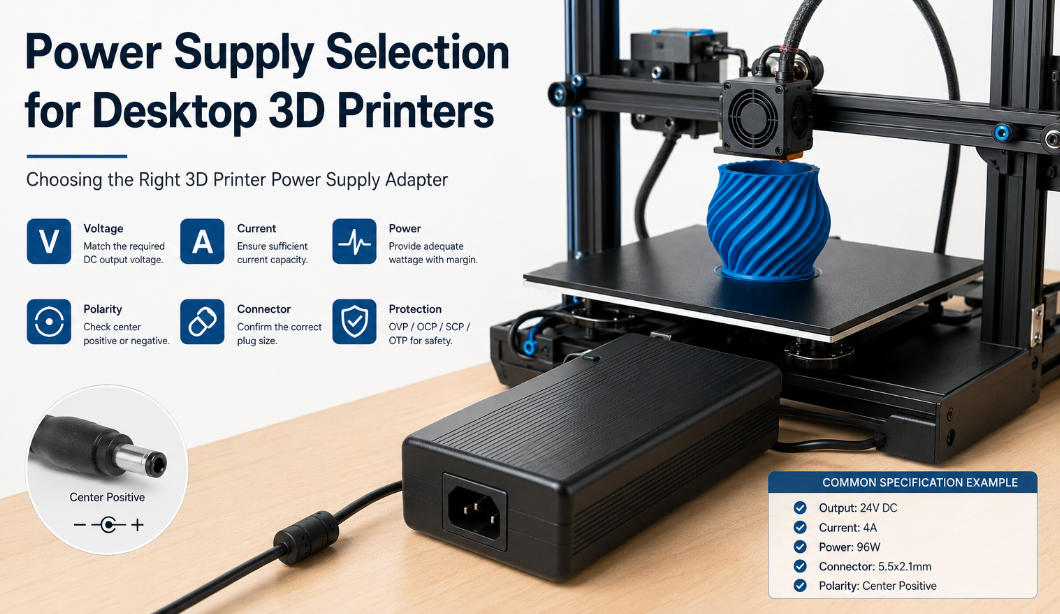
- 5.5 × 2.1mm DC barrel plugs
- 5.5 × 2.5mm DC barrel plugs
- Screw terminal adapters
- Locking DC connectors
- Bare-wire outputs
- Waterproof connectors
- Custom molded connectors
Two barrel plugs may look almost identical but use different inner diameters. A loose fit can cause intermittent power, arcing, resistance, and heat.
Center-Positive vs Center-Negative
Most consumer LED strip adapters with barrel connectors are center-positive, but this should never be assumed.
Polarity is usually shown with a symbol on the adapter label. Confirm that:
- The positive output connects to the positive strip terminal.
- The negative output connects to the negative strip terminal.
- The dimmer or controller uses the same input polarity.
Reverse polarity may prevent operation and can damage controllers or LED strips that lack reverse-polarity protection.
For OEM lighting products, Szjialu can support customized DC connector types, cable lengths, polarity configurations, and labeling. A compact option such as the 24W 교체형 전원 어댑터 includes output options such as 12V 2A and 24V 0.5A, although the final suitability must always be checked against the actual LED load.
8. Choose the Right Adapter Format
The physical adapter design also affects installation.
Wall-Mount Power Adapters
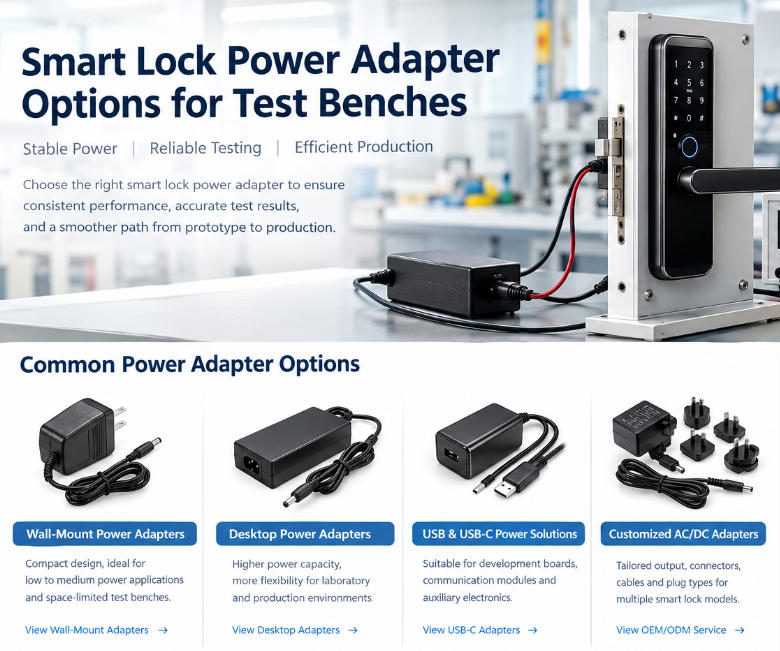
A 벽걸이형 전원 어댑터 plugs directly into the outlet. It is convenient for lower-power LED strips, small signs, shelf lighting, display cases, and consumer lighting kits.
Consider outlet clearance, adapter weight, heat dissipation, and regional plug requirements.
Desktop Power Supplies
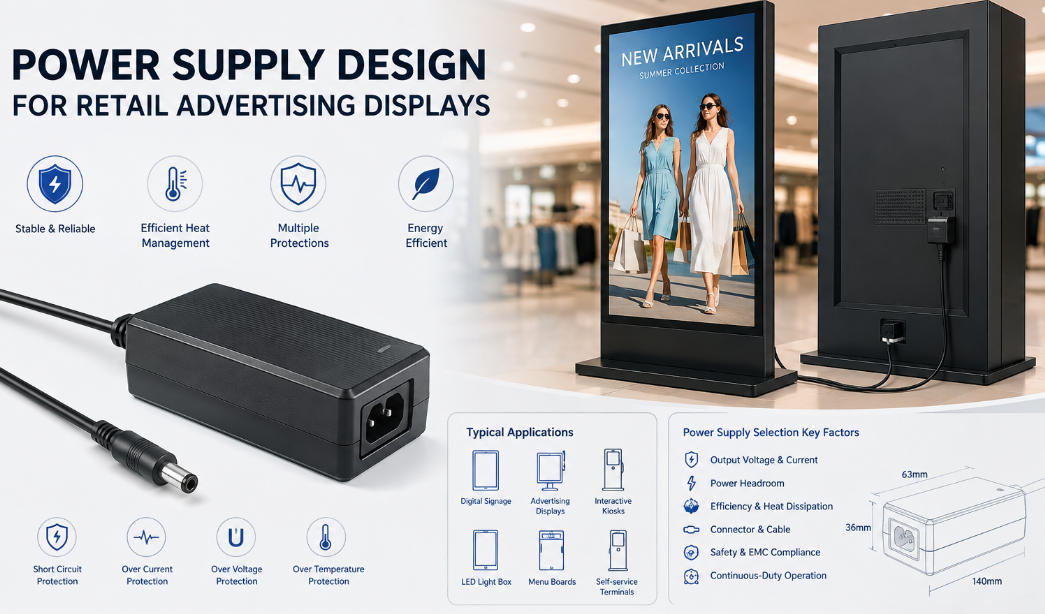
A 데스크탑 전원 공급 장치 uses a separate AC input cable and is often more suitable for higher-power or continuous-duty LED installations.
Desktop adapters can provide:
- Higher output capacity
- More enclosure space for thermal management
- Flexible AC cable options
- Easier placement away from crowded outlets
- Greater flexibility for commercial and OEM systems
Interchangeable-Plug Adapters
For products sold internationally, an interchangeable-plug power adapter can reduce the need to manufacture completely separate adapter versions for US, EU, UK, and AU markets.
Certification requirements still need to be evaluated for each destination market.
9. Consider Voltage Drop and Power Injection
Even with the correct adapter, long strips can become dimmer toward the far end. This is usually caused by voltage drop across the strip’s copper conductors and connecting wires.
Common solutions include:
- Using 24V strips for longer runs
- Using thicker power cables
- Reducing connector resistance
- Feeding power from both ends
- Adding power injection at intermediate points
- Dividing the installation into shorter branches
- Positioning the adapter closer to the load
Do not connect multiple power supplies to the same continuous strip section without an appropriate system design. Incorrectly paralleling adapters can create circulating current, uneven load sharing, or equipment damage.
For large installations, divide the lighting into planned zones and calculate the load, cable length, current, protection, and control requirements for each zone.
10. Look for Safety and Protection Features
A reliable power adapter for LED strip lights should include appropriate protection functions, such as:
- 과전류 보호
- 과전압 보호
- 단락 보호
- Overtemperature protection
The required safety approvals depend on the market and application. Products intended for North America, Europe, the United Kingdom, Australia, Japan, Korea, or other regions may require different certification and compliance documentation.
Also consider:
- Indoor or outdoor use
- Ambient operating temperature
- Ventilation
- Moisture exposure
- Enclosure flammability
- Continuous operating hours
- Installation accessibility
A standard indoor adapter should not be installed in a wet or exposed outdoor location unless it is placed in a suitable protective enclosure and the complete installation meets local requirements.
Quick Selection Example
Consider a 5-meter, 12V LED strip rated at 9.6W per meter.
Step 1: Calculate total wattage
9.6W × 5 = 48W
Step 2: Calculate current
48W ÷ 12V = 4A
Step 3: Add a 20% margin
48W × 1.20 = 57.6W
A practical selection would be a regulated 12V adapter rated at approximately 60W or higher, such as 12V 5A, provided that:
- The connector fits
- Polarity is correct
- The dimmer supports 12V input
- The dimmer supports at least 4A continuous output
- Wiring and connectors are rated for the current
- The adapter has adequate ventilation
흔히 저지르는 실수들을 피하는 방법
Avoid these frequent selection errors:
- Using a 24V adapter with a 12V strip
- Selecting an adapter at exactly the strip’s maximum wattage
- Ignoring controller power consumption
- Using a dimmer with insufficient current capacity
- Assuming all barrel connectors are identical
- Reversing output polarity
- Connecting a normal adapter to an AC wall dimmer
- Using thin cables for high-current 12V installations
- Installing an indoor adapter in a wet environment
- Covering the adapter with insulation or placing it in an unventilated enclosure
Why Work With Szjialu?
Selecting a power adapter for an LED product involves more than choosing a voltage printed on a label. OEM brands, lighting manufacturers, distributors, and system integrators may also need custom cable lengths, DC plugs, polarity, regional AC plugs, branding, packaging, efficiency requirements, and safety approvals.
Szjialu provides AC/DC power adapter solutions for different consumer, commercial, and industrial applications. Available formats include wall-mount, desktop, and interchangeable-plug designs, with support for customized output voltage, current, connectors, cables, housing options, and OEM/ODM requirements.
By reviewing the LED strip, controller, wiring, installation environment, target market, and expected duty cycle as one complete system, buyers can select a safer and more reliable power solution.
결론
The right LED 스트립 조명용 전원 어댑터 must satisfy several requirements at the same time.
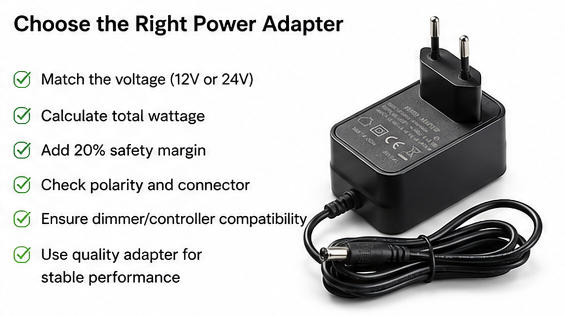
First, match the output voltage exactly: use a regulated 12V adapter for a 12V strip and a regulated 24V adapter for a 24V strip. Next, calculate the total strip wattage and add an appropriate operating margin. Verify that the adapter, controller, connectors, and wiring can all support the required current.
Finally, confirm polarity and determine how the lighting will be dimmed. DC-side PWM dimming, AC-side phase-cut dimming, and protocol-based commercial controls require different power-system designs.
A correctly selected adapter provides stable brightness, smoother dimming, lower thermal stress, improved safety, and longer service life for the complete LED lighting system.