Desktop 3D printers are becoming more and more powerful. Modern equipment may integrate heating construction platforms, high-temperature heat tips, multi-stepping motors, cooling fans, sensors, displays, and control electronic components into a relatively compact system. Although these components are the focus of attention during the printer design process, power supply is equally important for overall reliability.
Choose a suitable 3D printer power adapter, not just matching the voltage marked on the printer label. The power supply must provide sufficient continuous power, maintain a stable output when the load changes, use the correct connectors and polarity, and provide proper electrical fault protection.
For manufacturers, distributors, and product developers, power supplies should also be evaluated from the perspectives of certification, thermal performance, mechanical design, and long-term availability.
This guide explains the key considerations when choosing an external power supply for a desktop 3D printer and highlights the most important specifications in practical applications.
1. Start With the Printer’s Electrical Requirements
The first step is always to identify the printer’s actual electrical requirements.
Most desktop 3D printers use an AC/DC power supply to convert mains electricity into a lower DC voltage used by the printer’s electronics and motors. Common system voltages include 12V and 24V, although the exact requirement varies by printer architecture.
The printer specification should provide information such as:
- Rated input voltage
- Required DC output voltage
- Maximum operating current
- Rated or maximum power consumption
- DC connector specification
- Connector polarity
- Recommended power supply rating
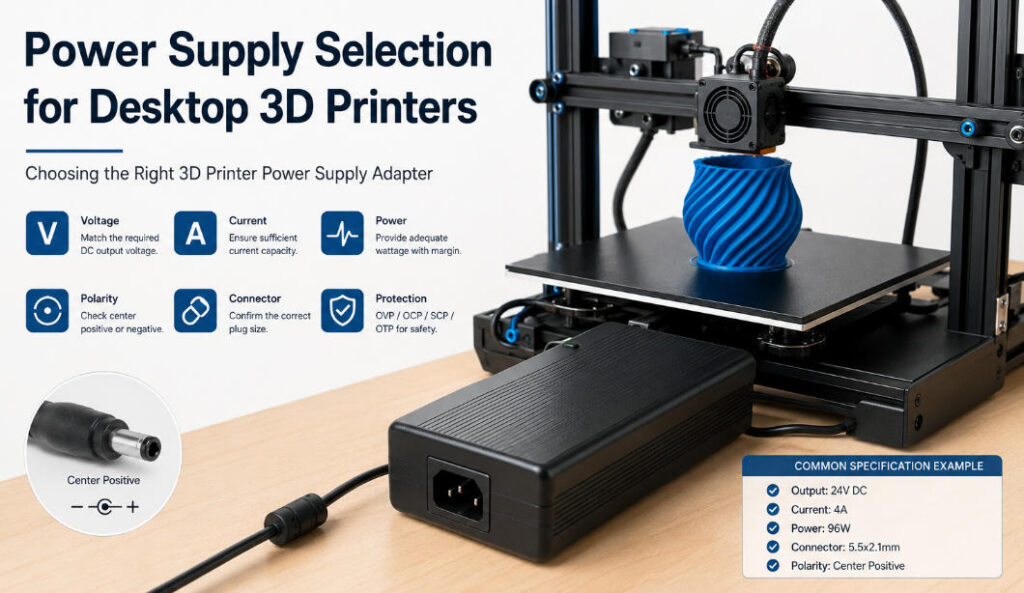
For example, a printer requiring 24V DC at 4A has a nominal power requirement of:
24V × 4A = 96W
In this situation, a 24V 4A power adapter provides a nominal 96W output capacity.
However, calculating the theoretical wattage is only the beginning. A 3D printer does not necessarily consume the same amount of power throughout a print.
The heater may switch on and off, motors may operate simultaneously, fans may change speed, and the electronics may experience short-duration load variations. Therefore, the selected adapter should provide enough continuous capacity to handle the printer’s normal operating conditions without running permanently at its maximum rating.
2. Why 24V Is Common in Desktop 3D Printers
24V has become an attractive operating voltage for many modern desktop 3D printer designs.
For a given power requirement, increasing the voltage reduces the current required by the system. For example, a 96W load at 24V requires 4A, while the same 96W load at 12V requires 8A.
Lower current can help reduce voltage drop and resistive losses in wiring and connectors. It can also make it easier to design power distribution paths for higher-power components such as heated beds.
This is one reason why 24V systems are frequently considered when designing higher-performance desktop 3D printers.
For equipment manufacturers, however, the correct voltage is determined by the printer’s electrical architecture—not simply by the fact that 24V may offer advantages.
Never replace a 12V supply with a 24V supply simply because the latter offers a higher wattage rating. Excessive voltage can damage the printer’s control electronics, motors, heaters, or other components.
3. Calculate Power Requirements Based on Real Operating Conditions
One of the most common mistakes when selecting a 3D printer power supply adapter is choosing the adapter based only on the printer’s average power consumption.
A printer may consume relatively little power while idle but significantly more during heating and active printing.
The major loads may include:
Heated bed
The heated bed can be one of the largest electrical loads in a desktop 3D printer. Initial heating typically requires substantial power, while maintaining temperature creates a repeating load cycle.
Hot end
The hot-end heater also creates a variable load. Its power requirement depends on the heater design and operating temperature.
Stepper motors
X, Y, Z, and extruder motors consume power during movement. Their contribution may not be as large as the heaters, but simultaneous motor operation can increase the overall load.
Cooling fans
Fans generally consume less power than heaters, but multiple fans running simultaneously still contribute to total system consumption.
Control electronics
The mainboard, display, sensors, communication modules, and other electronics usually require relatively low power compared with heating elements.
Because these loads operate differently, the power supply needs to handle both continuous operation and changing demand.
A practical selection approach is to determine the printer’s maximum expected load and then leave a reasonable operating margin rather than selecting an adapter that operates continuously at 100% of its rated output.
4. Voltage Matching Is More Important Than Higher Wattage
When comparing power supplies, buyers sometimes assume that a higher wattage model is automatically safer.
That is not correct.
Voltage compatibility comes first.
If a printer requires:
24V DC, 4A
the replacement supply should provide regulated 24V DC output.
A 120W adapter providing 30V is not a suitable replacement simply because its wattage is higher.
Similarly, a 24V 2A adapter and a 12V 4A adapter both provide 48W, but they are not interchangeable.
For a replacement or new printer design, always verify:
- Output voltage
- Maximum output current
- Output power
- Polarity
- DC connector size
- 입력 전압 범위
This specification-first approach is particularly important when sourcing adapters in bulk because an incorrect specification can result in an entire batch of incompatible products.
5. Choose a Power Supply With Adequate Current Capacity
Current capacity determines how much electrical load the adapter can continuously support.
Suppose a desktop 3D printer requires 24V at 3.5A during its highest normal operating condition. A 24V 3.5A adapter technically matches the calculated load, but there may be little operating headroom.
A higher-capacity 24V supply may be more appropriate if the printer has substantial load variation or if the application requires long operating periods.
This does not mean that the largest available adapter should always be selected.
Oversizing unnecessarily can increase:
- Product cost
- Physical dimensions
- 무게
- Shipping cost
- 에너지 소비량
- Mechanical integration requirements
The goal is to find an appropriate balance between capacity, reliability, thermal performance, and cost.
For OEM projects, this calculation should ideally be completed during the printer’s electrical design stage rather than after the hardware has already been finalized.
6. Desktop Power Supply vs Wall-Mount Adapter
For desktop 3D printers, the physical format of the external power supply also matters.
A wall-mounted adapter integrates the AC plug directly into the adapter body. It can be compact and convenient for lower-power applications.
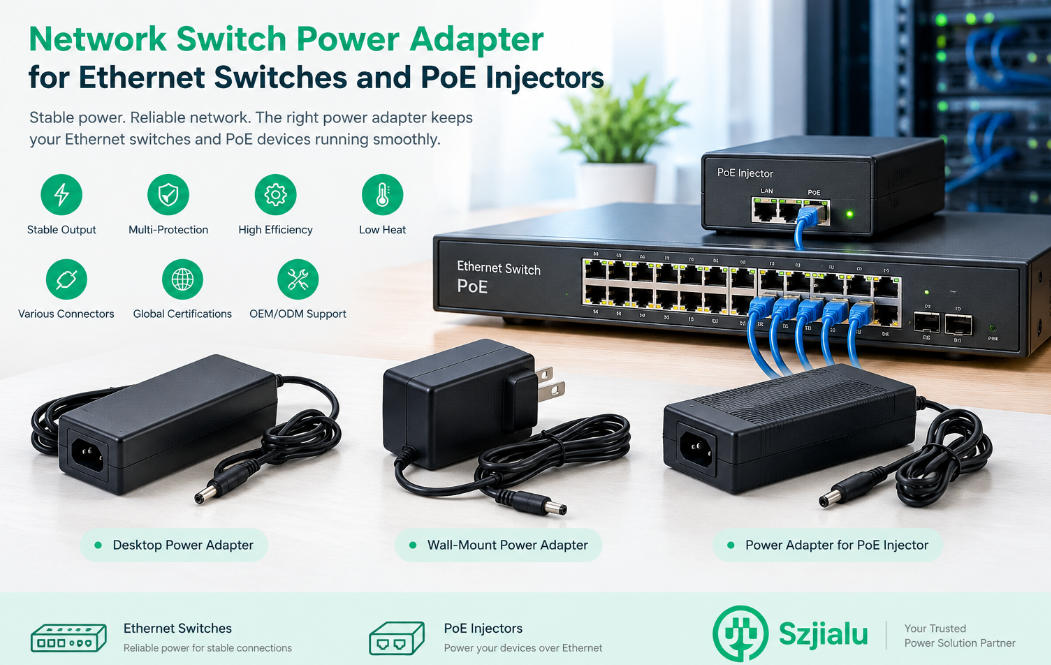
A desktop power supply normally uses a separate AC input cable and sits beside or underneath the equipment. This configuration can be advantageous for higher-power devices.
Desktop-style power supplies can provide several practical benefits for 3D printer applications:
- More space for thermal management
- Greater flexibility in connector and cable configuration
- Easier mechanical integration
- Better suitability for higher output power
- Easier replacement and servicing
- More flexible international AC cord configurations
For applications where the printer requires higher continuous power, a desktop-style design may therefore be more practical than a compact wall adapter.
Szjialu currently offers a dedicated desktop power supply range covering applications that require different output voltage and power configurations.
7. Connector Size and Polarity Cannot Be Ignored
Even when voltage and current are correct, a power adapter can still be incompatible with a 3D printer if the DC connector is wrong.
The connector should be checked for:
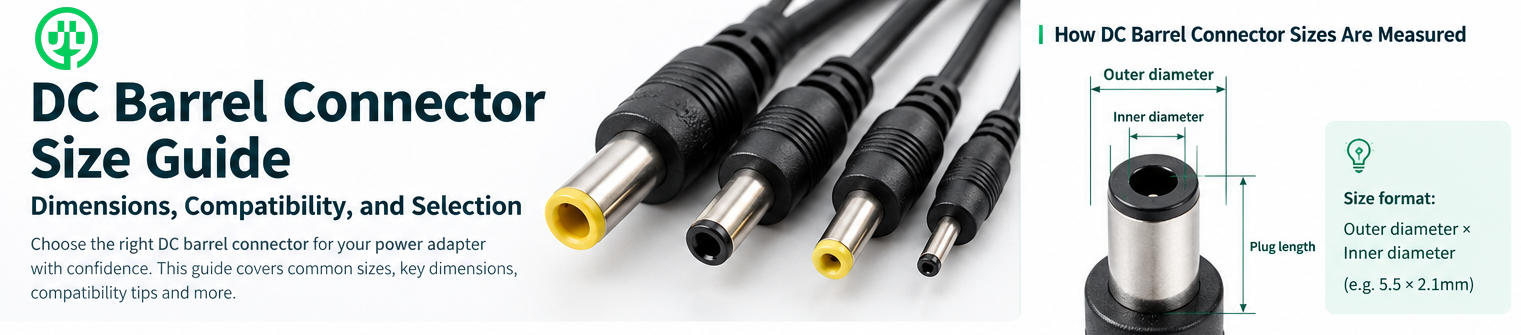
- Outer diameter
- Inner diameter
- Barrel length
- 플러그 타입
- Center polarity
- 케이블 길이
- Current-carrying capability
For common barrel connectors, seemingly similar sizes can have different electrical compatibility.
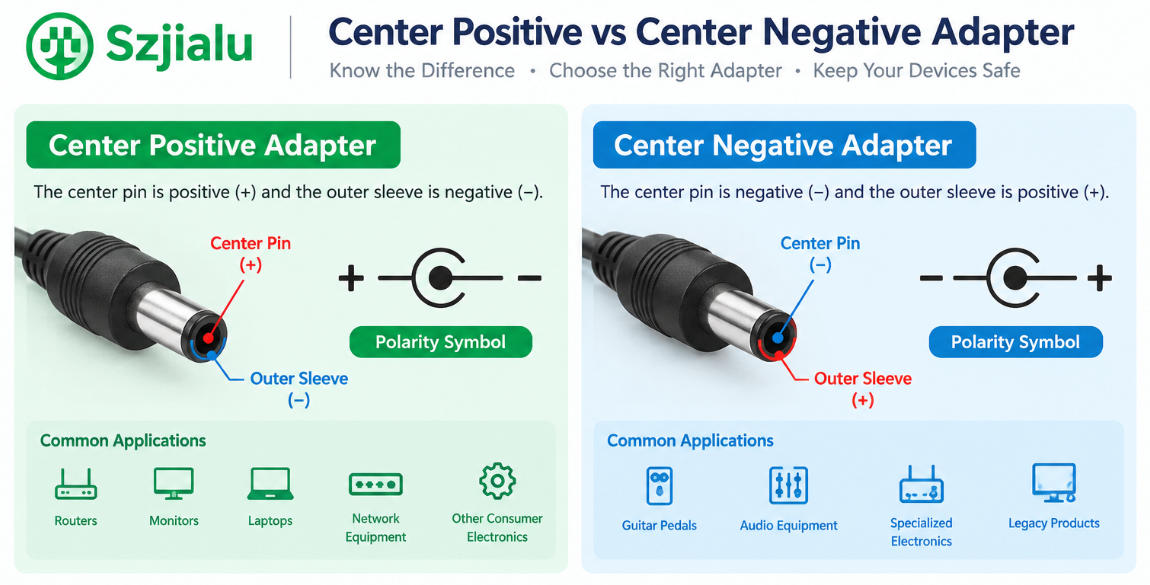
Polarity is particularly important. A common configuration is center-positive, but this should never be assumed without checking the printer specification or original adapter.
For OEM manufacturers, specifying the connector as part of the power supply BOM helps prevent incorrect substitutions during production.
8. Protection Features Matter in Long Printing Sessions
A desktop 3D printer may operate continuously for several hours or even longer. The power adapter therefore needs to remain stable throughout extended operation.
Important protection functions include:
과전압 보호
Helps protect the connected equipment if the output voltage rises beyond the specified range.
과전류 보호
Limits excessive current when the connected load exceeds the adapter’s designed capacity.
단락 보호
Helps prevent serious damage if the output terminals are accidentally shorted.
과열 방지
Helps protect the adapter when internal temperature rises beyond its safe operating range.
These protections are especially relevant for products intended for commercial or industrial deployment.
Szjialu’s power adapter products are designed with protection features such as OVP, OCP, OTP, and SCP depending on the product series, providing additional protection for connected equipment.
9. Thermal Performance Should Be Evaluated
Power supply reliability is strongly influenced by temperature.
A power adapter operating continuously near its maximum load generates heat internally. If the enclosure, components, and thermal design cannot dissipate that heat effectively, component aging may accelerate.
For 3D printer applications, consider:
- Continuous output load
- Ambient temperature
- Ventilation around the adapter
- Enclosure design
- Internal component quality
- 능률
- Operating duration
A supply that performs well during a short bench test may behave differently during a 12-hour print.
This is why OEM buyers should evaluate power supplies under realistic load conditions rather than relying exclusively on nominal specifications.
10. Efficiency and Standby Consumption
Efficiency is another consideration when selecting a 3D printer power supply adapter.
A more efficient adapter converts more of the input energy into useful output power and dissipates less energy as heat.
This can provide several advantages:
- Lower operating losses
- 열 발생량 감소
- Better long-term thermal performance
- Lower standby consumption
- Improved energy efficiency
For products sold internationally, efficiency requirements may also influence the choice of power supply platform and certification strategy.
For example, Szjialu’s adapter portfolio includes Level VI efficiency products and supports multiple international certification requirements, depending on the model.
11. Certification and Compliance for Commercial 3D Printers
For hobby use, buyers often focus primarily on price and electrical compatibility.
For manufacturers and distributors, compliance becomes much more important.
Depending on the target market, the power supply may need certifications or regulatory approvals such as:
- UL
- FCC
- CE
- 영국CA
- PSE
- KC
- 남에이
- CCC
- RCM
The exact certification requirements depend on the destination market, product configuration, and applicable regulations.
Therefore, OEM buyers should confirm certification requirements before finalizing the power supply design.
This is especially important when the same 3D printer is intended for distribution across North America, Europe, Asia-Pacific, and other international markets.
12. Don’t Overlook AC Input Requirements
A globally distributed 3D printer may be sold in countries with different mains voltage standards.
A universal-input adapter supporting a broad AC input range can simplify international product development.
For example, many Szjialu adapter platforms support wide input ranges such as 100–240V AC or 90–264V AC, depending on the model.
This approach allows the same basic power supply platform to support multiple markets while changing the AC plug or power cord configuration as necessary.
For manufacturers, this can reduce SKU complexity and simplify procurement.
13. What Should OEM Buyers Ask a Power Supply Manufacturer?
When sourcing a power adapter for a desktop 3D printer, asking for the datasheet alone is not always enough.
A qualified supplier should be able to provide information about:
- 출력 전압 및 전류
- Maximum continuous power
- 입력 전압 범위
- 능률
- Protection functions
- Connector specifications
- Cable configuration
- 안전 인증
- Operating temperature
- Reliability testing
- Aging or burn-in testing
- 보증
- 최소 주문 수량
- 리드 타임
- OEM/ODM 맞춤 제작
It is also useful to request samples and test them with the actual printer hardware.
For larger projects, manufacturers should evaluate the adapter under maximum realistic load conditions and during extended printing cycles.
Szjialu, for example, provides OEM/ODM power supply services and has developed multiple adapter platforms covering different voltage, current, and power ranges. The company’s production and engineering capabilities are designed to support customized power solutions for equipment manufacturers.
14. A Practical Selection Example
Consider a desktop 3D printer with the following requirements:
입력: 24V DC
Maximum operating current: 4A
Calculated power: 96W
A suitable adapter should therefore provide regulated 24V DC output with at least 4A continuous current capability.
If the printer experiences significant load fluctuations, the manufacturer may consider a higher-capacity model to provide additional operating margin.
The buyer should then confirm:
- 24V output regulation
- Current capacity
- Connector dimensions
- Center polarity
- Cable specification
- 입력 전압 범위
- Protection functions
- 인증 요건
- 열 성능
Szjialu also publishes technical guidance on selecting a 24V 4A 데스크탑 전원 어댑터, which can be useful when evaluating this type of higher-power DC application.
15. Final Checklist for Selecting a 3D Printer Power Supply Adapter
Before approving a power supply for a desktop 3D printer, check the following:
Electrical
- Is the output voltage exactly compatible?
- Is the continuous current sufficient?
- Is the rated wattage appropriate?
- Is there enough operating margin?
Mechanical
- Is the DC plug compatible?
- Is the polarity correct?
- Is the cable long enough?
- Does the adapter fit the intended installation space?
신뢰할 수 있음
- Does it support continuous operation?
- Are OVP, OCP, SCP, and OTP available?
- Has the adapter been tested under realistic loads?
- Is thermal performance acceptable?
규정 준수
- Does it have the certifications required for the target market?
- Does the AC input range support the intended region?
- Can the manufacturer provide the required compliance documentation?
Supply
- Can the supplier provide consistent production quality?
- Are OEM/ODM modifications available?
- Can the supplier support long-term production?
- Are samples available before mass production?
결론
Selecting the right 3D printer power supply adapter is ultimately an engineering decision rather than a simple wattage comparison.
The correct solution needs to match the printer’s voltage, current, connector, polarity, and real operating load while providing adequate thermal performance and electrical protection. For commercial 3D printer manufacturers, certification, consistency, customization, and long-term supply capability are equally important.
As desktop 3D printers continue to adopt higher-temperature heating systems, larger build platforms, and more powerful motion systems, the external power supply becomes an increasingly important part of the overall product architecture.
For OEMs, distributors, and equipment manufacturers, working with an experienced power supply manufacturer can make it easier to develop a reliable solution around the printer’s actual electrical requirements.
With experience in AC/DC power adapters, desktop power supplies, and customized OEM/ODM solutions, 스지알루 can support different power requirements for equipment manufacturers and international buyers looking for stable, application-specific power solutions.