USB-C has become the universal charging interface for smartphones, tablets, laptops, gaming devices, and even monitors. Behind this widespread adoption is USB 전력 공급(USB PD), the intelligent charging protocol that allows devices to negotiate the optimal voltage and current for safe, efficient charging.
As charging demands continue to increase, the USB Implementers Forum (USB-IF) introduced USB PD 3.1, an important upgrade to the widely adopted PD 3.0 specification. While many users assume PD 3.1 simply means “higher power,” the reality is more nuanced. For today’s popular 100W USB-C chargers, the practical differences between PD 3.0 and PD 3.1 are worth understanding.
This article explores how USB Power Delivery has evolved, compares PD 3.0 and PD 3.1 in detail, explains their impact on 100W chargers, and looks ahead to the future of USB-C charging technology.
Evolution of USB Power Delivery
When USB first appeared, it was designed primarily for data transfer, with power delivery limited to just a few watts. As mobile devices became more powerful, manufacturers needed a standardized way to charge everything from smartphones to high-performance laptops.
USB Power Delivery was introduced to solve this challenge.
From Basic Charging to Intelligent Power Negotiation
Unlike traditional USB charging, USB PD allows chargers and connected devices to communicate before power is delivered. Instead of supplying a fixed voltage, the charger dynamically adjusts output according to the device’s requirements.
혜택은 다음과 같습니다:
- 더 빠른 충전 속도
- 충전 효율 향상
- Better thermal management
- Enhanced battery protection
- Universal compatibility across brands
Over several generations, USB PD has continuously improved both power capability and communication efficiency.
USB PD Timeline
| Version | 최대 출력 | Major Features |
|---|---|---|
| PD 1.0 | 100와트 | Initial USB-C power delivery |
| PD 2.0 | 100와트 | Flexible voltage profiles |
| PD 3.0 | 100와트 | PPS support, improved communication |
| PD 3.1 | 240W | Extended Power Range (EPR) |
Among these versions, PD 3.0 became the industry standard for most consumer electronics, while PD 3.1 prepares USB-C for next-generation high-power devices.
Differences Between PD 3.0 and PD 3.1
Although both standards support USB-C fast charging, several important technical differences distinguish them.
Maximum Power Output
The biggest change is the introduction of Extended Power Range (EPR).
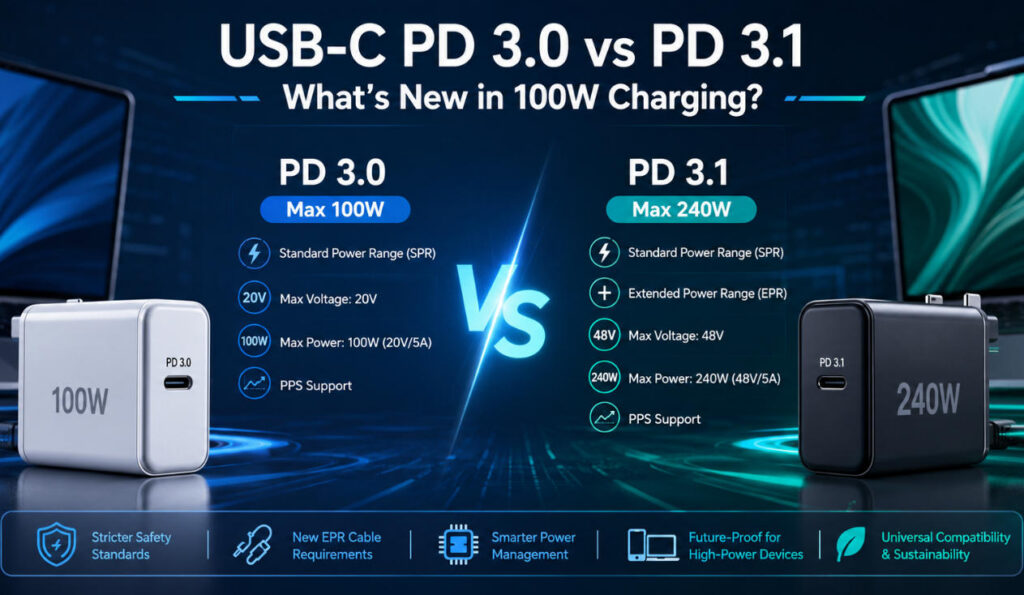
PD 3.0
Uses Standard Power Range (SPR) with a maximum output of:
- 5볼트
- 9V
- 15V
- 20V
Maximum power:
100W (20V / 5A)
This covers virtually all current smartphones, tablets, portable gaming devices, and many laptops.
PD 3.1
PD 3.1 retains SPR while adding EPR, introducing new voltage levels:
- 28V
- 36V
- 48V
Maximum power increases dramatically to:
240W (48V / 5A)
This makes USB-C capable of powering devices previously dependent on proprietary power adapters.
Improved Cable Requirements
Higher voltage naturally requires stricter safety standards.
PD 3.1 introduces:
- New EPR-certified USB-C cables
- Improved insulation
- Better connector reliability
- Enhanced temperature monitoring
A standard 100W USB-C cable cannot safely deliver 240W.
However, existing 100W cables remain fully compatible with PD 3.0 charging.
Better Voltage Management
Another enhancement is more refined voltage regulation.
PD 3.1 improves:
- Voltage accuracy
- Stability during rapid load changes
- Thermal efficiency
- Safety monitoring
This becomes increasingly important as charging power exceeds 140W.
프로그래밍 가능 전원 공급 장치(PPS)
One common misconception is that PPS is exclusive to PD 3.1.
In reality:
PPS was introduced in PD 3.0.
PPS allows chargers to adjust voltage in very small increments, improving efficiency while reducing battery heat.
Many Android smartphones use PPS for ultra-fast charging.
PD 3.1 continues supporting PPS while expanding maximum power capabilities.
Backward Compatibility
Perhaps the most important feature for consumers is compatibility.
PD 3.1 chargers remain fully compatible with:
- PD 3.0 devices
- Older USB-C products
- Standard USB charging protocols
Likewise, PD 3.0 devices can safely use PD 3.1 chargers.
Charging simply falls back to the highest supported power level.
Impact on 100W Charger Performance
Since both PD 3.0 and PD 3.1 support 100W charging, many people wonder whether upgrading actually makes a difference.
The answer depends on the application.
No Significant Speed Difference at 100W
A laptop requiring exactly 100W will charge at virtually the same speed whether connected to:
- a PD 3.0 charger
- a PD 3.1 charger
Both deliver:
- 20V
- 5A
- 100W maximum
Therefore, for today’s mainstream laptops, charging performance remains nearly identical.
Better Long-Term Compatibility
Although current devices may not need PD 3.1, newer hardware is beginning to exceed 100W.
예시로는 다음과 같은 것들이 있습니다.
- AI workstations
- Mobile creator laptops
- Gaming notebooks
- 휴대용 모니터
- 도킹 스테이션
A PD 3.1 charger offers greater future compatibility without sacrificing support for existing equipment.
Improved Power Management
Even at 100W, some PD 3.1 controller chips provide:
- faster communication
- more accurate power negotiation
- smoother dynamic load adjustment
- improved fault detection
These enhancements may not noticeably increase charging speed but can improve reliability under heavy workloads.
Multi-Port Charging Benefits
Modern GaN chargers often power multiple devices simultaneously.
예를 들어:
- 랩탑
- 스마트폰
- 태블릿
- 이어폰
PD 3.1 controllers generally provide more intelligent power allocation between ports, particularly in chargers supporting dynamic power distribution.
This leads to more stable charging when devices are connected or disconnected.
Better Thermal Efficiency with GaN Technology
PD protocol improvements work especially well with GaN(질화갈륨) technology.
Compared with traditional silicon chargers, GaN designs offer:
- higher efficiency
- lower heat generation
- smaller size
- 더 높은 전력 밀도
제조업체들 스지알루 have integrated modern PD controller chips with GaN power architectures to deliver compact 100W USB-C chargers that maintain stable performance across multiple connected devices. Rather than relying solely on higher wattage, the focus is on efficient power conversion, intelligent protection, and long-term reliability for both OEM and ODM applications.
Future of USB-C Charging Standards
USB-C charging continues to evolve alongside increasingly demanding electronic devices.
Several trends are shaping the next generation of charging technology.
Higher Power Becomes Mainstream
As professional laptops and portable workstations grow more powerful, power requirements continue increasing.
Future USB-C chargers will commonly support:
- 140와트
- 180와트
- 240W
without requiring proprietary connectors.
Universal Charging Ecosystems
Consumers increasingly expect one charger to power everything.
Future chargers will support:
- laptops
- 스마트폰
- 정제
- cameras
- gaming handhelds
- monitors
- accessories
USB-C continues moving toward becoming the universal connector for nearly all portable electronics.
Smarter Charging Algorithms
Future USB PD implementations will incorporate increasingly intelligent power management.
Expected improvements include:
- adaptive charging
- battery health optimization
- AI-assisted thermal management
- real-time efficiency optimization
- dynamic device recognition
These technologies will help extend battery lifespan while improving charging efficiency.
Sustainability Through Standardization
A single universal charging standard also reduces electronic waste.
Consumers no longer need multiple proprietary adapters for different brands, while businesses benefit from simplified procurement, inventory management, and long-term product compatibility.
USB PD continues to play an important role in supporting global sustainability initiatives.
PD 3.0 vs PD 3.1: Quick Comparison
| 특징 | PD 3.0 | PD 3.1 |
|---|---|---|
| 최대 출력 | 100와트 | 240W |
| Power Range | SPR | SPR + EPR |
| Maximum Voltage | 20V | 48V |
| PPS 지원 | 예 | 예 |
| 100W Charging Support | 예 | 예 |
| 미래 대비 | 좋은 | 훌륭한 |
| Cable Requirement | Standard 5A Cable | EPR Cable for >100W |
Which One Should You Choose?
If your devices—including laptops, tablets, and smartphones—require 100W or less, a high-quality PD 3.0 charger continues to deliver excellent performance. However, if you’re purchasing new charging equipment with long-term compatibility in mind, a PD 3.1-certified charger provides greater flexibility for future high-power devices while remaining fully backward compatible.
For businesses sourcing chargers through OEM or ODM programs, selecting modern PD controller platforms can also simplify future product updates and reduce redesign costs as USB-C standards continue to evolve.
결론
USB PD 3.1 represents more than just an increase in maximum charging power. It expands the capabilities of USB-C through Extended Power Range, stronger safety mechanisms, smarter power negotiation, and improved readiness for the next generation of high-performance electronics.
For today’s 100W charging applications, users should not expect dramatic speed improvements over PD 3.0. Instead, the real advantages lie in future compatibility, enhanced controller technology, and support for devices that will soon exceed the traditional 100W limit.
As USB-C continues replacing proprietary charging solutions across the electronics industry, understanding the differences between PD 3.0 and PD 3.1 helps consumers, IT buyers, and manufacturers make informed purchasing decisions while preparing for the future of universal fast charging.