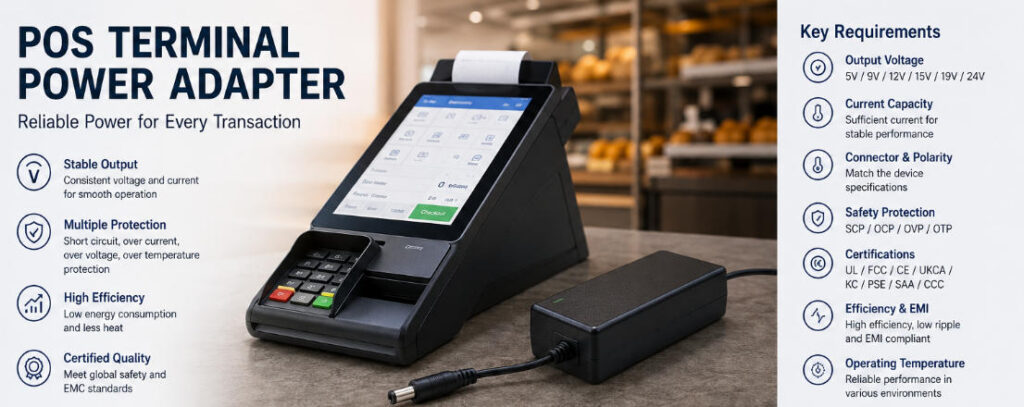
A POS terminal may look like a relatively simple retail device, but its power requirements may not be as simple as they appear. A typical POS system may include a touch screen, processor, memory, card reader, barcode scanner, receipt printer, customer display, communication module, and other peripherals. All of these components rely on a stable power supply.
For this reason, choosing the right POS terminal power adapter is not just about finding an adapter with the same voltage value printed on the label. Output current, power margin, connector size, polarity, protection function, electromagnetic compatibility, certification, and working conditions can all affect the reliability of POS systems.
For equipment manufacturers, distributors, and system integrators, power adapters should be considered as part of the overall design of POS hardware, not as generic accessories.
1. Match the POS Terminal’s Required Output Voltage
The first requirement when selecting a POS terminal power adapter is to match the equipment’s specified DC output voltage.
Common POS equipment may use DC outputs such as 5V, 9V, 12V, 15V, 19V, or 24V, depending on the terminal architecture and power requirements. The exact voltage should always be determined from the POS manufacturer’s technical specification or the original adapter label.
For example, if a POS terminal requires:
Input: 12V DC, 2A
the replacement power supply should provide a regulated 12V DC output. A higher voltage should not be substituted simply because the adapter has a higher wattage rating.
Voltage compatibility is particularly important for POS terminals because their internal processors, displays, storage components, and communication circuits are designed around specific operating voltage ranges.
When developing or sourcing a replacement adapter, buyers should confirm:
- Required DC output voltage
- Acceptable voltage tolerance
- Maximum operating current
- 입력 전압 범위
- DC connector specification
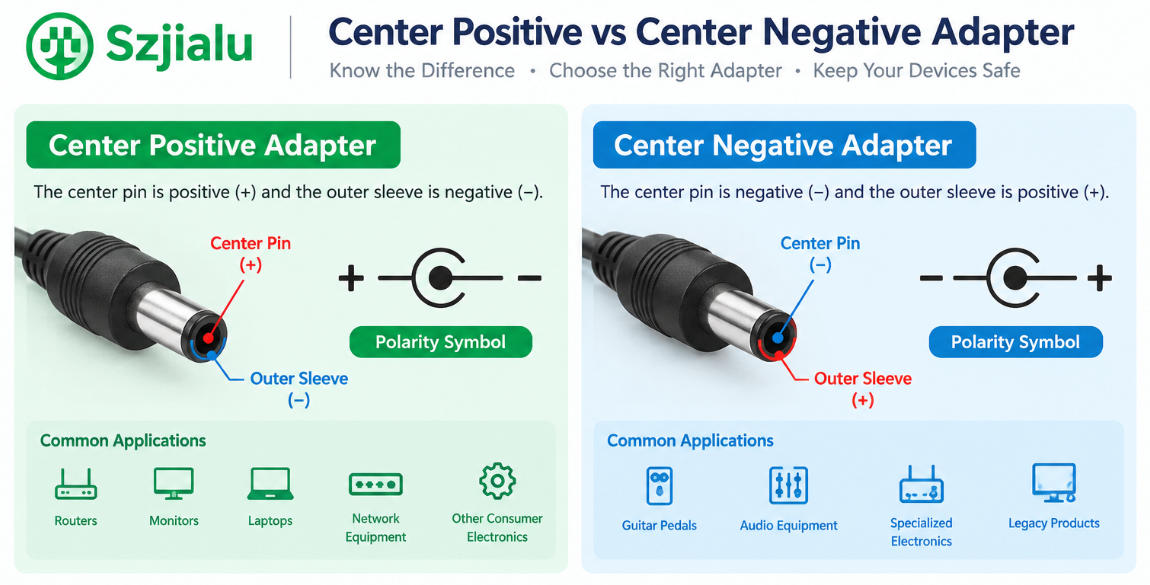
- Center-positive or center-negative polarity
A detailed understanding of voltage and current matching is also useful when evaluating other DC-powered equipment. Szjialu’s guide to choosing a 12V power adapter provides additional technical guidance on these specifications.
2. Select Enough Current Capacity
Current capacity is the second major requirement for a reliable POS terminal power adapter.
The adapter’s rated output current should normally be equal to or greater than the maximum current required by the terminal.
For example, a 12V POS device requiring 1.5A should not be paired with a 12V 1A adapter. An undersized power supply may experience excessive thermal stress, voltage drop, protection shutdown, or unstable operation.
On the other hand, using a higher-current-rated adapter does not normally mean that the terminal will be forced to consume the full current rating. A properly regulated 12V 3A adapter can generally supply a 12V 1.5A device, assuming the connector, polarity, voltage tolerance, and other specifications are compatible.
This distinction is important when purchasing POS power supplies in volume. Buyers should evaluate the actual load requirement rather than selecting an adapter based only on nominal wattage.
3. Allow Sufficient Power Margin
A POS terminal does not necessarily consume a constant amount of power.
During normal operation, the terminal may have relatively stable consumption. However, peripherals can create short-term increases in demand. A display turning on, a receipt printer starting, a communication module transmitting, or an attached scanner becoming active can increase instantaneous power consumption.
For this reason, selecting a power adapter that operates continuously at its absolute maximum rating is generally not ideal.
A practical design approach is to leave sufficient capacity above the terminal’s normal operating requirement. The appropriate margin depends on the POS hardware architecture, peripheral configuration, startup characteristics, and environmental conditions.
For OEM buyers, it is useful to test the complete system under:
- Normal continuous load
- Maximum peripheral load
- Startup conditions
- Communication activity
- High-temperature operation
- Long-duration continuous operation
The goal is not simply to make the adapter work during a short bench test, but to ensure stable performance throughout the POS system’s expected operating cycle.
4. Connector Size and Polarity Must Be Correct
Even when voltage and current are correct, a power adapter may still be incompatible because of the DC connector.
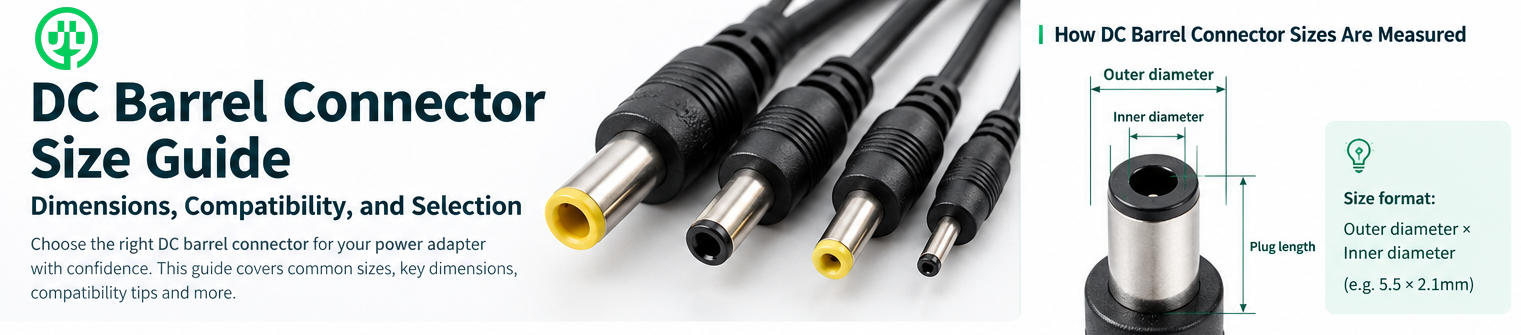
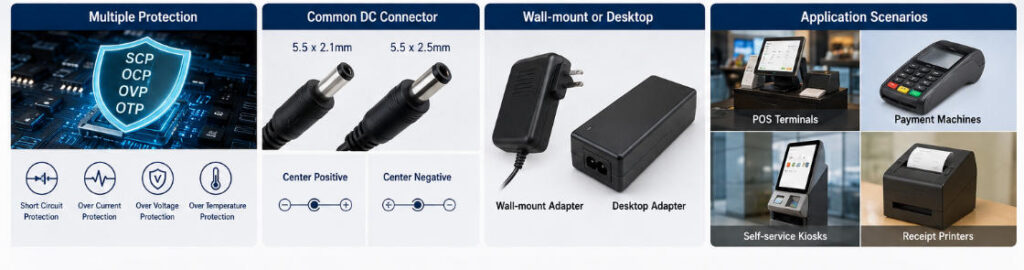
Barrel-type DC connectors are available in multiple dimensions. Common examples include 5.5 × 2.1mm and 5.5 × 2.5mm, but POS equipment can use other connector configurations as well.
The buyer should verify:
- Outer diameter
- Inner diameter
- Plug length
- Contact configuration
- Cable specification
- Polarity
Polarity is particularly important. A common configuration is center-positive, but this should never be assumed without checking the equipment specification.
For OEM and ODM projects, connector selection should be confirmed before production begins. A small difference in connector dimensions can result in poor contact, intermittent power loss, excessive contact resistance, or complete incompatibility.
5. Protection Features Matter in Retail Environments
POS 단말기 often operate for long periods and may be installed in environments where power disturbances occur. A suitable POS terminal power adapter should therefore include appropriate protection functions.
Common protection features include:
단락 보호(SCP): Helps protect the adapter and connected equipment if the output is shorted.
Over-Current Protection (OCP): Limits excessive output current and helps prevent abnormal loading conditions.
Over-Voltage Protection (OVP): Helps prevent excessive output voltage from reaching sensitive electronics.
Over-Temperature Protection (OTP): Provides additional protection when internal temperature rises beyond safe operating conditions.
These functions become especially important for POS deployments where equipment may remain powered throughout business hours or operate continuously.
Szjialu’s power adapter product range includes models designed with SCP, OCP, OVP, and OTP protection. For example, its 24W AS2406A series provides 12V 2A, 24V 0.5A, and 5V 4A output options and lists POS systems and payment terminals among its typical applications.
6. Efficiency and Thermal Performance for 24/7 POS Operation
POS systems are often used every day for extended periods. Therefore, thermal performance should be considered alongside electrical specifications.
An inefficient power adapter converts more input energy into heat. Excessive heat can affect component lifetime, enclosure temperature, and long-term reliability.
For commercial POS deployments, buyers should look beyond the nominal output power and evaluate:
- Efficiency level
- No-load power consumption
- Full-load temperature rise
- Component quality
- Enclosure material
- Ventilation requirements
- Long-duration aging performance
A well-designed adapter should maintain stable output without excessive thermal stress under its intended load.
For manufacturers, thermal testing under realistic POS loads is particularly valuable because a power supply that performs well during a short laboratory test may behave differently after several hours of continuous operation.
7. EMI and EMC Performance Should Not Be Ignored
POS terminals contain processors, displays, wireless communication modules, card readers, and other electronic circuits. The power supply therefore needs to operate without creating unacceptable electromagnetic interference.
Poorly designed adapters can introduce electrical noise into sensitive equipment or fail electromagnetic compatibility requirements.
When evaluating a POS terminal power adapter, commercial buyers should consider:
- Conducted emissions
- Radiated emissions
- Immunity performance
- Output ripple and noise
- Switching frequency behavior
- PCB layout
- Filtering design
This becomes especially important for payment-related equipment because stable electrical performance is part of the overall system reliability.
The adapter should be evaluated as part of the complete POS system rather than as an isolated component.
8. Safety Certifications for POS Power Adapters
Certification requirements depend on the target market and the final application.
For international POS equipment, buyers may need certifications or compliance documentation relevant to regions such as North America, Europe, the UK, Australia, Japan, Korea, or other markets.
Common certification marks encountered in power adapter sourcing include UL, FCC, CE, UKCA, KC, SAA, PSE, and CCC.
However, certification should not be treated simply as a logo on the product label. OEM buyers should confirm that the certification applies to the actual adapter model, output configuration, enclosure, and intended market.
Szjialu’s product portfolio includes power adapters with multiple international certifications. Its 12W AS1201A series, for example, offers multiple output configurations and lists UL, FCC, CE, UKCA, KC, SAA, PSE, and CCC among its certifications.
9. Wall-Mount or Desktop Power Adapter?
The physical installation of the POS terminal can influence the most appropriate adapter format.
Wall-Mount Adapter
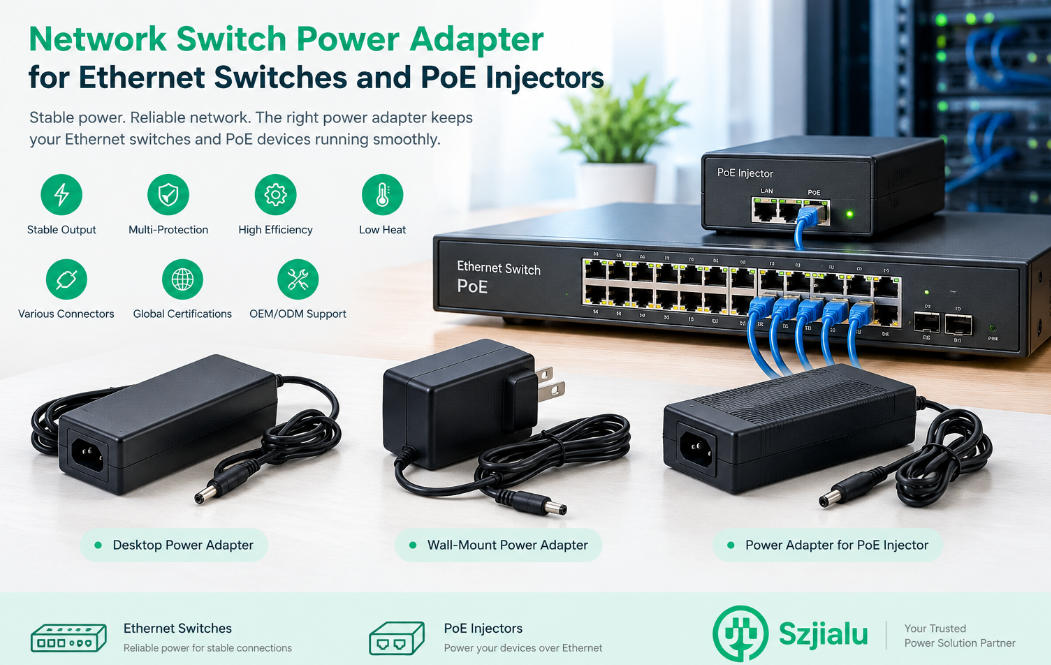
Wall-mount adapters integrate the AC plug into the adapter housing. They are useful when space is limited and a compact installation is preferred.
They can be suitable for:
- Compact POS terminals
- Small payment devices
- Retail counters
- Kiosks
- Peripheral equipment
데스크탑 전원 어댑터
Desktop adapters normally use a separate AC input cable and DC output cable. They can provide greater flexibility for equipment with higher power requirements or installations where the power supply needs to be positioned away from the terminal.
They are often suitable for:
- Larger POS systems
- Multi-peripheral configurations
- Retail kiosks
- Industrial POS equipment
- Equipment requiring higher output power
The correct choice depends on the mechanical design, power requirement, installation environment, and cable routing of the final POS system.
10. What Should OEM Buyers Specify to a Power Adapter Manufacturer?
For OEM and ODM projects, sending only a statement such as “we need a POS terminal power adapter” is usually not enough.
A manufacturer should receive a detailed technical specification covering:
- Input voltage and frequency
- Output voltage
- Maximum output current
- Required output power
- DC connector dimensions
- Polarity
- Cable length and wire specification
- 플러그 타입
- Protection requirements
- 인증 요건
- Operating temperature
- Mechanical dimensions
- Label requirements
- Packaging requirements
- Annual or monthly purchasing volume
Providing these details early can reduce prototype iterations and prevent compatibility problems during mass production.
This is particularly important when the adapter is being developed together with a new POS terminal. The power supply should be validated alongside the terminal rather than selected after the hardware design has already been finalized.
11. Choosing a POS Terminal Power Adapter Manufacturer
For B2B buyers, the supplier’s manufacturing capability can be just as important as the adapter’s datasheet.
A suitable supplier should be able to provide engineering support, prototype development, testing, certification documentation, production quality control, and customization.
Szjialu manufactures AC/DC power adapters across multiple power ranges and provides OEM/ODM services for customized power solutions. Its website lists wall-mount adapters, desktop power supplies, interchangeable-plug adapters, and USB power adapters as part of its power adapter portfolio.
For POS manufacturers and system integrators, this type of supplier can be useful when the project requires customized voltage, current, connector, housing, cable, label, certification, or packaging specifications.
결론
The correct terminal power adapter should be selected according to the complete electrical and mechanical requirements of the POS system, not just matching the voltage value.
Key features include output voltage, current capacity, power margin, connector size, polarity, protection function, efficiency, thermal performance, electromagnetic interference/electromagnetic compatibility performance, and regional certification.
For simple POS peripheral devices, a compact wall-mounted adapter may be sufficient. For systems with multiple peripherals and higher requirements, a more powerful desktop adapter may be needed, as well as additional cooling and electrical space.
For OEM and ODM buyers, the best approach is to define the power supply requirements during the POS hardware development stage. This allows the adapter manufacturer to optimize the electrical design, connector, enclosure, cable, certifications, and production specifications before mass production.
Szjialu provides a broad range of AC/DC power adapter solutions and customized OEM/ODM services, making it possible to develop POS power solutions around the actual requirements of the terminal rather than forcing the system to fit an off-the-shelf adapter.