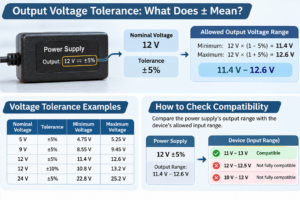
출력 전압 허용 오차 indicates how much a power supply’s actual output voltage can differ from its nominal value. For example, a 12V power supply with a ±5% tolerance is allowed to deliver between 11.4V and 12.6V under the manufacturer’s specified conditions. To determine whether this voltage is suitable for your device, the entire output range should fall within the device’s acceptable input voltage range. Matching the nominal voltage alone does not always guarantee voltage compatibility.

What Does Plus or Minus Mean in Output Voltage?
The voltage printed on a power supply, such as 5V, 12V, or 24V, is its nominal output voltage. This is the rated value the power supply is designed to provide, rather than a promise that the output will remain at exactly that number.
The plus (+) and minus (−) symbols describe how far the output is permitted to deviate from that nominal value.
For example, if a power supply is labeled 12V ±5%:
- +5% means the output can rise to 12.6V.
- −5% means the output can fall to 11.4V.
- The specified output range is therefore 11.4V to 12.6V.
A tolerance specification does not mean the voltage constantly moves between these limits. It defines an acceptable range under the conditions covered by the specification.
How to Calculate Output Voltage Tolerance
You can calculate the minimum and maximum output voltages using two simple formulas:
Maximum output voltage = Nominal voltage × (1 + Tolerance ÷ 100)
Minimum output voltage = Nominal voltage × (1 − Tolerance ÷ 100)
Here are several common examples:
| Nominal voltage | Tolerance | Minimum voltage | Maximum voltage |
|---|---|---|---|
| 5볼트 | ±5% | 4.75V | 5.25V |
| 9V | ±5% | 8.55V | 9.45V |
| 12V | ±5% | 11.4V | 12.6V |
| 12V | ±10% | 10.8V | 13.2V |
| 24V | ±5% | 22.8V | 25.2V |
The percentage is always calculated from the nominal voltage, not from the device’s input rating.
Notice that the same percentage produces a larger voltage difference at higher nominal voltages. A ±5% tolerance represents a 0.25V deviation for a 5V supply, but a 1.2V deviation for a 24V supply.
If you’re unfamiliar with rated voltage specifications, our guide to AC/DC adapter output voltage provides additional background.
How Does Output Voltage Tolerance Affect Device Compatibility?
The most useful way to evaluate voltage compatibility is to compare two ranges:
- The power supply’s minimum and maximum output voltages.
- The device’s specified minimum and maximum input voltages.
The power supply’s complete output voltage range should fit inside the device’s allowed input voltage range.
Suppose you have a 12V power supply with ±5% tolerance. Its specified output range is 11.4V–12.6V.
Now consider three devices:
| Device’s allowed input range | Voltage compatibility | Reason |
|---|---|---|
| 11V–13V | Compatible | The entire 11.4V–12.6V range is within the device’s limits |
| 12V–12.5V | Not fully compatible | The supply may deliver less than 12V or more than 12.5V |
| 10V–12V | Not fully compatible | The supply may exceed the device’s maximum input voltage |
This is why two products labeled “12V” are not automatically a perfect voltage match.
An input voltage below the specified minimum may cause a device to malfunction, reset, or shut down. A voltage above the permitted maximum may stress internal components or cause damage, depending on the device’s design.
What If the Device Only Says 12V?
Some devices display only a nominal input voltage, such as “DC 12V,” without specifying a tolerance.
In that situation, you cannot determine the exact acceptable input range from the label alone.
Check the device’s technical documentation for information such as “Operating Input Voltage,” “Input Voltage Range,” or “Recommended Supply Voltage.”
Avoid treating a device’s absolute maximum voltage rating as its normal operating limit. These specifications serve different purposes.
If no input voltage range is available, consult the manufacturer rather than assuming the device will accept any supply labeled 12V.
Is Output Voltage Tolerance the Same as Voltage Regulation?
Not exactly.
출력 전압 허용 오차 describes the permitted deviation from the nominal output voltage under specified conditions.
Voltage regulation describes how well a power supply maintains its output when operating conditions change.
For example, the output may vary as the connected device draws more or less current. Changes in the power supply’s input voltage or operating temperature may also affect the output.
Manufacturers may specify these characteristics separately as:
- Line regulation: Output changes caused by variations in input voltage.
- Load regulation: Output changes caused by variations in the connected load.
- Temperature coefficient: Output changes associated with temperature variation.
Some datasheets provide an overall output tolerance that already accounts for certain operating variations, while others list individual specifications separately. Always check what conditions and factors are included before combining tolerance figures.
You can explore the distinction further in our article about regulated vs. unregulated power supplies.
Does ±5% Include Output Ripple and Noise?
Not necessarily.
Output ripple and noise refer to unwanted voltage fluctuations superimposed on the DC output. They are often specified separately, typically in millivolts peak-to-peak (mVp-p).
A power supply may have an acceptable average DC output voltage while still producing ripple that matters to sensitive electronics.
Whether ripple and noise are included in an overall tolerance figure depends on how the manufacturer defines that specification.
For more detail, see our guide to power supply ripple and noise.
자주 묻는 질문
Is a Lower Output Voltage Tolerance Always Better?
A smaller tolerance generally means the output is controlled within a narrower range. However, a tighter specification is not automatically necessary for every device. The important requirement is that the output remains within the device’s acceptable operating limits.
Can I Use a ±10% Power Supply Instead of a ±5% One?
Possibly, but only if the wider output range remains acceptable to the device. For a 12V supply, ±10% permits 10.8V–13.2V, compared with 11.4V–12.6V for ±5%. Check the device’s input limits rather than comparing percentages alone.
Does ±5% Mean the Power Supply Is Inaccurate?
No. A tolerance is a permitted deviation, not a measurement of how far a particular unit actually differs from its rated voltage. A supply rated 12V ±5% might operate close to 12V in normal conditions.
Final Takeaway
The plus or minus sign in output voltage tolerance defines the permitted variation around a power supply’s nominal output voltage. For a 12V ±5% supply, that means 11.4V–12.6V under the specified conditions.
For voltage compatibility, compare the full output range with the device’s permitted input range—not just the nominal voltage printed on the labels.