An AC DC power adapter may look like a simple accessory, but it performs an essential role in the safety, stability, and long-term operation of electronic equipment. It converts alternating current from a wall outlet into the regulated direct current required by devices such as routers, security cameras, LED lighting systems, medical equipment, communication products, displays, and industrial controllers.
So, how long does an AC DC power adapter last?
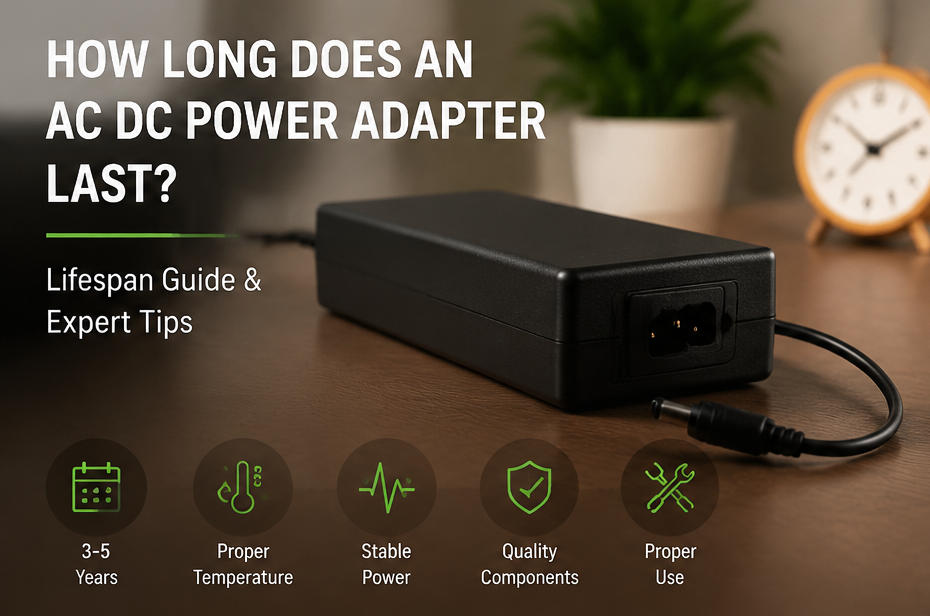
Under normal operating conditions, a well-designed AC DC power adapter may remain functional for approximately three to five years. High-quality models used within their rated electrical and environmental limits can often operate for five years or longer. However, an adapter exposed to excessive heat, unstable input voltage, continuous overload, poor ventilation, moisture, or frequent cable stress may fail much earlier.
The actual lifespan depends on more than the number of years since production. Component quality, operating temperature, load conditions, product design, manufacturing control, and user behavior all influence how quickly an adapter ages.
This guide explains the expected lifespan of an AC DC power adapter, the factors that shorten it, the warning signs of failure, and the practical steps manufacturers and end users can take to improve reliability.
What Is the Average Lifespan of an AC DC Power Adapter?
There is no universal expiration date for every power adapter. Two adapters with the same voltage and wattage may have very different service lives because of differences in component selection, thermal design, protection circuits, manufacturing quality, and actual operating conditions.
As a general reference:
- A low-cost adapter operating under demanding conditions may last one to three years.
- A properly designed consumer-grade adapter may last three to five years.
- A high-quality adapter working below its maximum rated load may remain operational for five years or longer.
- An adapter used continuously in a hot or poorly ventilated environment may have a considerably shorter lifespan.
These ranges should not be treated as guaranteed service periods. Power adapter life is strongly affected by temperature and electrical stress. An adapter that powers a device for eight hours per day in a cool office experiences different aging conditions from one operating continuously inside an enclosed cabinet.
The application also matters. A power adapter for a household router may face relatively stable conditions, while one used for industrial equipment, outdoor surveillance, LED signage, or telecommunications hardware may experience greater temperature variation, input disturbances, dust, and continuous loading.
Companies choosing a power solution for a new device should therefore evaluate the complete application rather than selecting an adapter based only on output voltage and current. The Szjialu guide on how to choose the right AC DC power adapter explains the major electrical, mechanical, and regional requirements involved in adapter selection.
Why Do AC DC Power Adapters Wear Out?
A power adapter does not contain conventional moving parts, but its internal electronic components still age. Every time the adapter operates, its components are exposed to electrical current and heat.
An AC DC adapter normally includes switching components, transformers, rectifiers, control integrated circuits, capacitors, resistors, protection devices, printed circuit boards, insulation materials, cables, and connectors. Each component has operating limits and an expected service life.
Over time, thermal cycles and electrical stress can change component characteristics. Solder joints may weaken, cable insulation may become less flexible, connectors may loosen, and internal capacitors may gradually lose performance.
The adapter may continue to function during this aging process, but its output stability, efficiency, ripple performance, and ability to operate under full load can deteriorate before complete failure occurs.
1. Operating Temperature
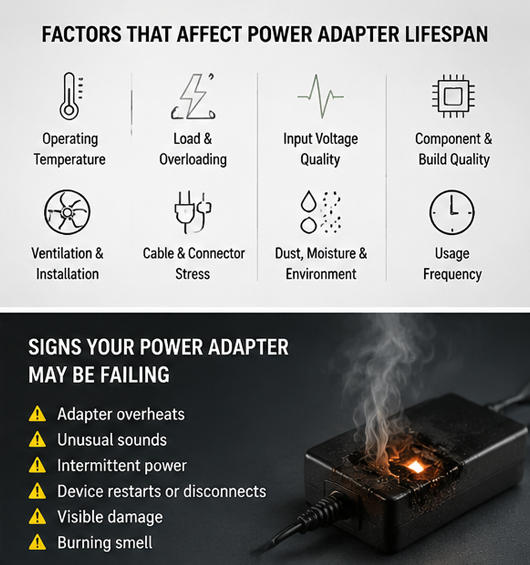
Heat is one of the most important factors affecting power adapter lifespan.
Every adapter produces some heat because power conversion is never completely lossless. A portion of the input energy is converted into heat inside the enclosure. The amount of heat depends on efficiency, output load, circuit design, component selection, enclosure structure, and ventilation.
When internal temperatures remain high for extended periods, electronic components age more quickly. This is particularly important for electrolytic capacitors, which are commonly used for input filtering and output smoothing.
An adapter may become warm during normal operation, especially when supplying a high load. However, it should not become excessively hot, produce a burning smell, or cause discoloration around the enclosure or cable.
Users should avoid placing adapters under carpets, behind heat-producing equipment, inside tightly sealed cabinets, or against soft materials that restrict heat dissipation. Product manufacturers should also consider the final installation environment during power-supply selection.
A larger enclosure can provide more internal space for component layout and thermal management. For this reason, applications with higher power requirements often use a desktop adapter rather than a compact direct-plug model. The article Wall Power Adapter vs Desktop Adapter provides a detailed comparison of these two common structures.
2. Continuous Load and Overloading
Power adapters are designed to provide a specified maximum output current and wattage. Operating continuously at or beyond that limit creates additional heat and electrical stress.
For example, a 12V 2A adapter has a nominal maximum output power of 24 watts. If the connected device regularly requires close to the full 24 watts, the adapter may operate at a higher internal temperature than a properly selected model with additional power margin.
A short current peak may be acceptable when the adapter and device are designed for it. However, repeated overload conditions can activate protection circuits, cause unstable output, increase temperature, and accelerate component aging.
A practical approach is to choose an adapter that can comfortably support the device’s normal demand and temporary peak current. This is especially important for devices containing motors, hard drives, wireless transmitters, pumps, amplifiers, or other components with variable power requirements.
Buyers sourcing common 12V power supplies can review the 12V Power Adapter Buying Guide for more information about current capacity, connector polarity, power margin, and application requirements.
3. Input Voltage Quality
An AC DC power adapter is connected directly to the local electrical supply, so input power quality can influence its reliability.
Voltage surges, lightning-related disturbances, unstable generators, poor building wiring, and frequent power interruptions can place additional stress on the input stage. Well-designed adapters normally include protection and filtering components, but severe or repeated disturbances can still shorten service life.
The risk may be greater in industrial facilities, outdoor installations, rural areas with unstable grids, and regions where electrical infrastructure is less consistent.
Using appropriate surge protection can help reduce exposure to transient events. For critical applications, the power adapter should also be selected according to the actual input-voltage range and regional safety requirements.
A universal-input adapter rated for 100–240V AC can support multiple markets, but the plug type, certification, cable, insulation system, and product labeling must still match the destination country.
4. Component and Manufacturing Quality
Two adapters with similar external dimensions and printed specifications may perform very differently.
Component selection affects efficiency, output stability, thermal behavior, safety, and expected service life. Important factors include capacitor ratings, transformer design, switching-device quality, printed circuit board layout, insulation distances, cable construction, connector durability, and enclosure materials.
Manufacturing consistency is equally important. Even a good circuit design can produce unreliable results if soldering, assembly, insulation, testing, or quality control is inconsistent.
Professional adapter manufacturing normally involves incoming-material inspection, production-line control, electrical testing, aging tests, safety verification, and final inspection. These steps help identify defects before products reach customers.
Szjialu develops and manufactures multiple categories of power adapters, including wall-mount, desktop, interchangeable-plug, and USB power solutions for different applications.
5. Ventilation and Installation Position
Even an efficient adapter needs a way to release heat.
An adapter positioned in open air will generally operate under better thermal conditions than the same unit placed inside an enclosed cabinet. Closely grouping several adapters together can also increase the surrounding temperature.
When designing a product or installation, allow reasonable space around the adapter and avoid direct contact with heat-sensitive materials. Do not cover the enclosure or place it beside radiators, heating pipes, high-power amplifiers, or other hot equipment.
For desktop installations, cable placement should also be considered. The adapter should not hang by its DC cable, remain under constant tension, or sit where the cable is repeatedly bent at a sharp angle.
6. Cable and Connector Stress
In many real-world failures, the internal electronics are not the first part to fail. Instead, damage occurs at the AC cable, DC output cable, strain relief, or connector.
Frequent pulling, twisting, tight bending, and improper removal can break internal conductors. The area near the adapter enclosure and the DC plug is especially vulnerable because it experiences repeated mechanical stress.
Users should disconnect an adapter by holding the plug rather than pulling the cable. Cables should not be wrapped tightly around the adapter while it is still hot, crushed under furniture, or routed through sharp metal edges.
For product manufacturers, cable length, wire gauge, strain-relief design, connector quality, and expected bending cycles should be included in the original specification.
7. Dust, Moisture, and Contamination
Standard indoor adapters are not automatically suitable for wet, dusty, or outdoor environments.
Moisture can cause corrosion, insulation problems, leakage current, or short circuits. Conductive dust and industrial contamination can create similar risks. Even when the adapter enclosure appears sealed, the cable connections and output connector may remain vulnerable.
Adapters used for outdoor security cameras, industrial controls, agricultural equipment, or LED installations may require special protection or installation inside an appropriate weather-resistant enclosure.
A standard indoor adapter should not be exposed to rain, condensation, cleaning chemicals, or high humidity unless the product is specifically designed and certified for those conditions.
Signs That an AC DC Power Adapter Is Failing
Power adapters do not always stop working immediately. Some show warning signs before complete failure.
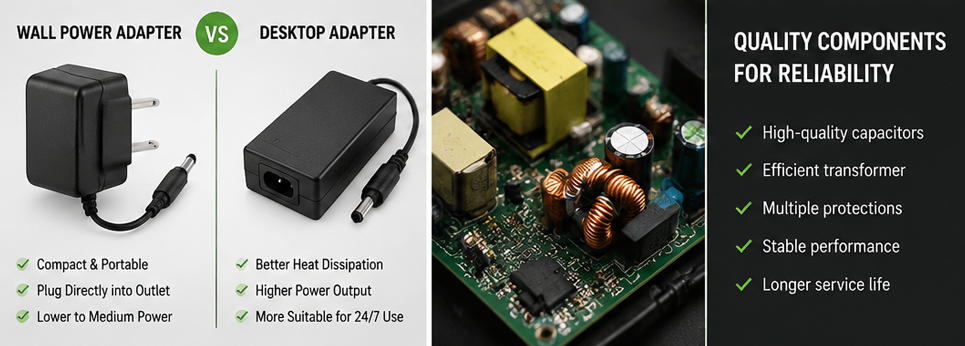
Common symptoms include:
- The connected device restarts or shuts down unexpectedly.
- Output power becomes intermittent when the cable is moved.
- The adapter makes unusual buzzing, clicking, or crackling sounds.
- Charging or device startup becomes slower than normal.
- The adapter becomes much hotter than it did previously.
- The enclosure, plug, or cable shows discoloration.
- The cable insulation is cracked, cut, swollen, or hardened.
- The DC connector feels loose or produces an unstable connection.
- There is a burning smell or visible deformation.
- The device works correctly with another compatible adapter.
Some operating noise can occur in switching power supplies, particularly under light or variable loads, but a new or increasingly loud sound should be investigated.
An adapter with a damaged enclosure, exposed wire, burning smell, melted area, or unstable output should be disconnected and replaced rather than continuously reused. More troubleshooting guidance is available in 일반적인 전원 어댑터 문제 및 해결 방법.
Can You Extend the Life of a Power Adapter?
Although normal component aging cannot be eliminated, good selection and operating practices can improve service life.
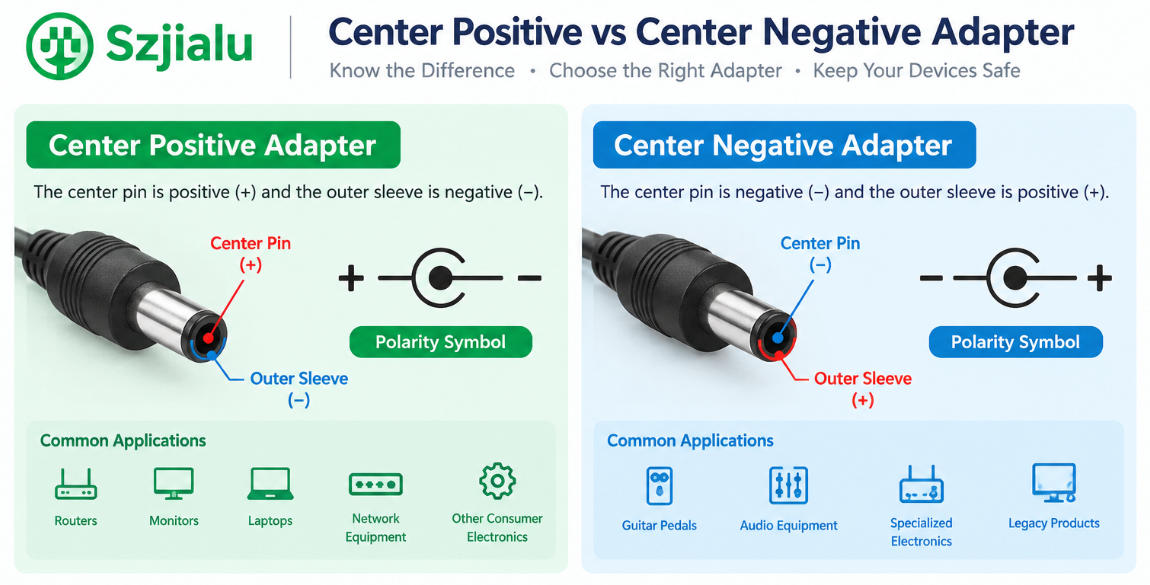
First, use an adapter with the correct output voltage, adequate current capacity, correct polarity, and compatible connector. Never assume that two adapters are interchangeable simply because their plugs fit.
Second, provide sufficient power margin. A device requiring 36 watts should not be paired with an adapter that can only supply 36 watts under ideal conditions without confirming startup and peak-current requirements.
Third, keep the adapter cool and ventilated. Avoid enclosed spaces and heat-producing surfaces.
Fourth, protect the cable and strain relief. Disconnect it by the plug and avoid sharp bends.
Fifth, use the adapter only in its intended environment. Indoor adapters should remain dry and free from heavy contamination.
Finally, source adapters from a manufacturer that can verify electrical specifications, protection functions, materials, testing procedures, and applicable certifications.
Does a Desktop Adapter Last Longer Than a Wall Adapter?
A desktop adapter does not automatically last longer than a wall-mount adapter. Lifespan depends on design quality, operating temperature, electrical loading, and environmental conditions.
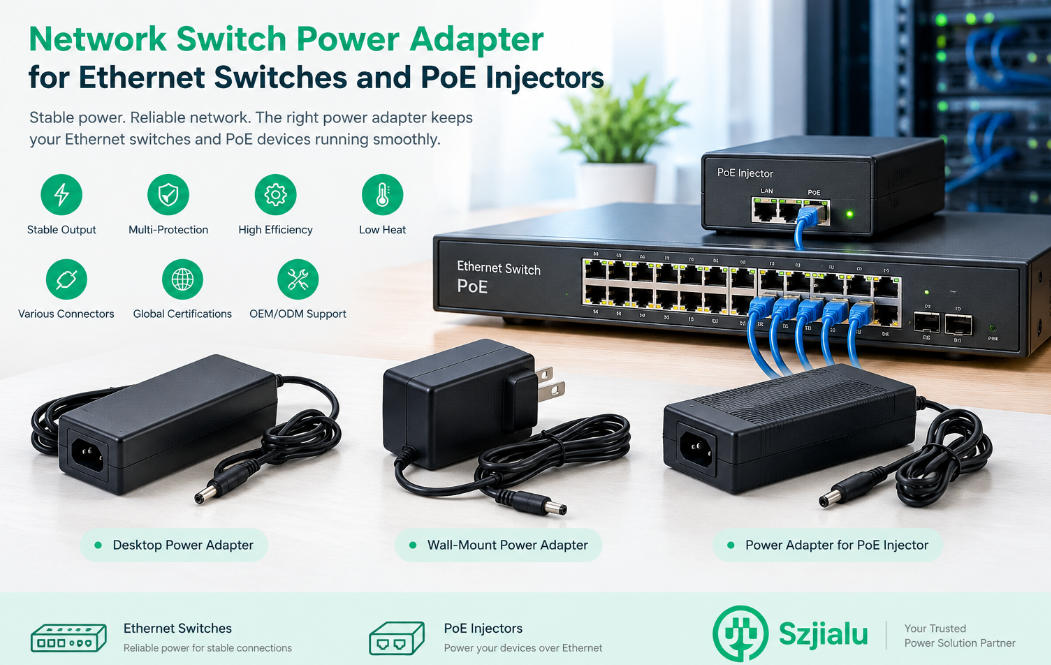
However, desktop adapters often have larger enclosures, which can provide more room for thermal management and higher-power components. They are therefore commonly used for monitors, networking equipment, audio products, medical devices, LED systems, and other medium- or high-power applications.
Szjialu’s desktop power supply category includes several output-power levels and configurations for equipment requiring an external power brick.
Wall-mount adapters can be more suitable for compact, lower-power consumer devices where portability and installation simplicity are priorities. The correct choice should be based on power level, plug arrangement, available space, cable requirements, thermal conditions, and target-market regulations.
When Should You Replace an AC DC Power Adapter?
A power adapter does not necessarily need replacement simply because it has reached a certain age. A properly functioning adapter may continue operating safely beyond the average lifespan when it has been used under favorable conditions.
Replacement should be considered when:
- The enclosure or cable is physically damaged.
- The adapter repeatedly overheats.
- Output becomes unstable.
- The connected device experiences unexplained resets.
- The connector no longer fits securely.
- The adapter has been exposed to water or severe electrical surges.
- Electrical requirements have changed.
- The adapter no longer has sufficient power for an upgraded device.
- The product shows signs of burning, melting, or insulation damage.
When replacing an adapter, match the output voltage exactly unless the device manufacturer specifies otherwise. The replacement must also provide at least the required current, use the correct connector dimensions and polarity, and meet relevant safety and efficiency requirements.
Selecting a Long-Life AC DC Power Adapter
For equipment manufacturers, the best time to improve adapter life is during product development.
The power-supply specification should include:
- AC input range and frequency
- DC output voltage and tolerance
- Continuous and peak output current
- Maximum power
- Connector type and polarity
- Cable length and wire gauge
- Operating and storage temperature
- Efficiency requirements
- Protection functions
- 안전 인증
- Plug type and target markets
- Mechanical dimensions
- Expected operating schedule
- Environmental conditions
OEM projects may also require custom housings, labels, logos, packaging, cable assemblies, connectors, and country-specific plugs.
Szjialu provides OEM and ODM power adapter services for customers requiring customized electrical specifications, enclosure designs, connectors, branding, and market-oriented power solutions.
A detailed application profile allows the manufacturer to evaluate thermal margin, component selection, safety requirements, and production testing more accurately.
자주 묻는 질문
How many hours can an AC DC adapter run continuously?
A properly specified adapter can be designed for continuous operation. However, it must remain within its rated input, output, temperature, and environmental limits. Adequate ventilation and power margin are especially important for 24-hour applications.
Is it normal for a power adapter to feel warm?
Yes. Mild or moderate warmth can be normal because the adapter generates heat during power conversion. Excessive heat, a burning smell, deformation, or a sudden increase in temperature may indicate overload, poor ventilation, internal failure, or incompatibility.
Should I unplug the adapter when it is not being used?
Unplugging an adapter can reduce standby energy consumption and exposure to electrical disturbances. It may also be appropriate when equipment will remain unused for an extended period. However, frequent pulling should be done carefully to avoid damaging the plug or cable.
Can an old adapter damage the connected device?
A failing adapter may produce unstable voltage, excessive ripple, intermittent output, or unexpected shutdowns. Protection circuits may reduce the risk, but a visibly damaged or electrically unstable adapter should not remain in service.
Does using a higher-current adapter damage a device?
A replacement adapter can generally have a higher available current rating when the output voltage, polarity, connector, and other requirements are correct. The device normally draws only the current it needs. However, voltage and polarity must never be selected incorrectly.
결론
The typical lifespan of an AC DC power adapter is approximately three to five years, but the real service life may be shorter or significantly longer depending on design quality and operating conditions.
Heat, continuous high loading, unstable input power, weak components, poor ventilation, moisture, contamination, and cable damage are among the most common causes of early failure. Selecting an adapter with sufficient power margin, suitable protection, appropriate certifications, and a design matched to the application can substantially improve long-term reliability.
For manufacturers, importers, wholesalers, and product developers, the adapter should be treated as part of the complete product rather than a generic accessory. A reliable power supply protects the connected equipment, improves the customer experience, reduces warranty risk, and supports product safety.
As a professional power-supply manufacturer, 스지알루 offers wall-mount adapters, desktop power supplies, USB adapters, interchangeable-plug models, PD chargers, GaN chargers, and customized OEM/ODM solutions for global applications.