When selecting a 9V Power Adapter, the most important question is not simply whether the label says “9V.” The real compatibility depends on a combination of electrical, mechanical, and regulatory specifications.
A replacement adapter can have the correct voltage and still fail to work because the current rating is insufficient, the DC plug is the wrong size, the polarity is reversed, or the power supply does not provide stable output under load.
For equipment manufacturers, distributors, and OEM buyers, these details become even more important. A suitable 9V adapter needs to work consistently across the expected operating conditions while also meeting the mechanical, safety, and certification requirements of the finished product.
This guide focuses on the specifications that actually matter when selecting or sourcing a 9V Power Adapter.

1. Start With the Complete Output Specification
A typical specification such as 9V 2A contains two separate pieces of information:
- Output voltage: 9V DC
- Maximum output current: 2A
Together, they indicate a nominal maximum output power of 18W.
| 9V Output | 최대 출력 |
|---|---|
| 9V 0.5A | 4.5W |
| 9V 1A | 9W |
| 9V 1.5A | 13.5W |
| 9V 2A | 18와트 |
| 9V 3A | 27W |
| 9V 4A | 36와트 |
| 9V 5A | 45와트 |
This calculation is useful when comparing different adapter platforms, but wattage alone should never be used to determine compatibility.
For example, a 9V 2A adapter and a 12V 1.5A adapter both provide approximately 18W, but they are not interchangeable because their output voltages are different.
For engineers and purchasing teams, the correct approach is to treat voltage, current, power, and load behavior as separate specifications.
2. How Much Current Should a 9V Adapter Provide?
Current capacity is one of the most common sources of confusion.
Suppose the equipment specifies:
Input: 9V DC, 1A
A 9V 1A adapter meets the stated requirement. A 9V 1.5A or 9V 2A adapter may also be suitable if the equipment is designed to accept the same voltage and connector configuration.
The higher current rating does not normally mean the adapter will force 2A into a device that only needs 1A. The connected equipment draws the current required by its operating conditions.
The opposite situation is more problematic.
사용 9V 0.5A adapter for equipment requiring 9V 1A may result in:
- Voltage drop under load
- Intermittent shutdown
- Excessive adapter heating
- Poor system stability
- Failure during startup or peak load
For this reason, selecting an adapter with adequate current headroom is often preferable, especially for equipment with variable or transient loads.
3. 9V 1A vs 9V 2A vs 9V 3A
These three configurations are particularly common when searching for a replacement or custom power supply.
9V 1A Power Adapter
A 9V 1A adapter provides up to 9W and is suitable for relatively low-power electronics.
Typical applications can include small controllers, compact networking devices, sensors, and other low-power equipment.
9V 2A Power Adapter
A 9V 2A adapter provides up to 18W.
This configuration gives considerably more power capacity while remaining relatively compact, making it useful for products with higher continuous consumption or greater startup requirements.
9V 3A Power Adapter
A 9V 3A adapter provides up to 27W.
For OEM applications, the additional current capacity can provide more design flexibility, particularly when the equipment has motors, communication modules, displays, or other components with short-duration load peaks.
However, a higher current rating should not be used as a substitute for checking the equipment’s actual electrical specification.
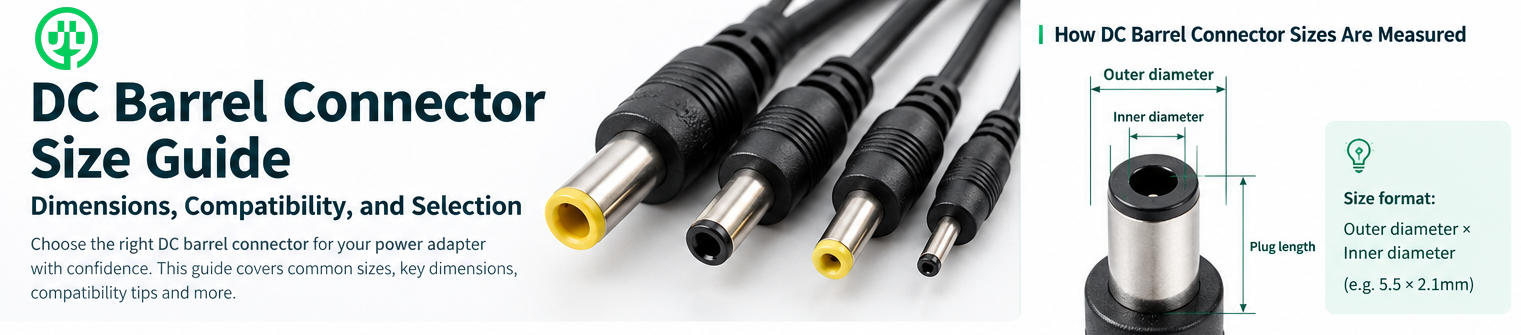
4. DC Plug Size Can Make or Break Compatibility
Voltage and current are only half of the compatibility equation.
The physical DC connector must also match.
Common barrel plug dimensions include:
- 5.5 × 2.1mm
- 5.5 × 2.5mm
- 4.0 × 1.7mm
- 3.5 × 1.35mm
- 4.8 × 1.7mm
The first measurement generally refers to the outer diameter, while the second refers to the inner diameter.
This distinction is particularly important with 5.5mm barrel connectors. A 5.5 × 2.1mm plug and a 5.5 × 2.5mm plug look very similar from the outside, but their inner dimensions are different.
A connector may physically enter the socket while still failing to establish reliable electrical contact.
For production applications, it is therefore better to specify the exact connector drawing, dimensions, and tolerance rather than simply writing “DC barrel plug.”
This is especially important when ordering large quantities because a connector mismatch can affect an entire production batch.
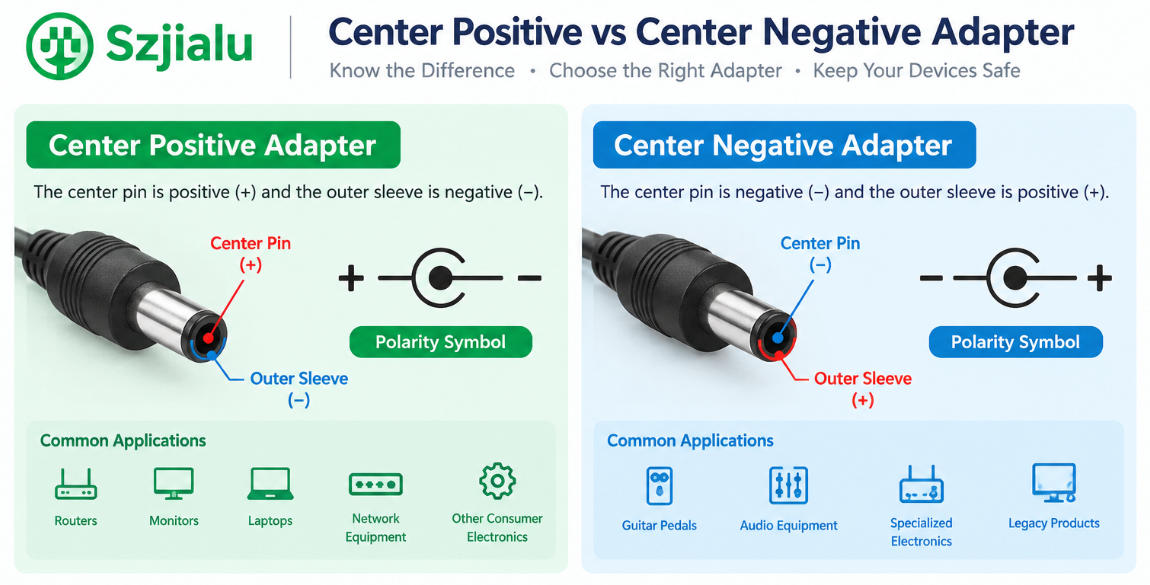
5. Check DC Polarity Before Connecting the Adapter
The next specification is polarity.
A barrel connector commonly uses either:
- Center positive
- Center negative
Center-positive configurations are widely used, but they should never be assumed.
The polarity marking on the original adapter or equipment should be checked before connecting a replacement.
A technically correct 9V output can still be unsuitable if the polarity is reversed.
For OEM projects, polarity should be included directly in the electrical specification alongside:
9V DC / Current / Connector / Polarity
This eliminates ambiguity during sample approval and mass production.

6. Regulated Output Matters More Than the “9V” Label
Not all low-cost adapters behave identically under load.
For sensitive electronic equipment, the important parameters can include:
- Output voltage regulation
- Ripple and noise
- Load regulation
- Line regulation
- 과도 응답
- Startup performance
- No-load behavior
A well-designed regulated 9V Power Adapter should maintain its output within the specified range as the connected load changes.
This becomes particularly relevant for products containing microcontrollers, communication modules, audio circuits, sensors, or other electronics that may be sensitive to unstable supply conditions.
For audio applications, for example, excessive ripple or switching noise can potentially become more noticeable than it would be in a simple resistive load.
Therefore, when comparing suppliers, it is useful to request actual electrical test data rather than evaluating products only by their nominal output voltage.
7. Input Range for Global Products
If the finished product is intended for multiple markets, input voltage should be considered early in the design process.
A universal input configuration such as:
100~240V 교류, 50/60Hz
can simplify international deployment because the same adapter platform can support a wide range of mains systems.
However, universal input does not mean that the product automatically meets every country’s requirements.
The AC plug configuration, insulation design, EMC performance, safety certification, labeling, and documentation may still need to be adapted for the destination market.
This is why international OEM projects should evaluate the electrical specification and regulatory requirements together rather than treating certification as a final production step.
8. Protection Functions to Look For
A reliable 9V adapter should incorporate appropriate protection mechanisms based on its design and intended application.
Common protection functions include:
Short-Circuit Protection
The adapter should respond safely if the DC output is accidentally shorted.
Over-Current Protection
This limits output current when the connected equipment attempts to draw more than the designed capacity.
Over-Voltage Protection
This helps prevent abnormal output conditions from reaching the connected equipment.
Over-Temperature Protection
Thermal protection can reduce the risk of damage when the adapter operates under excessive load or in unfavorable environmental conditions.
Surge Protection
Input-side protection can help the adapter withstand transient electrical disturbances from the AC supply.
The exact protection architecture varies by product design. For commercial and industrial applications, buyers should request the supplier’s protection specifications and test requirements rather than assuming that every adapter provides the same level of protection.
For a broader discussion of electrical protection and certification considerations, readers can also explore Szjialu’s 전원 어댑터 안전 resources.
9. Efficiency and Thermal Performance
Efficiency becomes increasingly important as output power increases.
A 9V adapter operating at 90% efficiency and another operating at 80% efficiency may both deliver the same output power, but the less efficient design converts more input energy into heat.
For example, when an adapter continuously supplies power, even a relatively small efficiency difference can influence:
- Internal temperature
- Component lifetime
- Enclosure temperature
- 에너지 소비량
- 장기적인 신뢰성
For compact wall-mounted adapters, thermal management can be especially important because there is limited physical space for heat dissipation.
For desktop models, the larger enclosure can provide greater flexibility for thermal design and component arrangement.
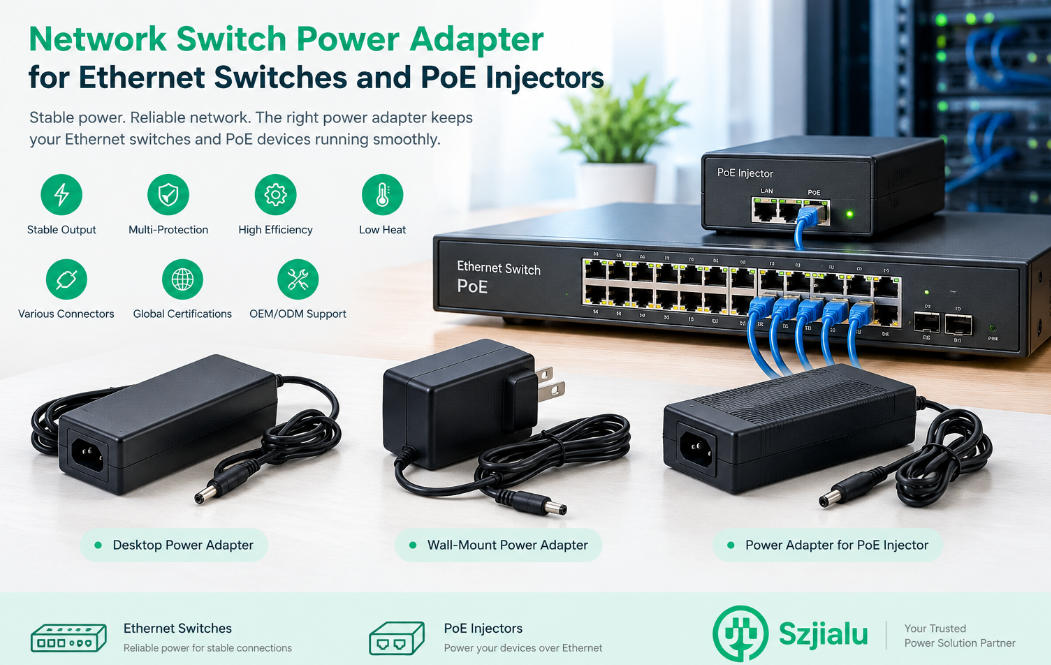
10. Wall-Mount vs Desktop 9V Power Adapter
The physical format should be selected according to the final product architecture.
Wall-Mount Design
A wall-mount adapter integrates the AC plug into the adapter housing.
Advantages include:
- Compact installation
- Fewer external cables
- Simple consumer setup
- Convenient deployment
This format is often suitable for lower-power electronics and applications where the adapter is directly connected to a wall outlet.
Desktop Design
A desktop adapter uses a separate AC input cable and DC output cable.
This design can provide greater flexibility for:
- Fixed equipment
- Industrial devices
- 네트워킹 장비
- Larger electronic systems
- Higher-power applications
For OEM buyers, enclosure size, cable routing, connector position, and strain relief should be evaluated together with the electrical specification.
Szjialu’s Power Adapter product category includes different adapter configurations, making it useful as a starting point when comparing form factors and application requirements.
11. When Should You Choose a Custom 9V Power Adapter?
A standard adapter is usually sufficient when the electrical and mechanical requirements match an existing model.
A custom design becomes more attractive when the application requires a specific combination of specifications.
예를 들어:
9V / 2A + 5.5 × 2.1mm + center positive + 1.5m cable + US plug
can be developed as a defined product specification rather than assembled from generic components.
OEM/ODM customization may include:
- 출력 전압 및 전류
- DC connector
- 케이블 길이
- Cable gauge
- AC plug
- 주택 설계
- Label
- Logo
- 색상
- 포장
- Certification configuration
For B2B buyers, customization can also help ensure that the power adapter is electrically and mechanically matched to the finished product.
Szjialu provides OEM/ODM power supply development and manufacturing services, which can be relevant for companies requiring a specific adapter configuration rather than a generic retail model.
12. What Certifications Should a 9V Adapter Have?
Certification requirements depend on the target market, product category, and applicable regulations.
Depending on the destination market, buyers may encounter requirements involving:
- UL
- ETL
- CE
- CB
- FCC
- 영국CA
- PSE
- KC
- 남에이
- RCM
It is important to distinguish between safety certification and EMC compliance.
An adapter can require both electrical safety evaluation and electromagnetic compatibility testing.
For international products, certification should therefore be considered during product development rather than after the adapter has already been finalized.
A qualified supplier should also be able to provide relevant test reports, certificates, technical documentation, and production information for the selected model.
13. What OEM Buyers Should Ask a 9V Power Adapter Manufacturer
Before placing a bulk order, purchasing teams should request more than a quotation.
A useful supplier evaluation checklist includes:
Electrical
- 출력 전압 허용 오차
- Rated current
- Rated power
- Ripple and noise
- 능률
- No-load consumption
- Protection functions
Mechanical
- DC plug dimensions
- 케이블 길이
- Cable specification
- Housing dimensions
- AC plug type
규정 준수
- Target-market certifications
- EMC requirements
- 안전 보고서
- Applicable standards
Manufacturing
- 최소 주문 수량
- Sample lead time
- Mass-production lead time
- Aging testing
- Automated testing
- Quality-control procedures
Customization
- Logo
- Label
- 포장
- Connector
- Cable
- Housing
- Electrical specifications
This approach helps buyers compare suppliers based on the complete product rather than the lowest unit price.
14. Common Mistakes When Buying a 9V Power Adapter
Several seemingly minor mistakes can create major compatibility problems.
Choosing the correct voltage but ignoring polarity.
9V alone does not guarantee compatibility.
Matching the current rating too closely.
An adapter with insufficient current capacity may become unstable under peak load.
Assuming similar DC plugs are interchangeable.
5.5 × 2.1mm and 5.5 × 2.5mm should not be treated as identical connectors.
Comparing adapters only by wattage.
Two adapters with the same wattage can have different voltage and current combinations.
Ignoring cable specifications.
Cable length, conductor size, voltage drop, flexibility, and connector quality can affect the final system.
Checking certification too late.
Changing the adapter after product certification can create additional engineering and testing costs.
15. Choosing the Right 9V Power Adapter for Your Application
For a straightforward replacement, the selection process can be reduced to a practical checklist:
- Confirm 9V DC output.
- Confirm the required current rating.
- Calculate the required power capacity.
- Verify DC plug dimensions.
- Confirm polarity.
- Check output regulation and ripple requirements.
- Confirm the AC input range.
- Review protection functions.
- Identify required certifications.
- For commercial products, evaluate OEM/ODM and production capabilities.
The goal is not to find the cheapest adapter carrying a 9V label. The goal is to find a power supply whose electrical output, mechanical interface, safety characteristics, and manufacturing quality are appropriate for the application.
결론
Selecting a 9V Power Adapter requires more than matching a single number on a product label.
Voltage and current determine the basic electrical capacity, but connector dimensions and polarity determine whether the adapter can physically and electrically connect to the equipment. Regulation, ripple, efficiency, thermal performance, and protection functions determine how reliably it performs in real-world operation.
For B2B buyers, certification, documentation, production consistency, customization capability, and supplier quality control are equally important.
For companies developing a new product, these requirements should be defined before mass production begins. A clear specification covering output voltage, current, power, connector, polarity, cable, input range, protection, certification, and mechanical configuration gives both the buyer and manufacturer a much stronger foundation for sample approval and production.
Szjialu supports a range of AC/DC power adapter and customized power supply requirements, making it possible for OEM and ODM customers to develop an adapter around the actual requirements of their finished product rather than adapting the product around an off-the-shelf power supply.