Retail advertising displays are no longer limited to static posters and simple illuminated signs. Modern stores increasingly use digital signage, commercial monitors, LED displays, interactive screens, promotional kiosks, and smart advertising terminals to attract customer attention.
Behind every reliable display system is a properly designed power architecture.
For manufacturers, system integrators, and retail technology providers, selecting a retail display power supply is not simply a matter of matching voltage and wattage. The power supply must work reliably for long operating hours, tolerate variable loads, fit within the physical installation, manage heat effectively, and meet the electrical and regulatory requirements of the target market.
This guide explains the key considerations when designing or sourcing a power supply for retail advertising displays, from electrical specifications to thermal management and OEM production.
1. Start With the Display’s Actual Power Requirements
The first step in designing a retail display power system is understanding the electrical characteristics of the complete device.
A display may contain more than the screen itself. Depending on the product architecture, the power system may also support:
- LCD or LED display panels
- LED backlighting
- Media players
- Touch interfaces
- Wi-Fi or Ethernet modules
- Speakers
- Sensors
- USB peripherals
- Cooling fans
- Lighting elements
- Control boards
These components can produce different load profiles.
For example, a digital advertising screen may consume relatively stable power during normal operation but experience a higher load during startup. A display with integrated speakers, wireless communication, and a media player can also have greater peak consumption than the panel specification alone suggests.
For this reason, the retail display power supply should be specified based on the complete system rather than the display panel alone.
A basic calculation is:
電力(W)=電圧(V)×電流(A)
If a display requires 24V at 4A, for example, its nominal electrical requirement is 96W.
However, the nominal figure should not automatically become the adapter’s maximum operating point. Designers should consider startup behavior, environmental temperature, component tolerances, and future configuration changes before selecting the final rated output.
2. Choose the Right Output Voltage
Output voltage must match the requirements of the display electronics.
Common DC architectures for commercial display equipment may use 5V, 9V, 12V, 24V, or other voltage levels depending on the internal design.
A display designed for 24V DC should normally be supplied by a properly regulated 24V power source rather than an arbitrary higher-voltage adapter.
Voltage stability is especially important for digital displays because fluctuations can affect multiple subsystems at the same time. Depending on the design, unstable power can cause:
- Screen flickering
- Unexpected restarts
- Backlight instability
- Media player crashes
- Communication interruptions
- Touchscreen malfunctions
- Reduced component life
For OEM projects, the output voltage tolerance should therefore be defined during the engineering stage instead of relying only on the nominal voltage printed on a standard adapter.
3. Allow Reasonable Power Headroom
One of the most common mistakes in power supply selection is choosing an adapter whose rated capacity is almost identical to the display’s measured consumption.
A commercial advertising display may operate for many hours every day, sometimes continuously. Running a power supply close to its maximum output for extended periods can increase thermal stress and reduce the available margin for load variation.
Suppose a display consumes approximately 80W during normal operation and can reach 90W during peak conditions. A 90W adapter would leave almost no design margin.
A higher-capacity power supply may provide a more appropriate operating range, provided that its voltage, connector, mechanical dimensions, thermal characteristics, and protection design are compatible with the equipment.
The goal is not to install the largest possible power supply.
Instead, designers should establish a practical balance between:
Actual load + peak demand + environmental conditions + engineering margin
This approach can improve reliability without unnecessarily increasing the cost or physical size of the power system.
4. Consider Continuous-Duty Operation
Retail displays often have very different operating patterns from consumer electronics.
A home device may operate for several hours per day. A retail advertising display could operate throughout business hours, and some installations may run nearly continuously.
That makes long-term reliability a major design consideration.
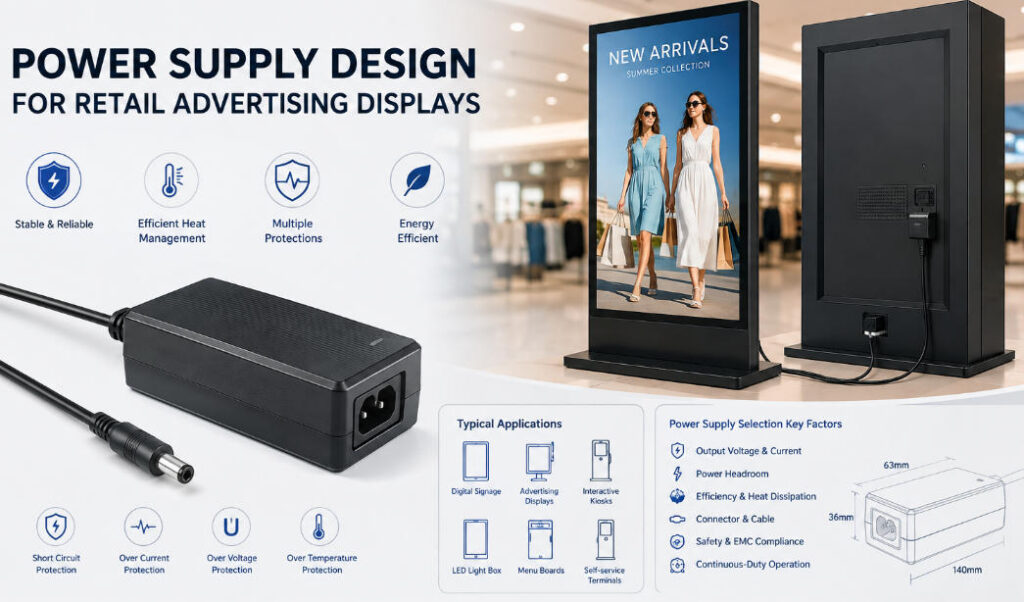
A suitable retail display power supply should be evaluated for:
- Long-duration operation
- Thermal stability
- Output regulation
- Component quality
- Protection functions
- Aging performance
- Load stability
- 環境温度
Protection functions such as short-circuit protection, over-current protection, over-voltage protection, and over-temperature protection can help prevent a temporary electrical problem from becoming a larger system failure.
For commercial projects, reliability should be considered at the system level rather than judged only by the adapter’s initial laboratory performance.
5. Thermal Design Matters More Than Many Buyers Expect
Heat is one of the most important factors affecting power supply reliability.
A retail display may already generate considerable heat through its panel, backlight, processor, and internal electronics. Adding a power adapter to a poorly ventilated enclosure can further increase the internal temperature.
When selecting the power supply, engineers should evaluate:
- Adapter efficiency
- Heat generation
- Installation position
- Airflow
- Enclosure dimensions
- Ambient temperature
- Continuous load
- Distance from heat-sensitive components
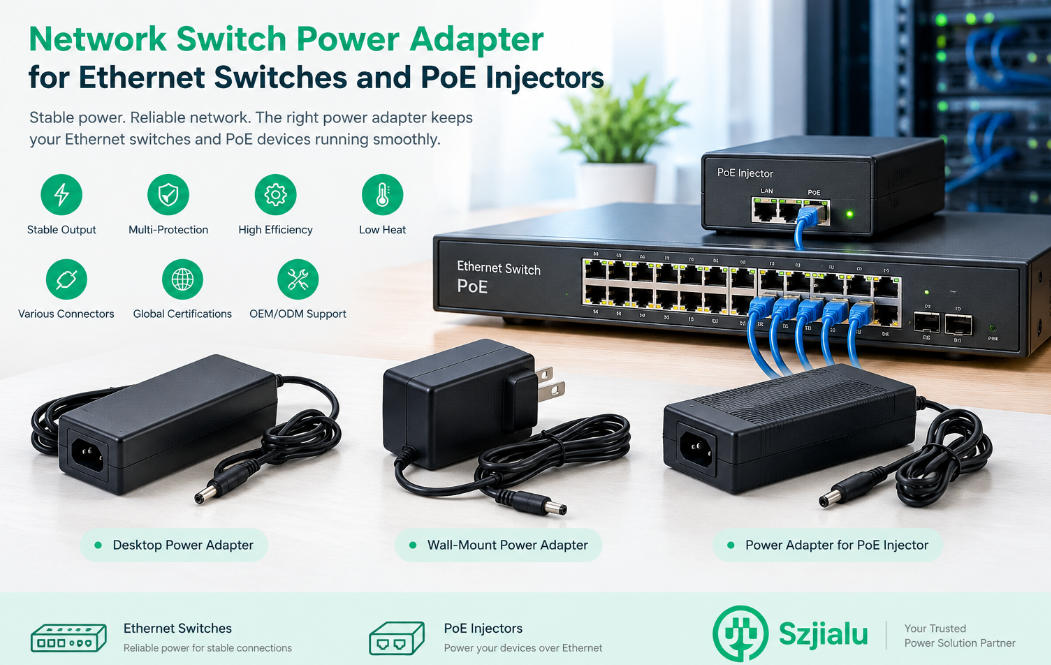
A desktop-style power adapter can sometimes be advantageous because it keeps the AC/DC conversion hardware outside the display enclosure.
This is one reason desktop power supplies are useful for commercial equipment where internal space and thermal management are important design constraints.
Szjialu’s current desktop power supply range includes models from 100W through higher-power configurations, providing different options for equipment manufacturers and system integrators.
6. Select the Correct Connector and Cable
Electrical compatibility alone is not enough.
The DC connector must physically and electrically match the display.
The design specification should clearly identify:
- コネクタタイプ
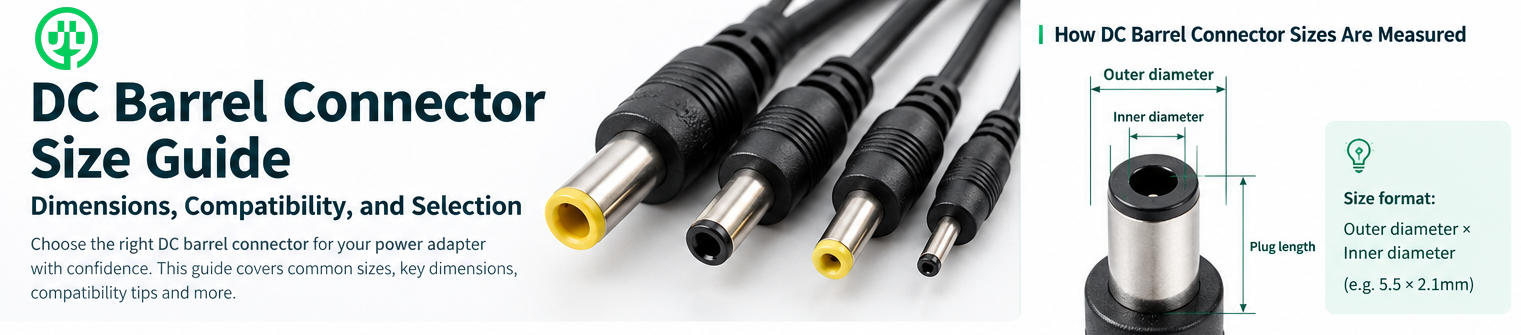
- Outer diameter
- Inner diameter
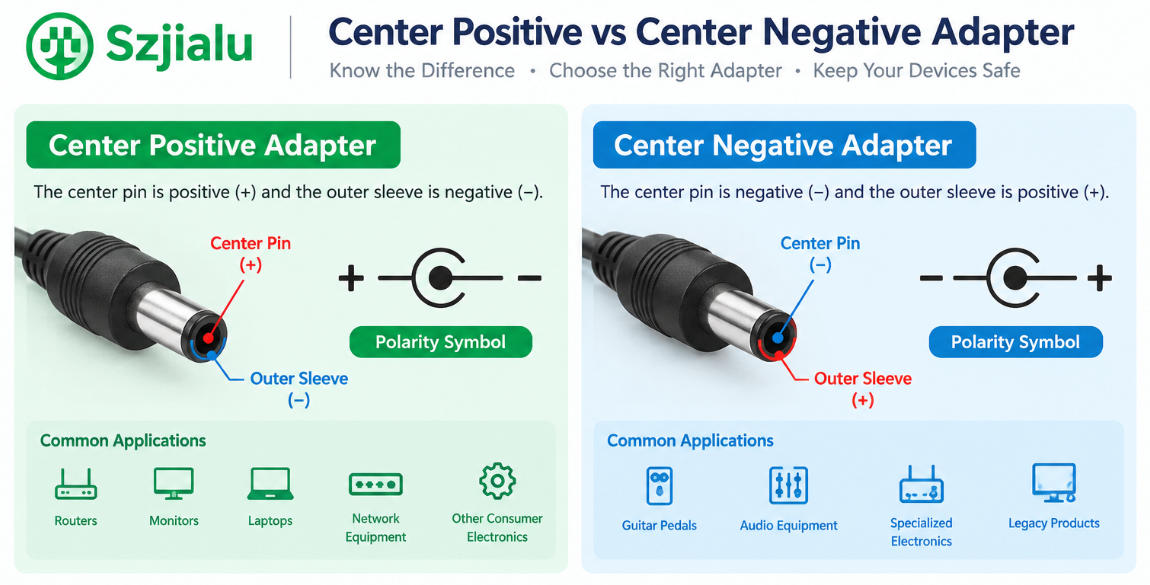
- Polarity
- ケーブルの長さ
- Wire gauge
- Connector orientation
- Locking mechanism, if required
For example, two DC barrel plugs may look almost identical while having different inner diameters. A connector that appears to fit may still produce unreliable electrical contact.
For displays installed in retail environments, cable routing should also be considered.
A cable that is too short can complicate installation. An unnecessarily long cable can create routing problems and additional voltage drop.
For OEM production, connector and cable specifications should be frozen during the sample approval stage so that the production version matches the validated prototype.
7. Wall-Mount vs. Desktop Power Supply
The physical format of the power supply can significantly influence the final display design.
Wall-Mount Power Supply
A wall-mount adapter integrates the AC plug directly into the adapter housing.
It can be a practical solution for smaller displays, compact advertising devices, controllers, and low- to medium-power equipment where installation simplicity is important.
However, the adapter’s physical size and plug orientation should be checked carefully when the equipment is installed close to walls, power strips, or other devices.
デスクトップ用電源
A desktop power adapter uses a separate AC input cable and DC output cable.
This configuration provides greater flexibility for larger commercial displays and equipment where the power supply can be positioned outside the main enclosure.
It can also simplify thermal management because the heat-producing AC/DC conversion stage does not necessarily need to occupy valuable space inside the display housing.
For higher-power advertising systems, desktop configurations can therefore provide a useful balance between electrical capacity, mechanical flexibility, and serviceability.
8. Efficiency Should Be Considered at the System Level
Power supply efficiency affects more than electricity consumption.
Lower efficiency means more input energy is converted into heat.
For a single display, the difference may appear small. For a retail chain operating hundreds or thousands of displays, however, the accumulated energy consumption and thermal load can become significant.
For example, if a display system operates for 12 hours per day, every additional watt of unnecessary power loss accumulates over thousands of operating hours.
Therefore, manufacturers should consider efficiency together with:
- Rated output power
- Typical operating load
- Peak load
- Ambient temperature
- Expected operating hours
- Product lifetime
A power supply that performs efficiently at the actual operating point may provide a better overall solution than simply selecting a model with a high headline efficiency figure at a different load condition.
9. EMC and Safety Compliance
Retail advertising displays are commercial electronic equipment and may be deployed in multiple countries.
The power supply therefore needs to be considered as part of the product’s overall compliance strategy.
Depending on the target market and product architecture, manufacturers may need to evaluate requirements relating to:
- Electrical safety
- Electromagnetic compatibility
- Energy efficiency
- Insulation
- サージ保護
- Leakage current
- Temperature rise
The required certifications vary according to the destination market, product category, and final system configuration.
For global OEM projects, certification requirements should be defined before mass production. Changing the power supply after compliance testing can create additional engineering work, testing costs, and schedule delays.
Szjialu’s power supply portfolio includes products with certifications such as UL, FCC, CE, UKCA, KC, SAA, PSE, and CCC across applicable product series.
10. Design for Installation and Maintenance
Retail displays are often installed in locations where maintenance access is limited.
A reliable power supply should therefore be evaluated not only for electrical performance but also for installation and serviceability.
Designers should consider:
- Adapter location
- Cable accessibility
- Connector durability
- AC plug configuration
- Strain relief
- Ventilation
- Replacement procedure
- Label visibility
If the display is installed behind shelving, inside a kiosk, or in a ceiling-mounted structure, replacing an inaccessible power adapter can become a significant maintenance expense.
For large retail deployments, standardizing the power supply across multiple display models can also simplify spare-parts management.
11. When a Custom Retail Display Power Supply Makes Sense
Off-the-shelf adapters can be suitable for standardized equipment, but commercial display manufacturers often have requirements that do not fit perfectly into a standard product.
Customization may involve:
- Output voltage
- Output current
- Power rating
- DC connector
- ケーブルの長さ
- Cable specification
- AC plug
- Housing dimensions
- ラベルデザイン
- Logo
- パッケージ
- Protection parameters
For example, a display manufacturer may need a 24V output with a specific connector and a longer DC cable because the adapter is installed outside the display cabinet.
Instead of modifying an existing consumer adapter after production, it is generally more efficient to define these requirements at the engineering stage.
Szjialu provides OEM/ODM power supply development and manufacturing services, with its portfolio covering switch-mode power adapters from 5W to 240W as well as customized power supply projects.
12. How to Specify a Retail Display Power Supply
Before requesting quotations from suppliers, manufacturers should prepare a detailed technical specification.
A useful RFQ should include:
| 仕様 | Example Requirement |
|---|---|
| AC Input | 100~240V AC |
| Output Voltage | 12V / 24V DC |
| Rated Current | Based on system load |
| 定格電力 | Based on continuous and peak demand |
| Connector | Exact type and dimensions |
| Polarity | Center positive or specified alternative |
| Cable | Length and wire gauge |
| AC Plug | US / EU / UK / AU, etc. |
| 保護 | SCP / OCP / OVP / OTP |
| 効率 | According to target market |
| 動作温度 | Based on installation environment |
| 認証 | 市場固有の要件 |
| Housing | Wall-mount or desktop |
| ブランディング | OEM label / logo |
| パッケージ | Retail or bulk packaging |
Providing this information early allows the manufacturer to recommend a suitable platform rather than quoting a generic adapter based on wattage alone.
13. Why Supplier Engineering Capability Matters
For a one-time replacement, price and availability may be the main considerations.
For a retail display manufacturer, the decision is more strategic.
A power supply supplier should ideally be able to support:
- Electrical specification review
- Sample development
- Connector customization
- Cable customization
- Safety certification
- Reliability testing
- Production consistency
- OEM labeling
- パッケージ
- Long-term supply
Szjialu operates as a power adapter and charger manufacturer with OEM/ODM capabilities. Its website currently lists multiple power adapter categories, including wall-mount, desktop, interchangeable-plug, and USB power adapters. The company also reports automated power testing and aging systems for production quality control.
For retail display manufacturers, this type of engineering-oriented supplier can be particularly valuable when the required power solution is application-specific rather than a simple off-the-shelf product.
14. Final Checklist for Retail Display Power Supply Design
Before approving a power supply for mass production, verify:
- Output voltage matches the display requirement.
- Continuous current capacity is sufficient.
- Peak startup demand has been evaluated.
- Reasonable power headroom has been included.
- Thermal performance has been tested.
- Connector dimensions and polarity are correct.
- Cable length and wire gauge are appropriate.
- The physical adapter format fits the installation.
- Required protection functions are included.
- EMC and safety requirements are defined.
- Regional certifications are appropriate.
- Long-duration operation has been tested.
- Samples have been evaluated with the complete display system.
- Production specifications are documented and controlled.
結論
A reliable retail display power supply is an important part of the overall advertising display design. The correct solution must do more than provide the required voltage and wattage. It must remain stable during long operating periods, handle peak loads, manage heat, fit the installation environment, and satisfy the safety and compliance requirements of the target market.
For smaller advertising devices, a compact wall-mount adapter may provide the best balance of cost and convenience. Larger digital signage systems may benefit from a desktop power supply with greater power capacity and more flexible installation.
For OEM manufacturers and retail technology providers, customization can become even more important. Connector type, cable length, output specifications, enclosure design, certification, labeling, and packaging can all be adapted to the final equipment.
By treating the power supply as part of the display system—not as an afterthought—manufacturers can improve reliability, simplify installation, reduce maintenance issues, and build a more consistent product for large-scale retail deployment.
For businesses developing or sourcing commercial display equipment, Szjialu can support the process with standard power adapters as well as customized OEM/ODM power supply solutions.