USB-C charging has transformed the way electronic devices receive power. Instead of carrying different chargers for laptops, smartphones, tablets, monitors, and accessories, consumers and businesses can now rely on one versatile connector that supports high-speed charging, fast data transfer, and even video output.
But despite its widespread adoption, many people still wonder how USB-C charging actually works. Why can the same USB-C charger safely power both wireless earbuds and a high-performance laptop? What happens behind the scenes when you connect a cable? And what role does USB Power Delivery (USB PD) play?
This guide explains the technology behind USB-C 충전, the communication process between chargers and devices, the importance of certified cables, and why USB-C has become the global charging standard.
Whether you’re an electronics buyer, OEM brand, engineer, or simply looking for a better understanding of modern charging technology, this article provides a practical explanation based on today’s USB-C ecosystem.
What Is USB-C Charging?
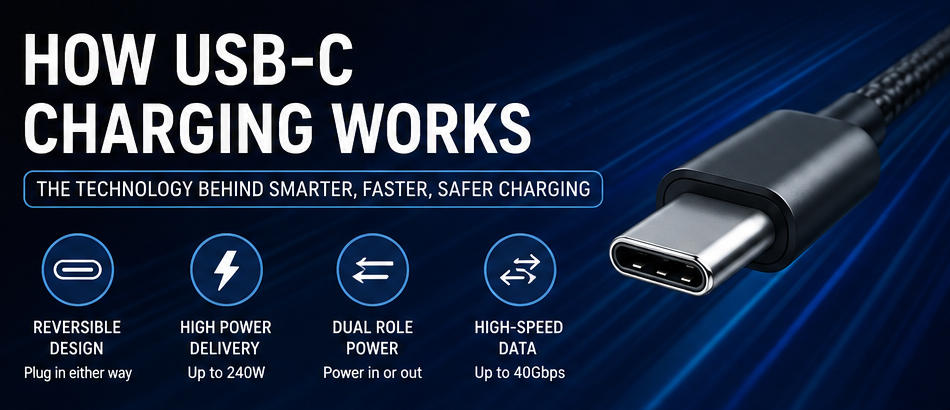
USB-C charging refers to delivering electrical power through the USB Type-C connector, a reversible 24-pin interface developed by the USB Implementers Forum (USB-IF).
Unlike previous USB connectors, USB-C was designed from the ground up to support multiple functions simultaneously, including:
- High-speed charging
- Data transmission
- Audio signals
- Video output
- External display connections
- 도킹 스테이션
- Power delivery in both directions
Its symmetrical connector eliminates orientation issues, making it easier and more reliable to connect devices.
More importantly, USB-C introduced a standardized framework that allows devices from different manufacturers to negotiate charging requirements automatically, greatly improving compatibility across the electronics industry.
For manufacturers producing modern charging solutions, understanding USB-C charging technology is essential for designing products that meet today’s performance and safety expectations.
Why USB-C Became the New Industry Standard
The transition from proprietary charging ports to USB-C didn’t happen overnight. It was driven by increasing consumer demand for universal compatibility and supported by advances in charging technology.
Compared with earlier interfaces like Micro USB or USB-A, USB-C offers several significant improvements:
- Higher power capability
- 더 빠른 충전 속도
- Reversible connector design
- Higher data bandwidth
- Support for video output
- Better long-term scalability
Today, USB-C is widely adopted across:
- 스마트폰
- 태블릿
- 울트라북
- Gaming handhelds
- Wireless headphones
- Cameras
- 휴대용 모니터
- 보조 배터리
- Industrial electronics
Its universal nature also helps reduce electronic waste by allowing multiple devices to share the same charger.
How USB-C Charging Actually Works
At first glance, charging a device through USB-C appears simple—plug in the cable and power begins flowing. In reality, a sophisticated communication process occurs within milliseconds before significant power is delivered.
Unlike older USB standards that supplied a fixed voltage, USB-C 충전 uses an intelligent negotiation mechanism. The charger (power source) and the connected device (power sink) exchange information to determine exactly how much power can be delivered safely.
This dynamic approach improves charging speed, enhances device compatibility, and significantly reduces the risk of overheating or overloading.
The entire charging process generally consists of five stages.
Step 1: Physical Connection Detection
When a USB-C cable is plugged in, the charger first detects that a device has been connected through the Configuration Channel (CC) pins built into the USB-C connector.
These dedicated communication pins allow both ends to identify:
- Whether a valid USB-C cable is connected
- Which device will provide power
- Whether the cable supports higher current
- Whether USB Power Delivery communication is available
Unlike older USB interfaces, USB-C doesn’t immediately output maximum power upon connection.
Step 2: Device Identification
Once the physical connection is established, the connected device communicates its charging capabilities.
Typical information exchanged includes:
- Supported voltage levels
- Maximum charging current
- Maximum acceptable power
- Battery charging status
- USB Power Delivery version
- Optional programmable power support (PPS)
This negotiation happens automatically without any user intervention.
예를 들어:
- A pair of wireless earbuds may request only 5V / 1A.
- A tablet might negotiate 9V / 3A.
- A high-performance laptop could request 20V / 5A (100W).
Even when the same charger is used, each device receives only the amount of power it is designed to handle.
Understanding USB Power Delivery (USB PD)
USB Power Delivery (USB PD) is the intelligent protocol that makes modern USB-C 충전 possible.
Rather than supplying one fixed voltage, USB PD allows compatible chargers and devices to negotiate different voltage and current combinations based on real-time requirements.
Typical USB PD power profiles include:
| Voltage | Maximum Current | 최대 출력 |
|---|---|---|
| 5볼트 | 3A | 15와트 |
| 9V | 3A | 27W |
| 12V | 3A | 36와트 |
| 15V | 3A | 45와트 |
| 20V | 5A | 100와트 |
| 28V | 5A | 140W (USB PD 3.1) |
| 36V | 5A | 180와트 |
| 48V | 5A | 240W |
With USB PD 3.1, USB-C charging has expanded beyond smartphones and laptops to support larger devices such as monitors, docking stations, all-in-one computers, and professional equipment.
This flexibility is one of the primary reasons USB-C has become the preferred charging interface across consumer and commercial electronics.
Intelligent Power Negotiation
One of the biggest advantages of USB-C charging is that power is requested, not forced.
Instead of the charger deciding how much power to output, the receiving device actively requests the voltage and current it needs.
예를 들어:
- A smartwatch connected to a 100W charger will still draw only a few watts.
- A smartphone connected to the same charger may negotiate around 20W–45W, depending on its fast-charging capabilities.
- A laptop can request up to 100W or more if both the charger and cable support it.
This intelligent negotiation ensures:
- Maximum charging efficiency
- Better battery protection
- 열 발생량 감소
- Broad compatibility across devices
- Improved user safety
Because of this design, using a higher-wattage USB-C charger does ~ 아니다 mean the device will be overcharged. The device controls the amount of power it accepts.
The Importance of USB-C Cables
Many users assume that every USB-C cable offers identical performance, but this is far from true.
A USB-C cable plays a critical role in the charging process. Its internal wiring, chip design, and certification determine how much power can safely pass through it.
USB-C cables generally fall into several categories:
- Standard charging cables
- Fast-charging cables
- USB PD-certified cables
- E-marker chip cables
- USB4 and Thunderbolt-compatible cables
For charging above 60와트, most cables require an integrated E-marker chip. This chip communicates the cable’s current capacity to both the charger and the device, ensuring safe high-power operation.
Using an uncertified or low-quality cable may result in:
- Reduced charging speeds
- 간헐적 충전
- Excessive heat buildup
- Device compatibility issues
- Premature cable failure
For applications requiring reliable high-power performance, it is always recommended to pair a quality USB-C charger with a certified cable.
Why USB-C Charging Is More Efficient Than Older USB Standards
The evolution from USB-A and Micro USB to USB-C 충전 is not just about convenience—it represents a significant leap in power efficiency, charging intelligence, and device compatibility.
Traditional USB charging methods delivered a fixed voltage with limited communication between the charger and the device. As battery capacities increased and modern electronics demanded more power, these older standards became inefficient and restrictive.
USB-C addresses these limitations through intelligent power management, higher power capabilities, and advanced communication protocols.
Dynamic Power Delivery
Older USB chargers typically output a constant 5V regardless of the connected device. This meant that smartphones, tablets, and laptops often required different proprietary chargers to achieve optimal charging speeds.
With USB-C charging, supported by USB Power Delivery (USB PD), the charger dynamically adjusts voltage and current based on the device’s real-time requirements.
예를 들어:
- A Bluetooth headset may charge at 5V/1A.
- A tablet might negotiate 9V/3A.
- A gaming laptop can request 20V/5A (100W) or even 28V/5A (140W) under USB PD 3.1.
Because only the required power is delivered, less energy is wasted as heat, resulting in higher charging efficiency and improved battery health over time.
Better Energy Conversion
Modern USB-C chargers—especially those based on GaN(질화갈륨) technology—convert AC power into DC power far more efficiently than traditional silicon chargers.
Higher conversion efficiency provides several benefits:
- 작동 온도 저하
- 대기 전력 소모 감소
- 더 작은 충전기 크기
- 더 높은 전력 밀도
- 부품 수명 연장
For businesses sourcing charging products, GaN-based USB-C chargers also reduce shipping costs and improve user portability due to their compact design.
Internal Link Opportunity:
Anchor text: GaN 충전기 기술
Link to your GaN charger category or related blog post discussing GaN advantages.
범용 호환성
One of the greatest strengths of USB-C charging is interoperability.
Instead of requiring separate chargers for each product, a single USB-C charger can safely power:
- 스마트폰
- 태블릿
- 노트북
- 무선 이어폰
- 휴대용 게임 콘솔
- Cameras
- 보조 배터리
- 휴대용 모니터
- 블루투스 스피커
- USB-C docking stations
This universal compatibility reduces electronic waste and simplifies device management for both consumers and businesses.
For OEM and enterprise buyers, adopting USB-C also lowers accessory costs and improves product compatibility across global markets.
Built-in Safety Features of USB-C Charging
Many consumers worry that a high-wattage charger could damage smaller devices. Fortunately, USB-C charging incorporates multiple layers of protection designed to ensure safe operation.
Intelligent Voltage Negotiation
Unlike conventional chargers, USB-C does not immediately deliver maximum output.
Instead, the charger and device communicate before power transfer begins.
Only after both sides agree on a supported voltage and current does charging commence.
This prevents accidental overvoltage and protects sensitive electronic components.
Overcurrent Protection
Modern USB-C chargers continuously monitor output current.
If abnormal current is detected due to:
- Cable damage
- Device malfunction
- Short circuits
- Internal hardware failure
the charger immediately limits or shuts off power to prevent further damage.
Overvoltage Protection
Voltage spikes are among the leading causes of charger failure.
Quality USB-C chargers include dedicated protection circuits that automatically stabilize output voltage.
This helps protect:
- Laptop motherboards
- Smartphone charging ICs
- Battery management systems
- USB-C controllers
Temperature Monitoring
Fast charging naturally generates heat.
Premium USB-C chargers integrate thermal sensors that monitor internal temperatures in real time.
If temperatures exceed safe operating limits, the charger intelligently reduces output until conditions normalize.
This feature improves:
- 안전
- 신뢰할 수 있음
- 장기 내구성
단락 보호
If a damaged cable or faulty device creates a short circuit, the charger immediately interrupts power delivery.
This minimizes the risk of:
- Component damage
- Fire hazards
- Connector melting
- Battery failure
Foreign Object Detection
Some advanced USB-C charging systems can detect abnormal resistance or unexpected electrical conditions caused by moisture, metal debris, or damaged connectors.
The charger will suspend charging until the issue is resolved, adding another layer of safety.
Common Myths About USB-C Charging
Although USB-C has become mainstream, several misconceptions continue to circulate.
Myth 1: A 100W Charger Will Damage My Phone
False.
The phone determines how much power it requests. A 100W USB-C charger does not force 100W into a smartphone.
If the phone supports only 20W or 30W charging, it will draw only that amount.
Myth 2: Every USB-C Cable Supports Fast Charging
False.
USB-C connectors may look identical, but cables differ significantly in terms of:
- Current capacity
- Data speed
- Internal wiring
- E-marker chip support
- USB PD 호환성
Choosing certified cables is essential for reliable fast charging.
Myth 3: USB-C Always Means Fast Charging
False.
USB-C is merely the connector type.
Fast charging depends on:
- Charger capability
- Device compatibility
- USB PD support
- Cable rating
A USB-C charger without USB Power Delivery may still provide only basic charging speeds.
Myth 4: All USB-C Chargers Are the Same
False.
Important differences include:
- Output power
- Charging protocol support
- Component quality
- 안전 인증
- Energy efficiency
- OEM manufacturing standards
For businesses purchasing in bulk, selecting an experienced manufacturer ensures better quality control and long-term reliability.
Internal Link Opportunity:
Anchor text: USB-C charger manufacturer
Link to your homepage or OEM/ODM service page to strengthen commercial SEO.
How to Choose the Right USB-C Charger
With hundreds of USB-C chargers available on the market, choosing the right one involves more than simply looking at the wattage. Whether you’re purchasing a charger for personal use or sourcing products for your brand, evaluating technical specifications, safety certifications, and manufacturer reliability is essential.
1. Match the Power Output to Your Device
Different devices have different charging requirements.
| 장치 | Recommended Power |
|---|---|
| 무선 이어폰 | 5W~10W |
| 스마트폰 | 20W–45W |
| 태블릿 | 30W~45W |
| 울트라북 | 45W~65W |
| MacBook Pro / Gaming Laptop | 100W–140W |
Choosing a charger with a higher maximum wattage is generally a good investment because the connected device will negotiate and draw only the power it requires. A high-quality 100W USB-C charger, for example, can safely charge both a smartphone and a laptop.
2. Look for USB Power Delivery Support
A USB-C connector alone does not guarantee fast charging.
For the best performance, choose a charger that supports USB 전력 공급(USB PD). USB PD enables intelligent voltage and current negotiation, providing faster charging while maintaining compatibility across a wide range of devices.
If you’re charging modern laptops, tablets, or flagship smartphones, USB PD support is highly recommended.
3. Prioritize Safety Certifications
Reliable USB-C chargers should comply with internationally recognized safety standards. Depending on your target market, look for certifications such as:
- UL
- CE
- FCC
- 영국CA
- PSE
- KC
- 남에이
- RoHS
These certifications indicate that the charger has undergone testing for electrical safety, electromagnetic compatibility, and environmental compliance.
For importers and distributors, certified products can also simplify regulatory approval and reduce business risk.
4. Consider GaN Technology
Gallium Nitride (GaN) technology has become the preferred choice for high-performance USB-C chargers.
Compared with traditional silicon chargers, GaN chargers offer:
- Higher energy efficiency
- 더 작은 사이즈
- 열 발생량 감소
- Better power density
- 장기적인 신뢰성 향상
These advantages make GaN chargers particularly attractive for travel, office use, and multi-device charging scenarios.
5. Choose an Experienced Manufacturer
For OEM, ODM, or wholesale buyers, the quality of the manufacturer is just as important as the product specifications.
A reliable manufacturing partner should provide:
- Strict quality control processes
- Comprehensive safety testing
- Stable production capacity
- 국제 인증
- 엔지니어링 지원
- Product customization services
Working with an experienced manufacturer helps ensure consistent product quality, shorter lead times, and better long-term cooperation.
The Future of USB-C Charging
USB-C charging continues to evolve rapidly as new technologies and higher power standards emerge.
Several key trends are shaping the future of the industry:
USB PD 3.1 Adoption
The latest USB Power Delivery 3.1 specification increases maximum power delivery from 100W to 240W, making USB-C suitable for larger laptops, monitors, industrial equipment, and even compact desktop computers.
Wider Adoption of GaN
As manufacturing costs decrease, GaN technology is becoming more accessible. Future chargers are expected to be:
- 더 작은
- 에너지 효율이 더 높습니다.
- More powerful
- Better at thermal management
Universal Charging Ecosystem
Governments and manufacturers are increasingly promoting USB-C as the universal charging standard. More devices—including smartphones, tablets, laptops, cameras, handheld gaming consoles, and accessories—are transitioning to USB-C, reducing the need for proprietary chargers and helping cut electronic waste.
Smarter Charging
Future USB-C chargers will incorporate even more intelligent features, including:
- Dynamic power allocation for multi-port chargers
- AI-assisted charging optimization
- Enhanced battery health management
- Real-time temperature monitoring
- Improved energy efficiency
These innovations will continue to make USB-C charging safer, faster, and more convenient.
결론
USB-C charging represents a major advancement in power delivery technology. By combining a versatile connector with intelligent communication protocols such as USB Power Delivery, it enables devices to charge faster, more safely, and more efficiently than previous USB standards.
From smartphones and tablets to high-performance laptops and professional equipment, USB-C has become the foundation of a truly universal charging ecosystem. As technologies like USB PD 3.1 and GaN continue to evolve, USB-C charging will deliver even greater efficiency, higher power levels, and broader compatibility.
For businesses developing or sourcing charging products, understanding how USB-C charging works is essential. Choosing certified components, reliable cables, and experienced manufacturing partners helps ensure product quality, user safety, and long-term market competitiveness.
~에 스지알루, we specialize in high-quality USB-C charging solutions for OEM and ODM customers worldwide. Our product portfolio includes USB-C PD chargers, GaN fast chargers, desktop power adapters, and customized charging solutions designed to meet international safety standards and the evolving needs of global brands.