Introduction: Why Choosing the Right CCTV Power Adapter Matters
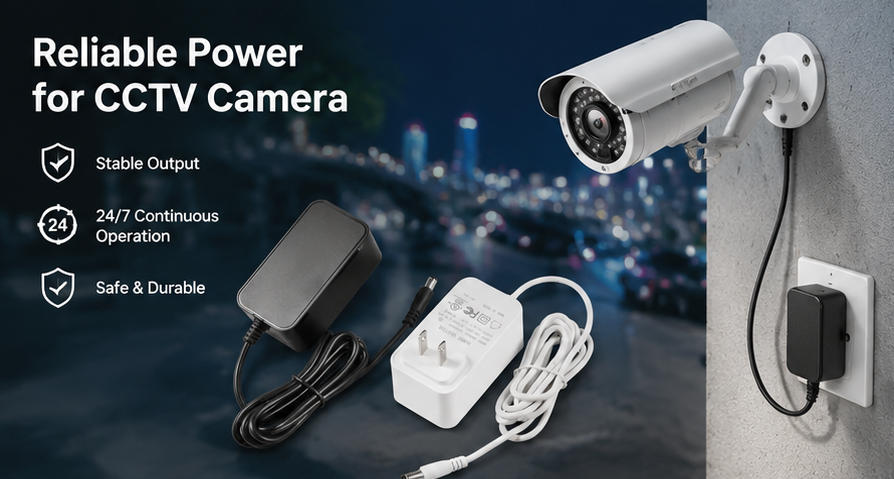
Security cameras are designed to operate continuously, often 24 hours a day, 7 days a week. While the camera lens, sensor, and recording system receive most of the attention, the power supply is one of the most important components determining the stability and reliability of a surveillance system.
A poor-quality power adapter for CCTV camera applications can lead to many problems, including intermittent camera shutdowns, image distortion, unexpected reboots, reduced infrared night vision performance, and even permanent damage to surveillance equipment.
When installing CCTV systems, users usually choose between two main power methods:
- Individual camera-level power adapters — each camera uses its own dedicated AC DC adapter.
- Centralized DVR/NVR power distribution systems — multiple cameras receive power from a centralized power supply near the recorder.
Understanding the differences between these two approaches helps installers, system integrators, and security equipment buyers select the correct power solution.
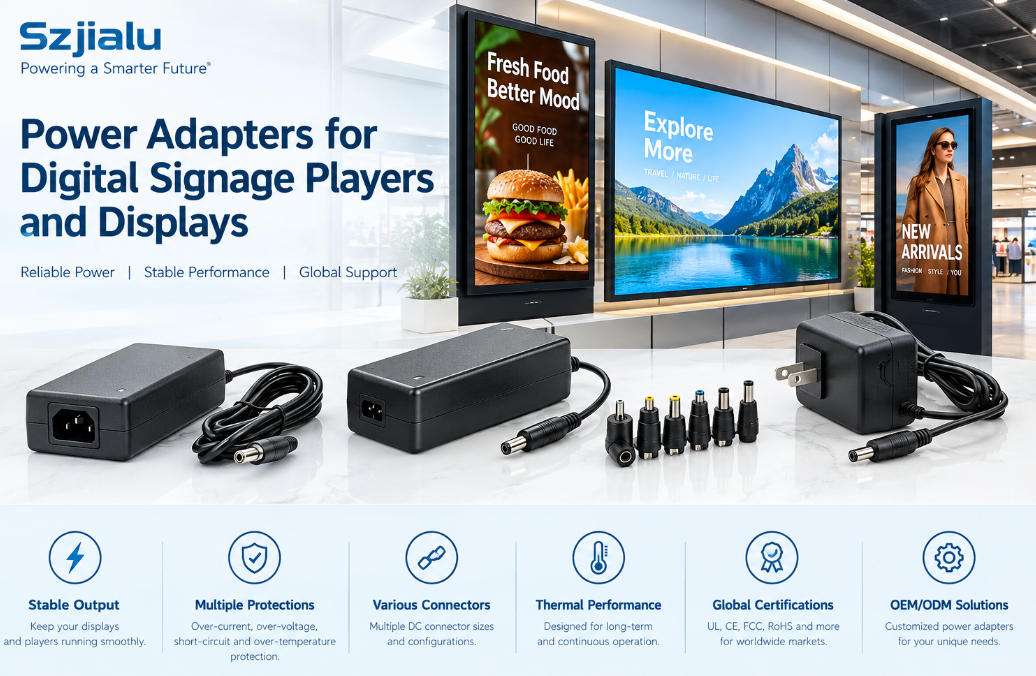
전문 전원 어댑터 제조업체로서, 스지알루 provides reliable AC DC power solutions designed for applications including security systems, industrial devices, LED equipment, and consumer electronics.
Choosing the right power supply is not only about matching voltage. Factors such as current capacity, connector compatibility, cable distance, protection features, and installation environment must also be considered.
Understanding CCTV Camera Power Requirements
Before selecting a power adapter, it is important to understand the basic electrical requirements of CCTV cameras.
Most analog cameras, IP cameras, and security monitoring devices require DC power input, commonly:
- 12V DC
- 24V AC
- 5V DC for some compact cameras
- 48V PoE power for network cameras
Among these options, 12V DC power adapters are the most widely used for traditional CCTV cameras.
A typical security camera may require:
- Voltage: 12V DC
- Current: 0.5A–2A depending on features
- Power consumption: 5W–20W
For cameras with additional functions such as:
- Infrared night vision
- PTZ movement
- Built-in microphone
- Heating systems
- Advanced AI processing
the power requirement may increase significantly.
A correctly selected adapter should provide enough current without operating near its maximum limit. For example, if a camera requires 1A, using a 12V 1.5A or 12V 2A adapter provides additional operating margin and improves long-term reliability.
Szjialu offers various solutions for applications requiring stable DC output, including:
12V power adapter solutions suitable for security equipment and other electronic devices.
Camera-Level Power Adapter: Individual CCTV Camera Supply
What Is a Camera-Level Power Adapter?
A camera-level power adapter means each surveillance camera has its own dedicated AC DC adapter.
The typical setup includes:
AC outlet → Power adapter → DC cable → CCTV camera
This method is commonly used for:
- Small residential CCTV systems
- Small offices
- Retail stores
- DIY security installations
Each camera operates independently, receiving power directly from its own adapter.
Advantages of Individual CCTV Camera Adapters
1. Easy Installation
One of the biggest advantages of individual adapters is simplicity.
Installers do not need to design a complicated centralized power distribution system. Each camera can be installed wherever an available AC outlet exists.
This makes individual adapters ideal for:
- Home security cameras
- Small business surveillance systems
- Temporary monitoring installations
2. Easier Troubleshooting
When a camera stops working, the problem can often be isolated quickly.
예를 들어:
- Camera A has no image
- Check Camera A adapter
- Replace adapter if necessary
Because each camera has an independent power source, one failed adapter usually affects only one camera.
3. Flexible System Expansion
Individual adapters make future upgrades easier.
A user can add another camera without replacing the entire power infrastructure.
This flexibility is especially useful for:
- Growing businesses
- Warehouses
- Expanding residential systems
Disadvantages of Camera-Level Power Adapters
Although convenient, individual adapters also have limitations.
Cable Management Challenges
Multiple adapters mean multiple power cables.
Large installations may experience:
- More cable clutter
- More wall outlets required
- Difficult cable organization
For systems with dozens of cameras, centralized power distribution may become more practical.
Longer Distance Voltage Drop
When cameras are installed far away from electrical outlets, long DC cables can cause voltage loss.
Voltage drop may result in:
- Camera restarting
- Weak infrared illumination
- Reduced image quality
In these situations, installers must consider:
- Higher current adapters
- Shorter DC cable runs
- Larger cable diameter
Centralized DVR/NVR Power Supply System
What Is Centralized CCTV Power?
A centralized power system uses one power supply unit to provide power to multiple cameras.
The structure is usually:
AC input → Central power supply → Multiple DC outputs → CCTV cameras
This approach is common in:
- Commercial buildings
- Shopping centers
- Factories
- Large surveillance projects
The DVR or NVR is usually installed near the centralized power source, creating a cleaner professional installation.
Advantages of Centralized DVR Power Distribution
1. Cleaner Installation
A centralized system reduces the number of individual adapters.
Instead of having:
- 16 cameras
- 16 power adapters
- 16 cables
a system may use:
- One centralized power supply
- Organized distribution cables
This creates a cleaner equipment room and easier maintenance.
2. Easier System Management
Security installers can monitor and maintain power from one location.
혜택은 다음과 같습니다:
- Faster troubleshooting
- Easier replacement
- Better cable organization
For professional surveillance projects, centralized power is often preferred.
3. Better for Large CCTV Systems
When installing dozens or hundreds of cameras, individual adapters become inefficient.
Centralized power systems are better suited for:
- Large office buildings
- Industrial facilities
- Public monitoring systems
Limitations of Centralized CCTV Power
Single Point of Failure
The biggest disadvantage is that one power supply failure can affect multiple cameras.
If the centralized power unit fails:
- Several cameras may stop working
- The security system may temporarily lose coverage
For critical applications, installers may add:
- Backup power supplies
- UPS systems
- Redundant power solutions
More Professional Installation Required
Centralized systems require careful planning.
Installers must calculate:
- Total camera current
- Cable distance
- Voltage drop
- Power distribution capacity
Incorrect calculation may cause unstable operation.
How to Choose Between Individual Adapters and Centralized Power
The correct choice depends on the application.
Small CCTV Systems: Choose Individual Adapters
Individual power adapter for CCTV camera solutions are recommended when:
- Fewer than 8 cameras are installed
- Cameras are spread across different locations
- Installation simplicity is important
- Users want easy replacement
Examples:
- Home security systems
- Small shops
- Small offices
Large CCTV Systems: Choose Centralized Power
Centralized power is better when:
- More than 8-16 cameras are installed
- Cameras are located in the same building
- Professional cable management is required
- Long-term maintenance is important
Examples:
- Warehouses
- Factories
- Commercial buildings
Selecting the Correct Voltage and Current for CCTV Camera Power Adapters
After deciding between individual adapters and centralized power systems, the next step is selecting the correct electrical specifications.
The most common mistake when choosing a power adapter for CCTV camera systems is focusing only on voltage while ignoring current capacity.
Both voltage and current directly affect camera performance.
1. Match the Correct Voltage
CCTV cameras are designed to operate at a specific voltage.
Common examples include:
- 12V DC cameras
- 24V AC cameras
- 5V USB-powered cameras
- 48V PoE network cameras
Using an adapter with incorrect voltage can cause serious problems.
예를 들어:
- A lower voltage adapter may cause unstable operation.
- A higher voltage adapter may damage internal camera components.
Always check the camera manufacturer’s specifications before selecting a replacement adapter.
For most traditional security cameras, a regulated 12V DC power adapter is the preferred choice because it provides stable output voltage under different operating conditions.
Szjialu specializes in regulated AC DC adapters designed to deliver consistent power for electronic devices requiring reliable DC output.
2. Choose Sufficient Current Capacity
Current determines how much electrical power the adapter can provide.
A CCTV camera requiring 800mA should not necessarily use an 800mA adapter because the adapter would operate at its maximum capacity continuously.
A better approach is to select an adapter with additional power margin.
예:
Camera requirement:
- Voltage: 12V DC
- Current: 1A
Recommended adapter:
- 12V 1.5A
- 12V 2A
This extra capacity helps the adapter handle:
- Startup current
- Infrared LED activation
- Temperature changes
- Long operating periods
A properly sized adapter usually operates cooler and lasts longer.
Consider Infrared Night Vision Power Consumption
Many CCTV cameras use infrared LEDs for nighttime monitoring.
During daytime operation, the camera may consume relatively low power. However, when darkness arrives, infrared LEDs automatically activate and increase current demand.
This is one reason why some cameras appear to work normally during the day but experience problems at night.
Common symptoms include:
- Camera restarting after sunset
- Flickering infrared lights
- Dark or unstable images
- Random disconnection
When selecting a power adapter for CCTV camera, always consider the maximum power consumption, not only the average operating condition.
Check Connector Type and Polarity Compatibility
Electrical compatibility is not limited to voltage and current.
The connector must also match the camera input.
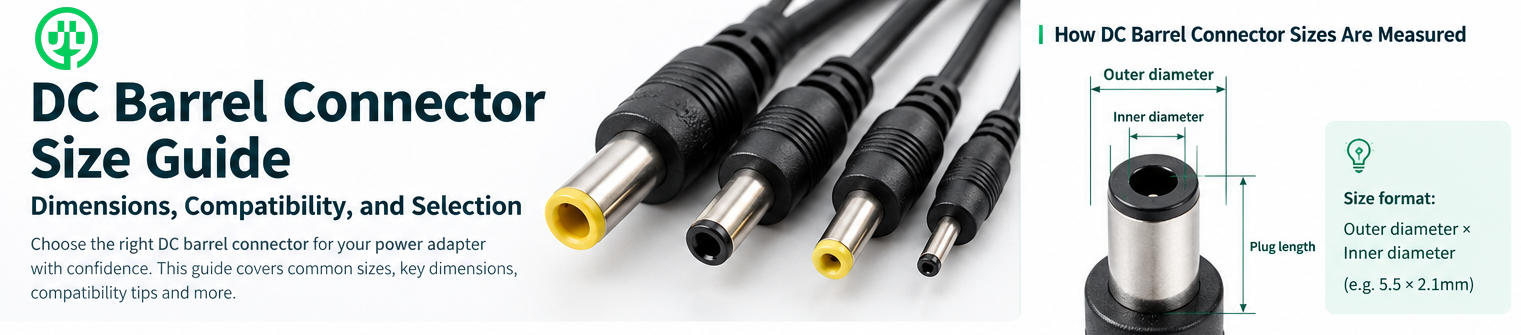
The most common CCTV power connector is:
- 5.5mm × 2.1mm DC barrel plug
However, some cameras may use:
- 5.5mm × 2.5mm connectors
- Custom connectors
- Terminal blocks
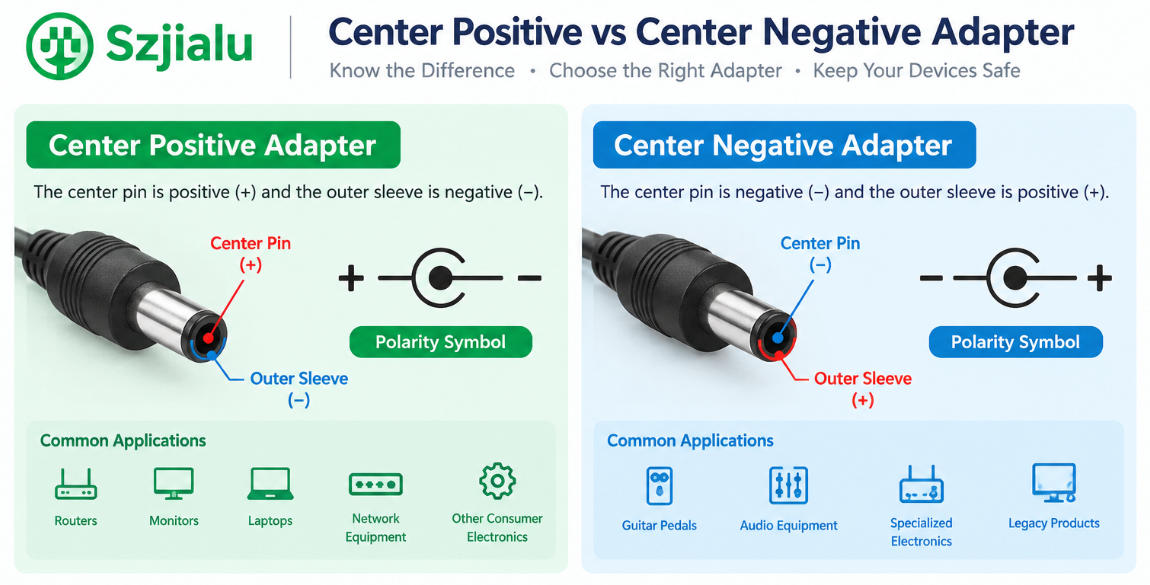
Polarity is another important factor.
Most CCTV cameras use:
- Center positive (+)
- Outer negative (-)
Connecting an adapter with reverse polarity may prevent operation or damage the camera.
Before purchasing a replacement adapter, verify:
- Output voltage
- Output current
- Plug size
- Polarity
- 케이블 길이
Regulated vs Unregulated CCTV Power Adapters
For security systems, regulated adapters are strongly recommended.
Regulated Power Adapter
A regulated adapter maintains stable output voltage despite changes in:
- Input voltage
- Load conditions
- Operating temperature
혜택은 다음과 같습니다:
- Better camera stability
- Reduced image interference
- Longer equipment lifespan
Unregulated Adapter
An unregulated adapter may output higher voltage when the load is low.
This can create risks such as:
- Voltage fluctuation
- Camera malfunction
- Reduced reliability
For surveillance applications where equipment operates continuously, regulated power supplies are the safer choice.
You can learn more about adapter selection principles through Szjialu’s guide:
How to Choose the Right AC DC Power Adapter
Safety Features to Look for in CCTV Power Adapters
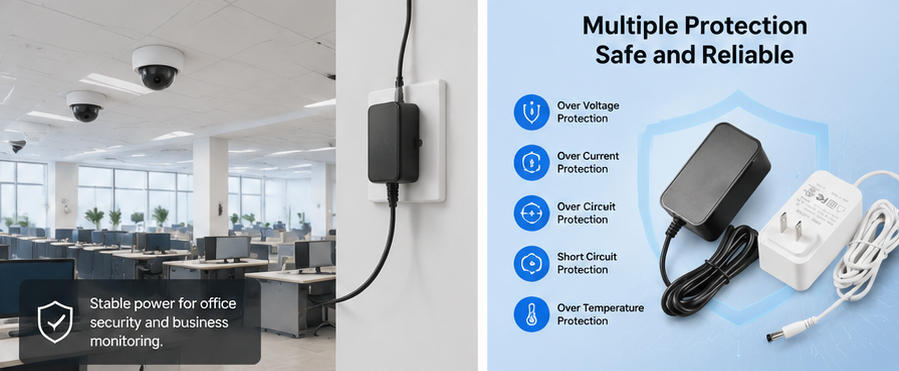
A reliable CCTV power adapter should include multiple protection functions.
Important safety features include:
과전압 보호(OVP)
Protects cameras from excessive output voltage.
과전류 보호(OCP)
Prevents damage caused by excessive current demand.
단락 보호(SCP)
Automatically shuts down when a short circuit occurs.
과열 보호(OTP)
Helps maintain safe operation in high-temperature environments.
These protections are especially important because surveillance systems often operate continuously for years.
A low-quality adapter may appear cheaper initially but can increase maintenance costs due to frequent replacement and equipment failure.
Power Adapter Selection for Different CCTV Applications
Different environments require different power solutions.
Home Security Cameras
Residential systems usually require:
- 12V DC adapters
- 1A–2A output
- Compact wall plug design
Advantages needed:
- Easy installation
- Low maintenance
- Quiet operation
Retail Stores
Retail surveillance systems often require:
- Multiple cameras
- Stable continuous operation
- Organized cable management
Recommended solutions:
- Individual adapters for small systems
- Centralized power for larger installations
Industrial CCTV Systems
Factories and warehouses require higher reliability.
Important considerations:
- Long cable distances
- Dust and temperature changes
- Continuous operation
Professional installations often combine:
- Centralized power supplies
- Backup systems
- Industrial-grade adapters
CCTV Power Adapter vs PoE Power Supply
With the growth of IP cameras, many users also compare traditional adapters with Power over Ethernet (PoE).
Traditional CCTV Adapter
장점:
- Simple installation
- Lower equipment cost
- Suitable for analog cameras
제한 사항:
- Separate power cable required
- More cable management
PoE Power System
장점:
- Power and data through one Ethernet cable
- Cleaner installation
- Better for IP camera networks
제한 사항:
- Higher equipment cost
- Requires PoE-compatible cameras and network equipment
For traditional DC security cameras, a dedicated power adapter for CCTV camera remains one of the most practical solutions.
Why Choose Szjialu for CCTV Power Adapter Solutions?
Szjialu focuses on designing and manufacturing reliable AC DC power adapters for various electronic applications.
With experience in power conversion technology, Szjialu provides solutions featuring:
- Stable regulated output
- Multiple voltage options
- Customized specifications
- Safety protection designs
- OEM/ODM 지원
For CCTV installers, distributors, and equipment manufacturers, selecting a dependable adapter supplier helps ensure long-term system reliability.
Explore Szjialu’s power solutions: AC DC power adapter products
Frequently Asked Questions About CCTV Camera Power Adapters
Can I use any 12V adapter for my CCTV camera?
No. A compatible adapter must match voltage, current, connector type, and polarity. A 12V adapter with incorrect specifications may cause unstable operation or damage.
How many cameras can one CCTV power supply support?
It depends on the total current requirement.
예를 들어:
Eight cameras requiring 1A each need at least:
8A total current capacity
A safety margin should also be added for reliable operation.
Is a higher amp adapter dangerous?
A higher current rating is generally safe as long as the voltage is correct.
예를 들어:
A 12V 2A adapter can replace a 12V 1A adapter.
The camera only draws the current it requires.
Why does my CCTV camera restart at night?
The most common causes include:
- Insufficient adapter current
- Voltage drop
- Poor cable quality
- Weak centralized power supply
Upgrading to a properly rated adapter often solves the issue.
Should CCTV cameras use regulated adapters?
Yes. Regulated adapters provide stable voltage and are recommended for continuous security applications.
Conclusion: Choosing the Right Power Adapter for CCTV Camera Systems
Selecting the correct power adapter for CCTV camera systems requires more than choosing a matching voltage.
Users must consider:
- Camera power requirements
- Individual adapter vs centralized DVR power
- Current capacity
- Cable distance
- Connector compatibility
- 보호 기능
For small installations, individual camera adapters provide simplicity and flexibility. For larger professional surveillance systems, centralized power distribution offers better organization and management.
A reliable AC DC power adapter ensures CCTV cameras operate consistently, improves system uptime, and protects valuable security equipment.
With stable power solutions and professional manufacturing experience, Szjialu helps customers build dependable surveillance and electronic systems.