When selecting a replacement power adapter, the DC plug can be one of the easiest specifications to overlook. A connector may look correct, fit into a socket, and still be electrically or mechanically unsuitable.
This is especially common with 5.5×2.1mm and 5.5×2.5mm DC plugs. Both connectors share the same 5.5mm outer diameter, making them almost indistinguishable at a glance. However, their inner diameters are different, and that small dimensional difference can determine whether the connection is reliable.
For engineers, purchasing teams, equipment manufacturers, and distributors sourcing power adapter DC plugs, understanding this distinction is essential. The wrong connector can result in loose contact, intermittent power, voltage drops, overheating, or equipment failure.
This guide explains exactly how 5.5×2.1mm and 5.5×2.5mm plugs differ, how to measure them, whether they are interchangeable, and what specifications should be confirmed before ordering power adapters in volume.
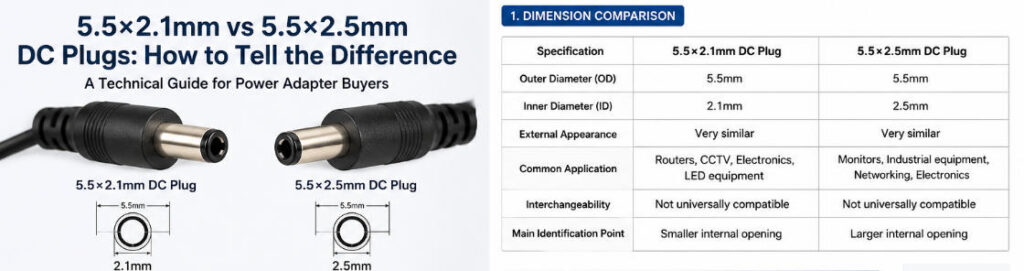
What Does 5.5×2.1mm or 5.5×2.5mm Mean?
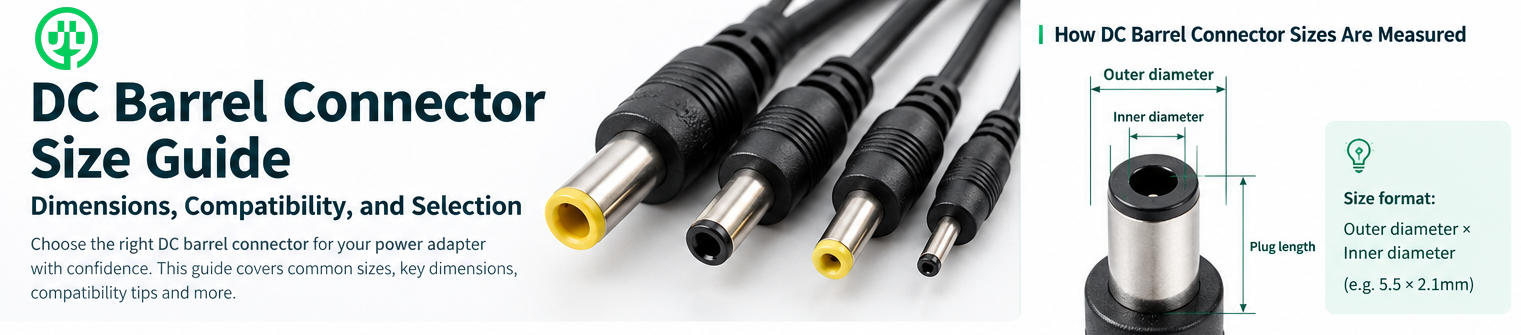
The dimensions of a DC barrel plug are normally written in the format:
Outer Diameter × Inner Diameter
Therefore:
- 5.5×2.1mm = 5.5mm outer diameter + 2.1mm inner diameter
- 5.5×2.5mm = 5.5mm outer diameter + 2.5mm inner diameter
The first number describes the outside diameter of the barrel. The second number describes the diameter of the internal opening that receives the mating socket’s center pin.
This is the key difference between the two connectors.
Because both versions have a 5.5mm outer diameter, their external appearance can be nearly identical. The difference is inside the barrel, where the center contact is located.
For replacement power supplies, this means simply measuring the outside of the plug is not enough.
You need to confirm both dimensions.
5.5×2.1mm vs 5.5×2.5mm: Technical Comparison
| 사양 | 5.5×2.1mm DC Plug | 5.5×2.5mm DC Plug |
|---|---|---|
| Outer diameter | 5.5mm | 5.5mm |
| Inner diameter | 2.1mm | 2.5mm |
| External appearance | Very similar | Very similar |
| Common application | Routers, CCTV, electronics, LED equipment | Monitors, industrial equipment, networking and electronics |
| Interchangeability | Not universally compatible | Not universally compatible |
| Main identification point | Smaller internal opening | Larger internal opening |
| Procurement requirement | Confirm OD + ID | Confirm OD + ID |
The most important point is that 5.5×2.1mm and 5.5×2.5mm are different connector specifications even though the outer diameter is identical.
For a complete explanation of connector selection together with voltage, current, polarity, and other adapter specifications, see Szjialu’s AC DC power adapter selection guide.
Why Can’t 5.5×2.1mm and 5.5×2.5mm Always Be Interchanged?
This is one of the most common technical questions surrounding power adapter DC plugs.
The problem is the difference between the center pin of the device socket and the internal diameter of the plug.
A 5.5×2.1mm plug has a 2.1mm internal opening. A 5.5×2.5mm plug has a 2.5mm internal opening.
Suppose a device uses a socket designed for a 2.5mm center pin.
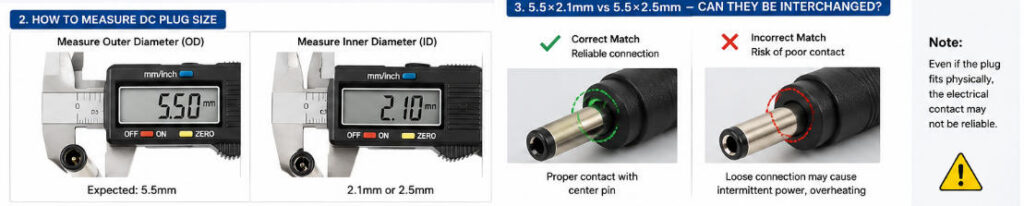
If a 5.5×2.1mm plug is inserted, the smaller internal diameter may prevent proper mating with the center contact. The connector may feel loose, make unreliable electrical contact, or fail to deliver stable power.
The reverse situation can also create problems.
A 5.5×2.5mm plug may physically enter a socket designed for a 2.1mm center pin in some configurations, but the larger internal opening can produce insufficient contact pressure around the center pin.
This can result in:
- Intermittent power
- Unexpected equipment shutdown
- Voltage drop
- Electrical arcing
- Localized heating
- Unstable operation
- Premature connector wear
Therefore, “it fits” is not the same as “it is compatible.”
This distinction becomes particularly important for OEM projects, where thousands of adapters may be produced with the same connector specification.
How to Tell a 5.5×2.1mm Plug from a 5.5×2.5mm Plug
1. Check the Original Adapter Label
The easiest method is to check the original power adapter, product manual, or technical datasheet.
Some manufacturers explicitly specify the connector as:
DC Plug: 5.5×2.1mm
or:
DC Jack: 5.5×2.5mm
If the specification is available, it is more reliable than trying to identify the connector visually.
For B2B purchasing, the original adapter’s complete specification should be used as the reference whenever possible.
2. Measure the Plug with a Caliper
For engineering and procurement applications, a digital caliper is one of the most practical tools.
Measure the outside diameter first.
If the outside diameter is approximately 5.5mm, the connector could belong to either of the two common specifications.
The next step is to determine the internal diameter.
A measurement close to:
- 2.1mm → 5.5×2.1mm
- 2.5mm → 5.5×2.5mm
However, measuring the internal hole with a standard caliper can be difficult because the opening is small.
For production validation, connector gauges or mating samples can provide more reliable confirmation.
3. Measure the Device’s DC Socket
If the original adapter is unavailable, measuring the device’s DC socket can help identify the connector.
However, the socket should be measured carefully because the visible opening does not always directly represent the exact mating specification.
For professional sourcing, the equipment manufacturer should provide the connector drawing or part number whenever possible.
4. Compare with a Known Reference Plug
Another practical method is to compare the unknown connector against known 5.5×2.1mm and 5.5×2.5mm reference plugs.
This can be useful during incoming quality inspection or sample approval.
For large-volume production, however, visual comparison should not replace dimensional inspection.

Does 5.5×2.1mm Fit a 5.5×2.5mm Socket?
In general, you should not assume that a 5.5×2.1mm plug is compatible with a 5.5×2.5mm socket.
The two specifications have different internal dimensions.
Even if a connector appears to insert, the electrical contact may not be designed for that combination.
A loose or incomplete center contact can increase contact resistance. Under load, this resistance can produce heat and voltage loss.
For low-power applications, the symptom may simply be intermittent operation. At higher currents, poor contact can become a more significant reliability concern.
The correct approach is simple:
Match the plug specification to the device socket specification instead of relying on physical fit.
Is 5.5×2.5mm Better Than 5.5×2.1mm?
Neither connector is universally better.
The correct choice depends on the equipment design.
The 5.5×2.1mm specification is widely used in many consumer and electronic devices, including certain networking products, CCTV equipment, LED applications, and other low-voltage systems.
The 5.5×2.5mm specification is also widely used in electronics, monitors, industrial equipment, networking products, and other DC-powered systems.
From an engineering perspective, the important question is not:
Which plug is better?
The correct question is:
Which connector matches the device’s mechanical and electrical interface?
A power adapter with the wrong connector cannot be considered a correct replacement even if its voltage, current, and wattage are otherwise suitable.
DC Plug Size Is Only One Part of Adapter Compatibility
When sourcing power adapter DC plugs, connector dimensions should never be considered independently from the electrical specifications.
For example, a device may require:
Input: 12V DC, 2A
The replacement adapter should normally provide the correct 12V regulated output and sufficient current capacity.
The connector must then match:
- Outer diameter
- Inner diameter
- Plug length
- Pin configuration
- Polarity
- Cable specification
- Mechanical retention
Szjialu’s 12V power adapter buying guide explains why voltage and current should be verified together with the DC connector specification.
This is especially important because a correctly sized connector does not automatically mean that the complete adapter is compatible.
Don’t Forget DC Polarity
Another critical specification is polarity.
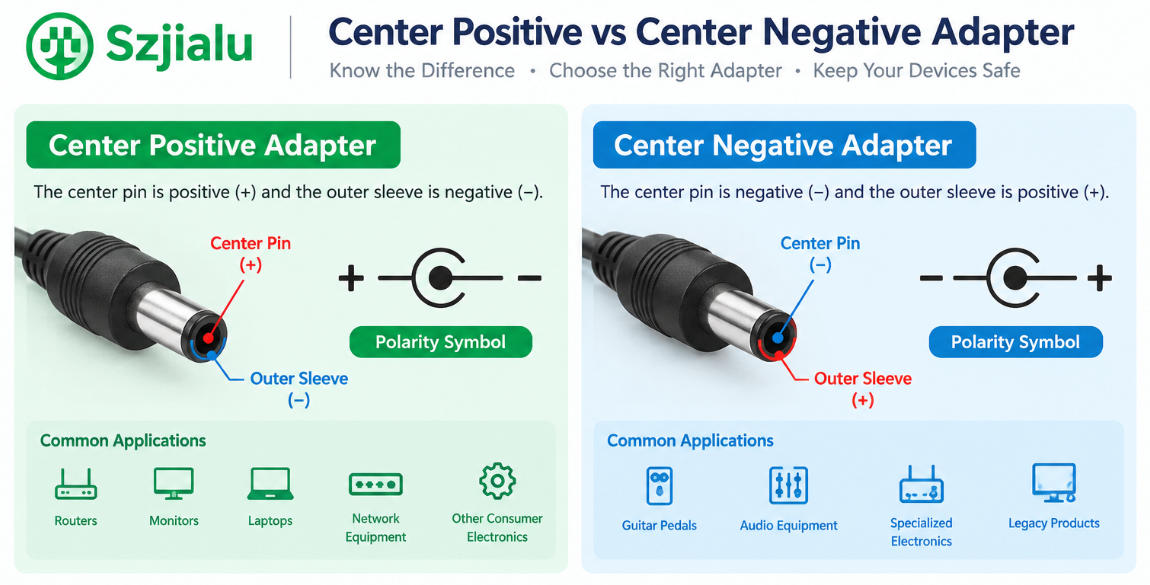
A common DC barrel configuration is:
Center Positive (+)
and:
Outer Negative (−)
However, polarity should never be assumed.
Before replacing or sourcing an adapter, check the polarity symbol on the original power supply or equipment documentation.
A connector with the correct 5.5×2.1mm dimensions but incorrect polarity can still cause equipment malfunction or damage.
For OEM manufacturing, polarity should be included in the official electrical specification rather than communicated only through informal descriptions.
Plug Length Also Matters
Outer diameter and inner diameter are not the only mechanical dimensions.
The insertion length of the DC plug can also affect compatibility.
Two connectors may both be described as 5.5×2.1mm but have different plug lengths or mechanical configurations.
Important mechanical parameters can include:
- Plug outer diameter
- Plug inner diameter
- Insertion length
- Center pin dimensions
- Barrel length
- Insulating section
- Cable exit direction
- Straight or right-angle design
- Locking mechanism
For a replacement adapter, these details may not always be visible from a simple product listing.
For OEM and ODM projects, a connector drawing or physical sample is therefore strongly recommended.
What Specifications Should Buyers Give a Power Adapter Manufacturer?
If you are purchasing power adapters in bulk, providing only the phrase “5.5mm DC plug” is not sufficient.
A professional RFQ should specify the complete connector configuration.
예를 들어:
산출: 12V DC, 3A
DC Plug: 5.5×2.1mm
Polarity: Center Positive
Plug Type: Straight
Cable Length: 1.5m
Cable Gauge: As required
Plug Length: As required
Application: CCTV equipment
Required Certifications: UL / FCC / CE
This gives the manufacturer enough information to evaluate the complete power supply rather than guessing the connector.
For example, Szjialu’s 36W wall-mount power adapter uses 12V DC at up to 3A and specifies a 5.5×2.1mm DC connector as the default, while other connector sizes can be customized.
This type of configuration is useful for OEM customers because the adapter’s electrical output and mechanical interface can be defined together.
5.5×2.1mm vs 5.5×2.5mm for OEM Projects
For an OEM or ODM project, connector selection should ideally happen during the product design stage rather than after the power adapter has already been developed.
Changing the connector later may require modifications to:
- Cable assemblies
- Injection molds
- Product packaging
- Labels
- 기술 문서
- Certification samples
- Production testing
- Inventory
For this reason, equipment manufacturers should provide the exact DC connector requirement when requesting adapter samples.
A good supplier should also be able to support alternative connector sizes when the standard configuration does not match the customer’s equipment.
Szjialu manufactures AC/DC power adapters across multiple power ranges and supports customized power supply projects, including connector and cable configurations. The company’s product portfolio covers wall-mount adapters, desktop power supplies, interchangeable-plug adapters, and other power supply solutions.
A Practical Checklist Before Ordering
Before purchasing a replacement or bulk power adapter, confirm these specifications:
Electrical
- Input voltage
- Output voltage
- Output current
- Maximum output power
- Regulation
- Ripple and noise
- Protection functions
DC Connector
- Outer diameter
- Inner diameter
- Plug length
- Center pin specification
- Polarity
- Straight or right-angle design
- Locking requirements
Cable
- 케이블 길이
- Wire gauge
- Jacket material
- Flexibility requirements
- Strain relief
규정 준수
- Required regional certifications
- EMC requirements
- Safety standards
- Environmental requirements
Commercial
- 최소 주문 수량
- Sample availability
- Production lead time
- Packaging requirements
- Custom labeling
- OEM/ODM requirements
This checklist helps reduce the risk of ordering adapters that meet the electrical specification but fail the mechanical interface requirement.
결론
The difference between a 5.5×2.1mm and 5.5×2.5mm DC plug is only 0.4mm in inner diameter, but that small dimensional difference can have a major impact on connector compatibility.
The key point is simple: do not identify a DC barrel plug by its outer diameter alone.
When sourcing power adapters, always verify the complete connector specification, including outer diameter, inner diameter, plug length, polarity, and mechanical design. For OEM and bulk purchasing, a technical drawing or physical reference sample is even better than a simple connector description.
For engineers and purchasing teams, treating the DC connector as a formal product specification can prevent compatibility problems before they reach production.
As a power adapter manufacturer, Szjialu supports a range of AC/DC adapter configurations and customized OEM/ODM power solutions. When the application requires a specific connector, cable, output specification, or regional compliance configuration, the connector should be defined together with the complete power supply during the product development process.