Choosing a power adapter may appear simple until terms such as “universal,” “regulated,” “switching,” “fixed-output,” and “interchangeable-plug” begin appearing on product specifications. Among these terms, universal power adapter and regulated power adapter are frequently compared as though they describe two completely different product categories.
In reality, they describe different characteristics.
A universal power adapter is primarily defined by its compatibility. It may accept a broad range of AC input voltages, support several regional plug standards, or provide multiple selectable DC outputs. A regulated power adapter, on the other hand, is defined by its ability to maintain a stable output voltage when the input voltage or connected load changes.
This means that one adapter can be both universal and regulated.
For electronics brands, distributors, system integrators, and original equipment manufacturers, understanding this distinction is important. Selecting an adapter based only on the word “universal” can result in voltage mismatch, insufficient current capacity, unstable device performance, or unnecessary product complexity.
This guide explains the differences between universal and regulated power adapters, how each type works, where they are used, and how to choose the right solution for a commercial or OEM project.
What Is a Universal Power Adapter?
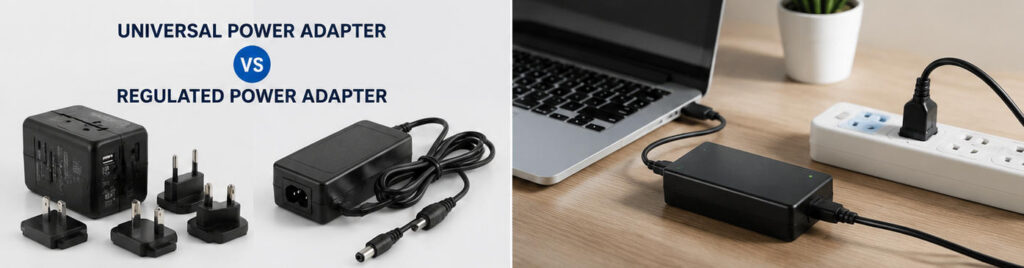
A universal power adapter is designed to work across multiple electrical environments, devices, or geographic markets. However, “universal” does not always mean the same thing.
Depending on the product, the term may refer to one or more of the following features:
- A wide AC input range, typically covering approximately 100–240V AC
- Compatibility with 50Hz and 60Hz power systems
- Interchangeable US, EU, UK, AU, or other regional plug heads
- Multiple selectable DC output voltages
- A selection of interchangeable DC connector tips
- Compatibility with several consumer electronic devices
Because the term is broad, buyers should never assume that a universal adapter will automatically work with every device. The output voltage, available current, connector dimensions, polarity, and power rating must still match the equipment.
For international products, a universal-input adapter can simplify distribution because the same electrical design may be used in countries with different mains voltages. An 交換可能なプラグ電源アダプター can further reduce inventory complexity by allowing different regional AC plug modules to be paired with the same adapter body.
For example, the Szjialu 24W交換式電源アダプター supports 100–240V AC input and can be configured for different outputs, including 12V 2A, 24V 0.5A, and 5V 4A. Its modular plug structure is intended for products distributed across multiple international markets.
What Is a Regulated Power Adapter?
A regulated power adapter is designed to keep its DC output voltage within a specified tolerance despite changes in operating conditions.
Those conditions may include:
- Variations in AC input voltage
- Changes in the current drawn by the device
- Startup or transient loads
- Temperature changes
- Normal component tolerances
For example, a regulated 12V adapter should continue supplying approximately 12V when the connected device changes from a light load to a heavier load, provided the current remains within the adapter’s rated capacity.
This stable output is essential for modern electronics. Routers, security cameras, displays, point-of-sale terminals, communication equipment, controllers, medical peripherals, and embedded computing systems can behave unpredictably when their supply voltage fluctuates excessively.
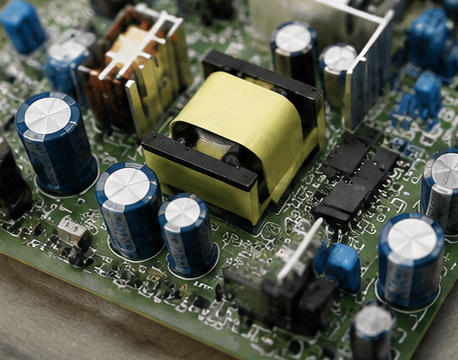
Most modern regulated AC/DC adapters use switch-mode power supply technology. A feedback circuit continuously monitors the output and adjusts the power-conversion process to keep the voltage within its designed range.
Regulation should not be confused with protection. Output regulation controls normal operating voltage. Protection circuits respond to abnormal conditions such as excessive current, overvoltage, overheating, overload, or short circuits.
A properly engineered adapter often combines both features.
Universal and Regulated Are Not Opposites
The most important point in the universal power adapter vs regulated power adapter comparison is that these terms describe two separate dimensions.
“Universal” usually describes compatibility.
“Regulated” describes output performance.
An adapter may therefore be:
- Universal-input and regulated-output
- Universal-input but poorly regulated
- Fixed-input and regulated-output
- Multi-voltage and regulated at each selected output
- Interchangeable-plug, universal-input, and regulated
- Fixed-output, region-specific, and regulated
For most modern commercial applications, the preferred solution is normally a universal-input regulated adapter with a fixed output selected specifically for the target device.
This configuration provides international AC compatibility while maintaining the precise DC voltage required by the equipment.
Key Differences at a Glance
| Comparison Factor | Universal Power Adapter | Regulated Power Adapter |
|---|---|---|
| Primary purpose | 幅広い互換性 | Stable DC output |
| Input range | Often 100–240V AC | May be universal or region-specific |
| Output voltage | Fixed or selectable | Maintained within a defined tolerance |
| Plug options | Often fixed or interchangeable | Any plug structure is possible |
| Device compatibility | May support several devices | Usually optimized for a defined load |
| Output stability | Depends on design quality | A central design requirement |
| Typical users | Travelers, distributors, multi-market brands | OEM devices, commercial and industrial equipment |
| Main selection concern | Compatibility and configuration | Electrical stability and reliability |
Input Compatibility
Universal-input adapters are designed to operate across the common mains-voltage systems used worldwide. This is particularly valuable for companies selling one product in North America, Europe, Asia, Australia, and other regions.
Instead of manufacturing separate 120V and 230V power-supply versions, a brand can use one wide-input electrical platform and modify only the wall plug or AC power cord.
A regulated adapter does not necessarily have universal input. It could be engineered for a limited input range while still maintaining a highly stable DC output. Therefore, buyers should check the label for the actual input specification rather than relying on the product name.
For OEM programs, a 100–240V AC, 50/60Hz input is generally the most flexible choice when global distribution is planned.
Output Voltage and Current
A universal adapter may offer selectable output voltages, such as 5V, 9V, 12V, 15V, or 24V. This flexibility can be convenient for replacement or service applications, but it also creates a risk: selecting the wrong voltage may damage the connected equipment.
A regulated fixed-output adapter removes this uncertainty. It is engineered around one defined voltage and current profile, such as:
- 5V 3A
- 9V 2A
- 12V 2A
- 12V 5A
- 19V 3.42A
- 24V 4A
The connected device determines how much current it draws. The adapter’s rated current should meet or exceed the device’s maximum requirement, while the output voltage should match the device specification.
For equipment requiring a stable 24V supply, the Szjialu 24V 4A デスクトップ電源アダプター provides a dedicated 96W output rather than relying on a user-selectable multi-voltage arrangement. It also includes short-circuit, overcurrent, overvoltage, and overtemperature protection.
Voltage Regulation and Device Performance
Poor voltage regulation can cause more than complete device failure. It may create intermittent problems that are difficult to diagnose.
Possible symptoms include:
- Unexpected device restarts
- Display flicker
- Communication errors
- Audio noise
- Unstable sensor readings
- Reduced motor performance
- Excessive heating
- Shortened component life
- Failure during peak load conditions
A power adapter may show the correct voltage when measured without a load but drop significantly after the device is connected. Another poorly designed adapter may produce an excessive no-load voltage that only falls toward the nominal value under load.
A regulated design minimizes these variations.
For sensitive electronics, buyers should evaluate output-voltage tolerance, ripple and noise, transient response, and behavior at minimum and maximum load—not only the nominal voltage printed on the label.
Connector and Polarity Compatibility
Electrical output is only part of adapter compatibility. The DC connector must also match the device.
Important connector factors include:
- Outer barrel diameter
- Inner pin diameter
- Connector length
- Center-positive or center-negative polarity
- Straight or right-angle design
- Locking mechanism
- USB-A, USB-C, barrel, DIN, or custom connector
- Cable length and wire gauge
Some consumer-oriented universal adapters include several detachable DC tips. While this can increase compatibility, a tip that physically fits is not proof that the electrical specifications are correct.
For OEM applications, a fixed connector is usually safer. It reduces installation mistakes, improves mechanical reliability, and allows the cable assembly to be validated as part of the complete product system.
Szjialu supports customized DC connectors, cable lengths, housing colors, labeling, packaging, and electrical output configurations for OEM and ODM projects.
Safety and Protection Features
Neither “universal” nor “regulated” automatically guarantees safety. Buyers should examine the complete design and compliance package.
Common protection functions include:
- SCP: short-circuit protection
- OCP: overcurrent protection
- OVP: overvoltage protection
- OTP: overtemperature protection
- OLP: overload protection
These protections help prevent a temporary fault from becoming a larger electrical or thermal hazard. However, their trigger points and recovery behavior must be appropriate for the application.
International products may also require region-specific safety and electromagnetic-compatibility approvals. Depending on the destination and product category, relevant marks may include UL, ETL, CE, FCC, UKCA, GS, RCM, PSE, KC, SAA, CCC, or other certifications.
The correct certification strategy should be determined during product development rather than after mass production has started.
効率と熱性能
Regulation accuracy alone does not determine adapter quality. Conversion efficiency and thermal design are also important.
An inefficient adapter converts more electrical energy into heat. Excessive internal temperature can accelerate the aging of electrolytic capacitors, insulation materials, semiconductors, solder joints, and other components.
For this reason, buyers should consider:
- Average active efficiency
- No-load power consumption
- Temperature rise at rated load
- Performance at high and low input voltage
- Ventilation around the adapter
- Expected operating hours
- Ambient temperature
- Load derating requirements
A useful overview of the factors affecting service life is available in Szjialu’s guide, How Long Does an AC DC Power Adapter Last?.
For continuous operation or high-power equipment, operating the adapter with reasonable design margin can improve thermal performance and long-term reliability.
Wall-Mount vs Desktop Construction
Universal and regulated adapters can be manufactured in either wall-mount or desktop formats.
A wall-mount adapter plugs directly into the AC outlet. It is compact, reduces the number of cables, and is well suited to lower-power consumer electronics.
A desktop adapter is connected to the wall through a separate AC cord. Its larger enclosure generally provides more space for power components, insulation distances, filtering, and heat management.
Desktop adapters are therefore often selected for displays, industrial systems, medical equipment, communication hardware, LED systems, and other medium- or high-power applications.
For a more detailed comparison, see Wall Power Adapter vs Desktop Adapter.
High-demand equipment may require a solution such as the Szjialu 200W–240W desktop power adapter, which combines a wide AC input range with high-current 12V or 24V output options.
Which Type Is Better for Consumer Use?
A universal multi-output adapter can be useful when one adapter must temporarily support several devices. Typical examples include repair work, travel, testing, and replacing an unavailable original adapter.
However, users must verify every electrical parameter before connection. Convenience does not eliminate mismatch risk.
For regular daily use, a regulated fixed-output adapter designed for the specific device is generally the better choice. It removes voltage-selection errors and provides a more predictable relationship between the power supply and the connected load.
When international travel is required, the ideal option is often not a manually adjustable adapter. It is a regulated fixed-output adapter with universal AC input and the correct regional plug or interchangeable plug module.
Which Type Is Better for OEM and Industrial Projects?
OEM and industrial buyers should normally prioritize a regulated, application-specific output.
A universal input range and interchangeable plug system can then be added when global market compatibility is required.
The recommended specification frequently includes:
- 100~240V AC入力
- Fixed regulated DC output
- Adequate current and startup-load capacity
- Application-specific connector and polarity
- Appropriate ripple and noise limits
- Protection against electrical and thermal faults
- Energy-efficiency compliance
- Required regional certifications
- Verified thermal performance
- Suitable housing and cable construction
This approach provides the market flexibility associated with a universal adapter without sacrificing the stability of a regulated power supply.
How to Choose the Right Power Adapter
Before selecting a universal or regulated adapter, confirm the following requirements.
1. Match the Output Voltage
The adapter voltage should match the device’s specified input voltage. Do not substitute a higher voltage unless the equipment manufacturer explicitly permits it.
2. Provide Enough Current
The adapter’s current rating should be equal to or greater than the device’s maximum demand. Also consider startup surges from motors, displays, storage devices, radios, and capacitive loads.
3. Verify Total Power
Power is calculated by multiplying voltage by current. A 12V device requiring 3A needs at least 36W under its rated operating condition.
4. Confirm the Connector
Check the physical dimensions, polarity, retention method, cable length, and wire size.
5. Define the Input Market
Determine whether the product needs one regional plug, an interchangeable plug system, or a desktop adapter with different detachable AC cords.
6. Evaluate Regulation Quality
Ask about output tolerance, ripple, noise, transient response, and voltage behavior across the complete input and load range.
7. Review Safety and Compliance
Confirm that the adapter design, insulation system, materials, protection functions, and certification package match the target market and application.
For a broader purchasing checklist, read Szjialu’s guide to choosing the right AC DC power adapter.
Why Choose Szjialu for Custom Power Adapters?
Szjialu develops and manufactures wall-mount adapters, desktop power supplies, interchangeable-plug adapters, USB power adapters, PD chargers, GaN chargers, and customized power solutions.
The company supports power-adapter designs covering multiple output levels, enclosure formats, plug standards, connector configurations, and regional compliance requirements. Its OEM and ODM services can include customized voltage and current, cable length, DC connectors, housing colors, private labeling, and packaging.
Buyers can explore the complete Szjialu power adapter range to compare available formats and power levels.
For an OEM project, the most reliable approach is to provide the device input specification, maximum operating current, startup behavior, connector drawing, target countries, expected certifications, operating environment, and annual order volume. These details allow the power supply to be evaluated as part of the complete product rather than as an isolated accessory.
よくある質問
Is a universal power adapter regulated?
It may be, but the word “universal” does not guarantee regulation. Check the electrical specification to confirm output tolerance and regulated performance.
Can a regulated adapter work worldwide?
Yes, when it also supports universal input such as 100–240V AC and uses a suitable plug or AC cord for the destination country.
Is a multi-voltage adapter better than a fixed-output adapter?
A multi-voltage adapter offers flexibility, but a fixed-output regulated adapter is generally safer and more appropriate for a dedicated commercial product.
Can I use an adapter with a higher current rating?
Normally, yes, provided the output voltage, polarity, connector, regulation, and other specifications match. The device draws the current it requires; the adapter rating indicates its maximum available capacity.
What is the best choice for an international OEM product?
A universal-input, fixed-output, regulated adapter with the required regional plug options, safety approvals, energy-efficiency performance, and customized DC connection is usually the most practical choice.
結論
The universal power adapter vs regulated power adapter comparison is not a simple choice between two opposing technologies.
A universal adapter emphasizes broad input, plug, voltage, or device compatibility. A regulated adapter emphasizes stable DC output under changing electrical loads and input conditions.
For travel, repair, and temporary replacement, a carefully selected universal multi-output adapter may be convenient. For consumer products, commercial equipment, and industrial systems, a fixed-output regulated adapter is generally the safer and more reliable option.
For global OEM deployment, the best solution often combines both concepts: universal AC input, interchangeable regional plug options, and a precisely regulated output designed for the connected device.
By evaluating voltage, current, power, regulation, connector compatibility, protection, efficiency, temperature, and certification requirements together, buyers can select a power adapter that supports both reliable product performance and long-term market success.