For years, consumers struggled with a frustrating reality: every new device seemed to require a different charging cable. Smartphones, laptops, tablets, cameras, headphones, and countless accessories all relied on proprietary connectors or incompatible charging solutions. The result was unnecessary electronic waste, higher costs, and a poor user experience.
Today, that landscape has changed dramatically. The USB-C standard has emerged as the world’s universal charging interface, powering everything from smartphones and gaming consoles to professional laptops and industrial equipment.
Major technology companies—including Apple, Samsung, Dell, Lenovo, ASUS, HP, Google, and many others—have adopted USB-C as their primary charging interface. Governments have also recognized its benefits, with regulations encouraging or requiring standardized charging solutions to reduce electronic waste.
But what makes USB-C so successful? Why has it replaced USB-A, Micro USB, Lightning, and many proprietary connectors?
In this guide, we’ll explore the technology, industry trends, and business advantages behind the USB-C standard, helping buyers, engineers, distributors, and OEM partners understand why USB-C has become the future of charging.
The Evolution of USB Connectors
Before USB-C, the market was fragmented.
Common connectors included:
- USB Type-A
- USB Type-B
- Mini USB
- Micro USB
- Apple’s Lightning connector
- Various proprietary DC connectors
Each connector had different capabilities, speeds, and charging limits. Consumers often carried multiple cables just to power everyday devices.
As device performance improved, these older connectors struggled with:
- Higher charging power
- Faster data transfer
- Reversible connections
- Video output
- ユニバーサル互換性
The industry needed a connector capable of handling every modern application.
That solution became USB Type-C.
What Is the USB-C Standard?
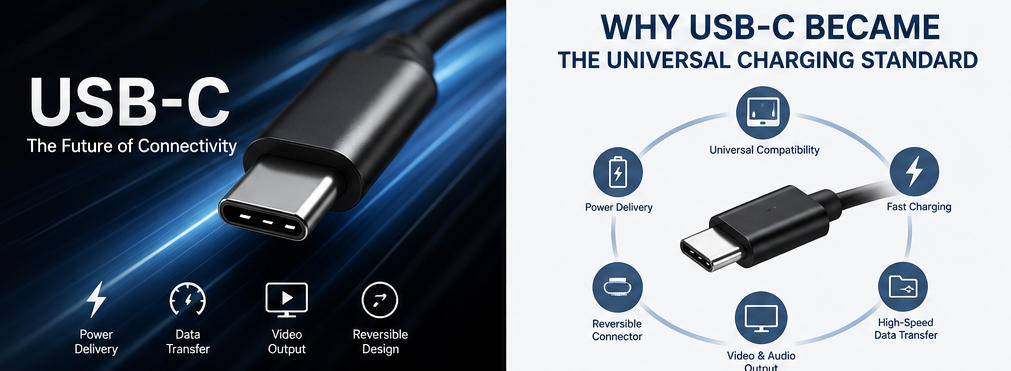
の USB-C standard refers to a universal connector specification developed by the USB Implementers Forum (USB-IF). Unlike previous USB generations, USB-C is not simply another connector—it is an entire ecosystem designed for power, data, and multimedia.
A USB-C connector supports:
- 急速充電
- High-speed data transmission
- Audio transmission
- Video output
- External display support
- Power delivery in both directions
- Multiple communication protocols
Instead of requiring different ports for charging, displays, and accessories, one USB-C port can perform nearly every function.
This versatility explains why manufacturers across nearly every electronics category have embraced the USB-C standard.
One Connector for Almost Every Device
One of the biggest reasons the USB-C standard became universal is convenience.
Today, one USB-C charger can power:
- スマートフォン
- 錠剤
- MacBooks
- Windows laptops
- ニンテンドースイッチ
- 携帯型ゲーム機
- Wireless headphones
- Cameras
- モバイルバッテリー
- ポータブルモニター
- Bluetoothスピーカー
- スマートホームデバイス
Instead of carrying several chargers during travel, users often need only one compact USB-C charger.
For businesses, this simplifies inventory management, logistics, and customer support.
USB-C Supports Much Higher Power
Older connectors were never designed for modern power demands.
Micro USB typically supported limited charging capabilities.
USB-C completely changed this.
と USB Power Delivery (USB PD), USB-C supports dramatically higher power levels suitable for:
- スマートフォン
- 錠剤
- ウルトラブック
- プロフェッショナル向けノートパソコン
- ゲーミングノートパソコン
- Portable workstations
- 産業機器
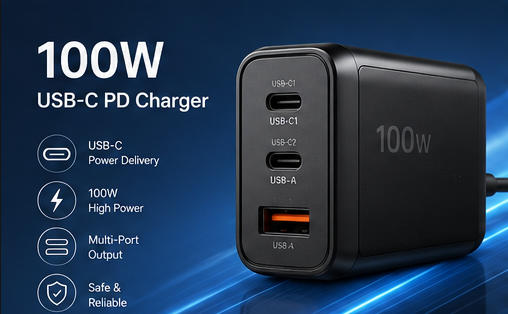
Modern USB-C PD chargers intelligently negotiate voltage and current with connected devices, delivering only the power required.
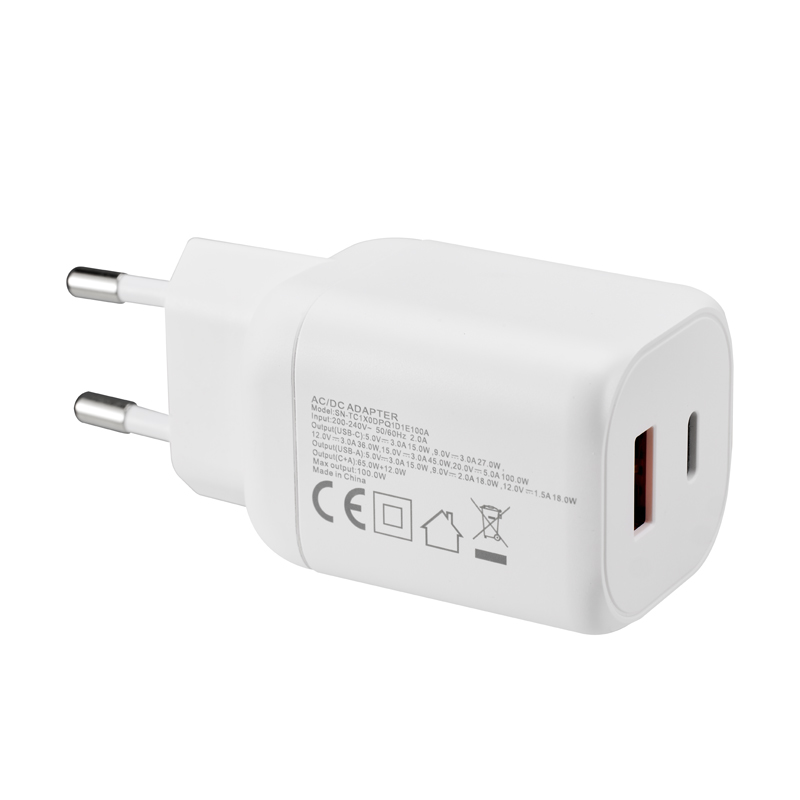
For users looking for high-performance charging solutions, a 100W USB-C PD充電器 provides an excellent balance of portability and performance.
Fast Charging Changed Consumer Expectations
Consumers now expect their devices to charge in minutes rather than hours.
USB-C made this possible through:
- USB Power Delivery
- PPS(プログラマブル電源)
- インテリジェントな電圧ネゴシエーション
- Dynamic current adjustment
Rather than continuously outputting maximum power, USB-C chargers communicate with devices to optimize charging efficiency.
This improves:
- 充電速度
- Battery lifespan
- 安全性
- 熱管理
Modern GaN chargers further improve these advantages by delivering higher efficiency in much smaller form factors.
Reversible Design Improves User Experience
One of the simplest but most appreciated innovations of the USB-C standard is its reversible connector.
Unlike USB-A and Micro USB, users no longer need to determine the correct orientation before plugging in a cable.
メリットは以下のとおりです。
- Faster connection
- Reduced port wear
- Better durability
- Improved accessibility
- Easier operation in low-light environments
Although simple, this design significantly enhances everyday usability.
USB-C Supports High-Speed Data Transfer
Charging is only part of the story.
USB-C also supports extremely fast data transfer, depending on the underlying USB protocol.
Applications include:
- Large video file transfers
- Professional photography workflows
- 外付けSSD
- ドッキングステーション
- Enterprise storage
- Industrial data collection
Many professionals now rely on a single USB-C cable for both charging and data synchronization.
Video Output Through One Cable
USB-C also supports DisplayPort Alt Mode and other video standards.
One cable can simultaneously provide:
- Video output
- Audio
- USB data
- Device charging
これにより、以下のことが可能になります。
- Single-cable docking
- Multi-monitor workstations
- Conference room displays
- Portable office setups
Business users particularly benefit from simplified cable management and cleaner workspaces.
Why Governments Support the USB-C Standard
Electronic waste has become a global concern.
Millions of chargers are discarded every year simply because new devices require different connectors.
A universal charging interface reduces:
- Redundant accessories
- Manufacturing waste
- Consumer costs
- Packaging materials
- 二酸化炭素排出量
The adoption of USB-C aligns with global sustainability initiatives by encouraging charger reuse across multiple devices.
For manufacturers, standardization also simplifies product development and compliance with international market requirements.
USB-C Benefits Manufacturers
For OEM and ODM manufacturers, USB-C offers several strategic advantages.
Lower Development Costs
Using standardized USB-C interfaces reduces engineering complexity and shortens product development cycles.
Simplified Certification
USB-C products often follow established compliance frameworks, making certification more efficient.
グローバル互換性
Products supporting the USB-C standard can be sold across international markets with fewer compatibility concerns.
Stronger Customer Satisfaction
Consumers increasingly expect USB-C compatibility. Products that meet this expectation are more likely to achieve positive customer feedback and lower return rates.
GaN Technology Accelerates USB-C Adoption
Gallium Nitride (GaN) technology has played an important role in the success of USB-C charging.
Compared with traditional silicon chargers, GaN offers:
- 効率性の向上
- 小型サイズ
- 発熱量を低減
- より高い電力密度
- 熱性能の向上
This allows manufacturers to produce compact chargers capable of powering multiple devices simultaneously.
If you’d like to understand the technology behind these improvements, read:
USB-C Makes Multi-Port Charging Smarter
Modern USB-C chargers often include multiple ports:
- USB-C
- USB-A
- デュアルUSB-C
- Triple USB-C
Smart power allocation automatically distributes available power depending on connected devices.
例えば:
- Laptop receives 65W
- Smartphone receives 20W
- Earbuds receive 5W
All from a single charger.
This flexibility makes USB-C ideal for business travelers and professionals managing multiple devices.
Why Businesses Prefer USB-C Solutions
Corporate IT departments increasingly standardize around USB-C because it simplifies equipment management.
メリットは以下のとおりです。
- Fewer charger SKUs
- Easier procurement
- Lower accessory costs
- Simplified employee support
- Reduced inventory
Companies deploying hundreds or thousands of laptops appreciate the operational efficiencies enabled by a universal charging standard.
USB-C Improves Product Longevity
Consumers also benefit financially.
Instead of replacing chargers every time they upgrade devices, they can continue using existing USB-C accessories.
This extends the useful life of:
- Chargers
- Cables
- ドッキングステーション
- モニター
- アクセサリー
Reduced replacement frequency lowers both costs and environmental impact.
Choosing a Reliable USB-C Charger Manufacturer
As demand for USB-C products continues to grow, selecting the right manufacturing partner is essential.
信頼できるサプライヤーは以下を提供する必要があります。
- USB-IF compliant designs
- 国際認証
- 厳格な品質管理
- OEMおよびODMサービス
- Comprehensive safety testing
- Stable production capacity
シュジアル specializes in manufacturing USB-C fast chargers, GaN chargers, and USB Power Delivery solutions for global OEM and ODM customers. With advanced production capabilities and a focus on product reliability, the company supports businesses seeking high-performance charging products for international markets.
The Future of the USB-C Standard
The USB-C standard continues to evolve alongside advances in charging technology.
Future developments include:
- Higher power delivery capabilities
- Smarter charging algorithms
- Improved energy efficiency
- Expanded support for AI-powered devices
- Faster data transmission
- Broader integration into automotive, industrial, and IoT applications
As more industries embrace universal connectivity, USB-C is expected to remain the dominant interface for years to come.
Manufacturers investing in USB-C today are positioning themselves to meet growing global demand while supporting sustainability and cross-device compatibility.
結論
の台頭 USB-C standard represents one of the most significant advancements in modern consumer electronics. By combining high-speed data transfer, intelligent power delivery, reversible design, and broad compatibility into a single interface, USB-C has transformed how people charge and connect their devices.
For consumers, it means greater convenience and fewer cables. For businesses, it simplifies procurement, improves compatibility, and reduces long-term costs. For manufacturers, it provides a scalable platform for developing innovative charging solutions that meet international standards.
As USB-C adoption continues to expand across smartphones, laptops, industrial equipment, and emerging technologies, choosing high-quality USB-C products from an experienced manufacturer becomes increasingly important. Whether you’re sourcing OEM chargers, designing new electronic products, or upgrading your charging ecosystem, embracing the USB-C standard is a strategic investment in performance, efficiency, and future compatibility.