Selecting an external power supply involves more than matching voltage and current. The physical format of the adapter can influence installation, portability, thermal performance, regulatory planning, packaging, and the overall experience of using the finished device.
For many electronics manufacturers and OEM buyers, the decision eventually becomes a comparison between two common formats: a wall-mounted adapter and a desktop adapter.
Although both products convert AC mains electricity into regulated DC output, they are designed for different operating environments and product strategies. A wall adapter connects directly to the electrical outlet, while a desktop adapter uses a separate AC power cord and normally rests on a desk, floor, shelf, or equipment surface.
これ Wall Power Adapter vs Desktop Adapter guide explains the practical differences between these two designs and helps product developers, distributors, sourcing teams, and brand owners select the most suitable option.
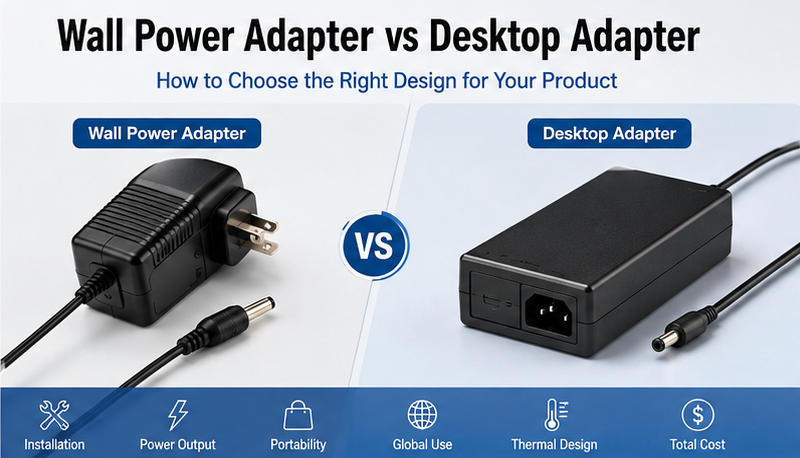
Wall Power Adapter vs Desktop Adapter: Quick Comparison
| Selection Factor | Wall Power Adapter | Desktop Adapter |
|---|---|---|
| AC connection | Plug integrated into enclosure | Separate AC power cord |
| Typical positioning | Directly on wall outlet | Desk, shelf, floor, or equipment surface |
| 携帯性 | Usually more compact | Larger and less portable |
| Output capacity | Best suited to low and moderate power | Suitable for low to high power |
| Outlet loading | Adapter weight hangs from outlet | Minimal mechanical load on outlet |
| Thermal space | More limited | More enclosure space for heat management |
| Regional plug changes | Often requires plug-specific versions | AC cable can be changed by market |
| パッケージ | Usually smaller | Requires adapter and AC cable |
| Installation flexibility | Simple direct connection | Better reach and placement flexibility |
| 代表的な用途 | Consumer and portable products | Commercial, industrial, and higher-power products |
This table provides a useful starting point, but wattage alone should not determine the final choice. The operating environment, certification strategy, cable arrangement, expected service life, and target market must also be considered.
1. Power Output Requirements
The first step in the Wall Power Adapter vs Desktop Adapter decision is determining the device’s actual power requirement.
Power can be calculated using:
Power in watts = Output voltage × Output current
For example, a product requiring 12V at 2A needs a 24W adapter. A device requiring 24V at 5A needs 120W.
Wall-mounted adapters are particularly practical for low- and medium-power products. A compact 24W wall-mount power adapter can support applications such as communication devices, small displays, routers, LED products, and household electronics.
As output power increases, however, the enclosure must accommodate larger transformers, capacitors, switching components, insulation distances, protection circuits, and thermal-management requirements. A desktop enclosure usually provides more internal space for these components.
For demanding applications, a high-power product such as the Szjialu 200W–240W desktop power adapter is generally more practical than a direct-plug format.
The adapter should also have sufficient power margin. Continuously operating a power supply at its absolute limit may increase thermal stress. Buyers should therefore discuss startup current, peak load, continuous load, and environmental temperature with the adapter manufacturer rather than selecting a model from nominal wattage alone.
2. Installation and Outlet Space
A wall adapter creates a clean installation because no separate AC cable is required. This is useful for compact consumer products and portable devices.
However, the adapter enclosure occupies space around the outlet. A wide adapter may partially block an adjacent socket on a wall plate or power strip. Large wall adapters may also be inconvenient behind furniture or in recessed installation areas.
The adapter’s weight is another consideration. Because the enclosure hangs directly from the socket, a heavy unit may place mechanical stress on the outlet. Plug retention can become especially important where equipment is moved, vibration is present, or wall sockets are loose.
A desktop adapter separates the power supply body from the outlet through an AC cord. This arrangement provides several installation advantages:
- The adapter can be positioned away from crowded sockets.
- The equipment can be placed farther from the wall outlet.
- Less weight is applied directly to the socket.
- The power supply can be secured inside furniture or equipment installations.
- Different AC-cable lengths can be selected.
Desktop adapters are therefore often preferred for permanent workstations, surveillance installations, industrial equipment, office systems, and products installed inside cabinets.
3. Portability and User Convenience
Wall-mounted designs usually provide the best portability. The user carries one adapter rather than an adapter body plus a separate AC cord.
This format is suitable when the customer regularly moves the product between locations. Examples include portable speakers, personal-care devices, compact networking products, small consumer electronics, and rechargeable equipment.
A desktop adapter requires more storage space and introduces an additional cable. For travel-oriented products, this may reduce convenience.
Nevertheless, portability is not always the primary requirement. A desktop adapter may provide a better user experience for equipment that remains in one location, especially when the power supply needs to be hidden beneath a desk or placed away from the outlet.
When evaluating convenience, product teams should consider the complete installation rather than the adapter alone. A smaller adapter does not automatically create a cleaner setup if it blocks another socket or cannot fit behind the equipment.
4. Thermal Performance and Continuous Operation
Every AC DC adapter generates heat during power conversion. Efficiency, component selection, enclosure design, ambient temperature, ventilation, and load all influence operating temperature.
Wall adapters generally use compact housings with closely arranged components. This helps reduce product size but leaves less surface area and internal volume for heat distribution. Their location can also affect cooling. An adapter installed behind furniture, next to another power supply, or inside a poorly ventilated area may operate at a higher temperature.
Desktop adapters commonly have larger enclosures. This can give engineers more flexibility to distribute components, manage heat-generating areas, and design for sustained output.
This difference becomes important for products operating continuously, including:
- Network devices
- CCTV cameras and recorders
- Digital signage
- Industrial controllers
- Communication systems
- LED installations
- POS equipment
A desktop format is not automatically cooler or more reliable. Actual performance depends on circuit design, efficiency, materials, component quality, and validation. Buyers should request temperature-rise testing under realistic input voltage, output load, and ambient conditions.
For additional guidance on electrical compatibility and adapter selection, buyers can review Szjialu’s guide to choosing the right AC DC power adapter.
5. Global Plug and Cable Strategy
Regional compatibility is one of the most important differences in the Wall Power Adapter vs Desktop Adapter comparison.
A fixed wall adapter normally incorporates a plug for a specific market, such as:
- 米国プラグ
- EUプラグ
- 英国プラグ
- AUプラグ
- Korea plug
- China plug
Selling the same device in several countries may therefore require multiple adapter models, plug molds, packaging versions, inventory codes, and certification combinations.
A desktop adapter can simplify this process. The same adapter body may be paired with different approved AC power cords for each destination. The manufacturer or distributor can change the cord while retaining the main power supply platform.
This can reduce:
- Adapter housing variations
- Tooling requirements
- Inventory complexity
- Regional packaging changes
- Product-management workload
However, the power cord itself must still meet applicable regional requirements. Buyers should verify the cord plug, conductor size, inlet type, voltage rating, approvals, and cable length.
For low-power products that need global portability without a separate cord, another option is an 交換可能なプラグ電源アダプター. This design combines a compact adapter body with replaceable plug modules for different markets.
6. Safety and Regulatory Compliance
Both wall and desktop adapters can be designed to comply with relevant safety, electromagnetic compatibility, and energy-efficiency requirements. The form factor alone does not determine certification quality.
Depending on the target market and application, requirements may involve standards or marks such as UL, ETL, CE, UKCA, FCC, CB, GS, PSE, KC, SAA, DOE Level VI, or ErP.
The required certification plan can depend on:
- Country of sale
- Equipment category
- Output power
- Indoor or outdoor use
- Insulation classification
- End-product safety standard
- Medical or industrial requirements
- AC plug or power-cord configuration
For wall adapters, changing the integrated plug may create additional model and certification considerations. Desktop adapters may simplify the adapter-body platform, but regional AC cords must still be properly approved.
Essential protection functions may include:
- 過電圧保護
- 過電流保護
- 短絡保護
- 過負荷保護
- Overtemperature protection
OEM buyers should not rely only on certification logos printed on a label. They should request valid reports, certificates, model references, label drawings, and specification documents relevant to the exact configuration being purchased.
7. Cable Management and Connector Options
A wall adapter normally includes one fixed DC output cable. Its simple structure reduces the number of loose components in the package, but its practical reach depends on the distance between the outlet and the powered device.
A desktop adapter uses both an AC cable and a DC output cable. Although this creates additional cable management, it offers greater installation flexibility.
Customization options may include:
- DC cable length
- Wire gauge
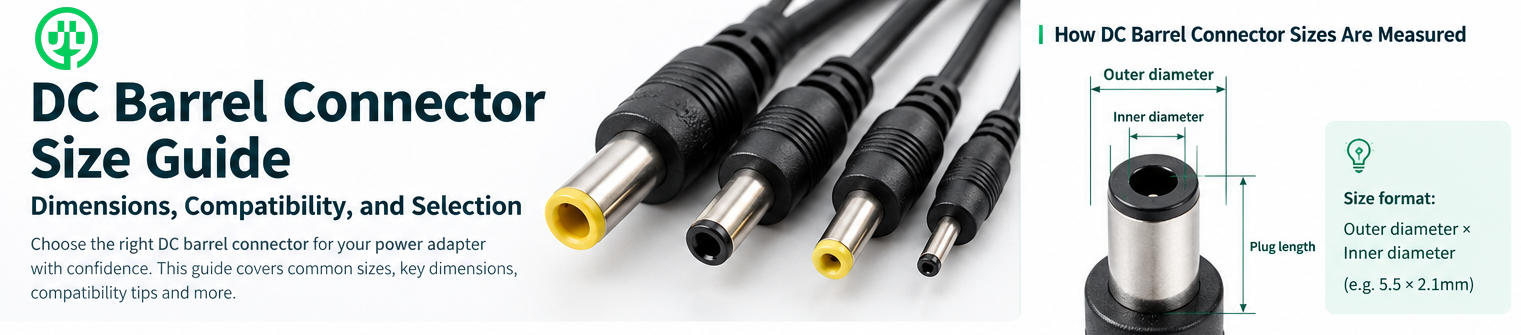
- Barrel connector dimensions
- Locking connectors
- USB-C output
- Right-angle connectors
- Ferrite cores
- Cable labels
- Strain relief design
- Custom pin assignments
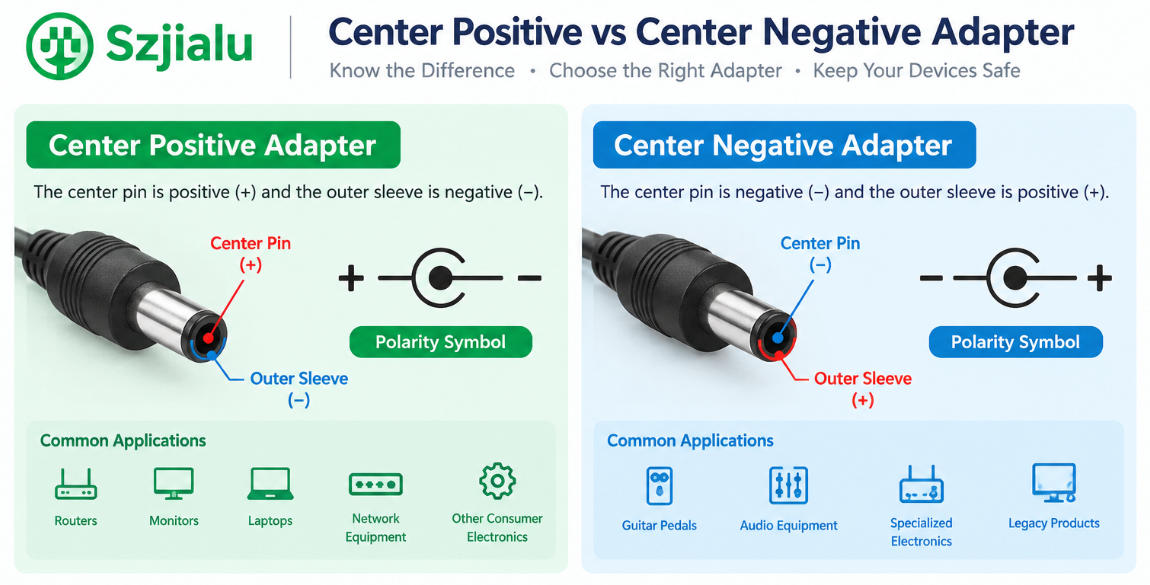
The connector must match the equipment mechanically and electrically. Matching the barrel diameter alone is insufficient; polarity, pin definition, current rating, contact quality, and insertion depth must also be confirmed.
For USB-C devices, power negotiation is different from a conventional fixed-output barrel adapter. Product teams working with USB-C equipment may benefit from Szjialu’s USB-C Power Delivery and fast-charging guide.
8. Packaging, Logistics, and Product Cost
Wall adapters often use less packaging space because no separate AC cord is included. This can reduce package dimensions, assembly steps, product weight, and shipping volume.
For high-volume consumer electronics, these savings may significantly influence the total landed cost.
Desktop adapters generally require:
- A larger power supply enclosure
- A separate AC cable
- Additional packaging space
- More packing and inventory coordination
Their initial cost may therefore be higher.
However, purchase price should not be considered in isolation. A desktop adapter may create long-term value by supporting higher power, improving installation flexibility, simplifying regional cable changes, and reducing the need for multiple adapter housings.
The correct comparison is total cost of ownership, including:
- Tooling
- 認証
- パッケージ
- Freight
- Regional inventory
- Failure and warranty costs
- Assembly labor
- Replacement availability
- Product lifecycle
A lower-cost adapter is not economical if it produces installation complaints, excess heat, field failures, or multiple unnecessary SKUs.
9. OEM and Branding Flexibility
Both formats can support OEM customization, but the available options vary by enclosure size, tooling, order quantity, and project requirements.
Typical customization services include:
- 出力電圧と電流
- Housing color
- Customer logo
- Product label
- DC connector
- ケーブルの長さ
- Plug style
- Protection settings
- パッケージ
- Efficiency level
- 地域認証
Wall adapters are attractive for highly integrated consumer packaging, but each fixed plug configuration may need separate manufacturing planning.
Desktop adapters offer a modular approach. One adapter platform can potentially be supplied with different AC cables, labels, DC connectors, or output specifications.
Szjialu develops and manufactures power adapter solutions for OEM and ODM customers requiring different wattages, enclosure structures, connectors, cable specifications, and market approvals.
When Should You Choose a Wall Power Adapter?
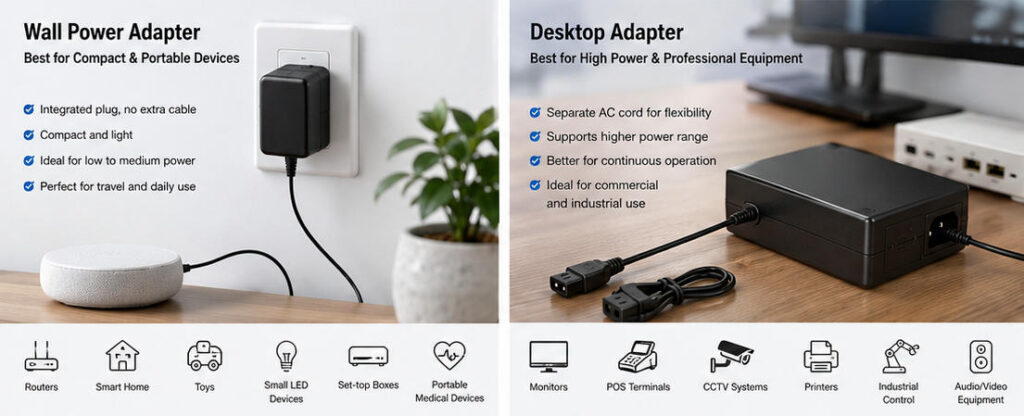
A wall adapter is usually the better option when:
- The device has a low or moderate power requirement.
- Portability is an important selling point.
- The package must remain compact.
- The product is designed mainly for consumer use.
- The adapter will not block nearby sockets.
- The target market uses a clearly defined plug type.
- The equipment operates intermittently or at a moderate continuous load.
- Minimizing the number of separate accessories is important.
Typical applications include smart home devices, toys, compact routers, small speakers, consumer IoT products, charging devices, and lightweight household electronics.
When Should You Choose a Desktop Adapter?
A desktop adapter is generally preferable when:
- The device requires medium or high power.
- The equipment operates continuously.
- The power supply must be placed away from the wall socket.
- Mechanical loading on the outlet should be minimized.
- The product will be sold in multiple countries.
- Different AC cable lengths are needed.
- Thermal design is a major consideration.
- The application is commercial, industrial, or professional.
- The project requires extensive cable or connector customization.
Typical applications include monitors, POS terminals, surveillance systems, industrial controls, networking equipment, audio systems, LED products, printers, and computing devices.
Questions to Ask Before Finalizing the Adapter
Before approving a power supply, OEM buyers should answer the following questions:
- What are the required output voltage, continuous current, and peak current?
- How many hours per day will the product operate?
- What is the expected ambient temperature?
- Will the adapter be installed in an enclosed space?
- Is portability more important than installation flexibility?
- Which countries will receive the product?
- Will a fixed plug create too many regional SKUs?
- What DC connector, cable length, and polarity are required?
- Which certifications are required for the adapter and end product?
- What efficiency and no-load power targets must be met?
- Is custom branding or packaging required?
- What reliability tests will be completed before mass production?
Providing these details to the power adapter manufacturer early can reduce sampling delays, redesign costs, and certification problems.
Final Verdict: Wall Power Adapter vs Desktop Adapter
There is no universal winner in the Wall Power Adapter vs Desktop Adapter comparison.
A wall power adapter provides compact packaging, straightforward installation, and excellent portability. It is often the most efficient choice for low- and medium-power consumer products sold in a limited number of plug markets.
A desktop adapter provides greater power capability, flexible positioning, easier regional cord changes, and more room for thermal and structural design. It is particularly suitable for commercial equipment, continuous-duty systems, higher-power electronics, and products distributed internationally.
The best decision should be based on the complete device rather than the adapter’s appearance. Output requirements, installation conditions, target countries, certification plans, cable configuration, operating temperature, packaging, and lifecycle cost should all be evaluated.
As an experienced power supply manufacturer, シュジアル provides wall-mounted adapters, desktop power supplies, interchangeable-plug adapters, USB power solutions, and customized OEM/ODM services. By sharing your device specifications and market requirements with the Szjialu engineering team, you can develop a safer, more reliable, and commercially practical power solution for your product.
よくある質問
Is a desktop adapter more powerful than a wall adapter?
Desktop adapters are generally available in higher power ranges because their larger enclosures provide more space for power components, insulation, and thermal design. However, the actual capacity depends on the specific model and engineering design.
Are wall power adapters safe for continuous use?
A properly designed and certified wall adapter can support continuous operation within its rated load and environmental limits. Buyers should confirm temperature-rise performance, component quality, protection functions, and application conditions.
Which adapter is better for international sales?
Desktop adapters often simplify international distribution because the main adapter can be paired with different regional AC power cords. Interchangeable-plug wall adapters are another useful option for global products.
Can I replace a wall adapter with a desktop adapter?
It may be possible when the output voltage, current capacity, polarity, connector, regulation, and application requirements are compatible. Form factor alone does not determine electrical compatibility.
Which format is better for a 12V device?
Either format may be suitable. A small 12V device may use a wall adapter, while a higher-current or continuously operated 12V system may benefit from a desktop power supply. Buyers should evaluate total wattage and operating conditions.
Does a desktop adapter require more certifications?
Not necessarily. Certification requirements depend on the target market, equipment type, electrical specifications, and construction. The separate AC cord must also comply with applicable regional standards.
Can Szjialu customize wall and desktop power adapters?
Yes. Depending on the project, customization may include output voltage, current, cable length, DC connector, plug type, enclosure color, logo, labeling, packaging, protection functions, and certification support.