Choosing a power adapter may seem simple, but using the wrong one can cause unstable operation, poor performance, overheating, premature component failure, or permanent damage to your equipment. Whether you are sourcing an adapter for consumer electronics, LED lighting, networking devices, security systems, medical equipment, industrial controllers, or battery-powered products, the adapter must match the electrical and mechanical requirements of the application.
To Choose the Right AC DC Power Adapter, you need to evaluate more than voltage and current. Input range, output regulation, connector type, polarity, efficiency, safety certification, operating environment, reliability, and regional plug requirements can all influence the final decision.
This guide explains the most important factors to consider and provides a practical selection process for engineers, purchasing teams, product developers, distributors, and equipment manufacturers.
What Is an AC DC Power Adapter?
An AC DC power adapter is an external power supply that converts alternating current from a wall outlet into regulated direct current required by an electronic device.
The electricity supplied by a building is normally AC power, while most electronic components operate on low-voltage DC power. The adapter performs the conversion and delivers the correct voltage and current to the connected equipment.
Modern switching power adapters are used in a wide range of products, including:
- Routers and network switches
- CCTV cameras and access-control systems
- LED strips and lighting equipment
- Monitors and displays
- Audiogeräte
- Point-of-sale terminals
- Household appliances
- Battery chargers
- Industrielle Steuerungssysteme
- Smart-Home-Geräte
- Medical and laboratory equipment
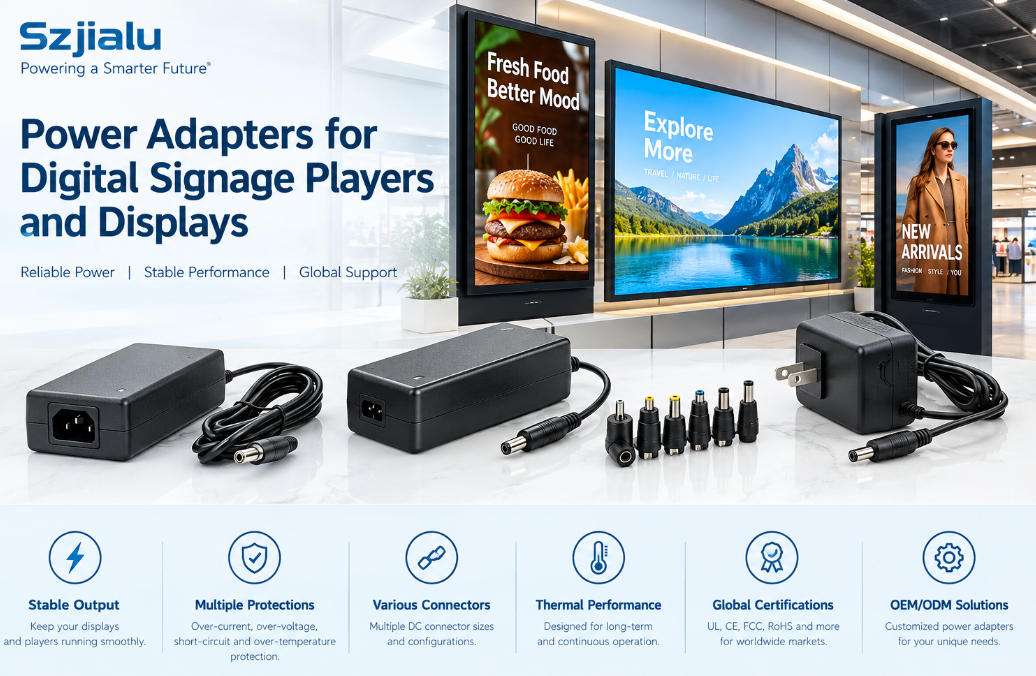
Different applications require different adapter structures. Compact devices may use a wall-mounted adapter, while higher-power equipment may require an external desktop power supply. Companies selling products in several countries may prefer an interchangeable-plug design.
Szjialu offers a broad selection of AC DC power adapters covering different power levels, enclosure formats, output specifications, connectors, and regional requirements.
1. Check the Required Output Voltage
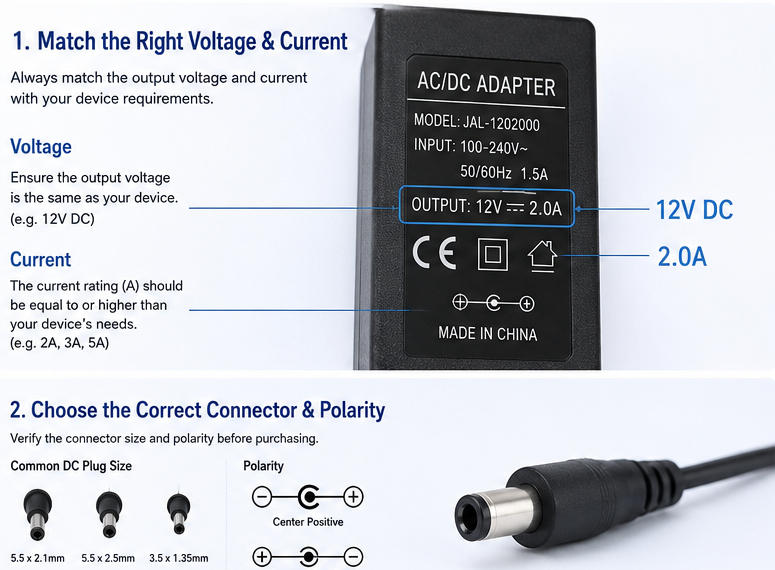
Output voltage is the first specification you should confirm.
The voltage listed on the adapter must match the rated input voltage of the device. If the equipment requires 12V DC, the selected adapter should normally provide a regulated 12V DC output.
Common AC DC adapter output voltages include:
- 5V
- 9V
- 12V
- 15V
- 19V
- 24V
- 36V
- 48V
Using an adapter with a higher voltage than the device requires can damage internal components. A lower-voltage adapter may cause the device to restart, operate incorrectly, fail to start, or draw excessive current.
For voltage-sensitive equipment, you should also review the adapter’s output tolerance and voltage regulation. A nominal 12V adapter does not always produce exactly 12.00V under every operating condition. High-quality regulated adapters are designed to keep the output within a defined tolerance as the input voltage and connected load change.
When you Choose the Right AC DC Power Adapter, always treat voltage matching as mandatory rather than optional.
2. Determine the Required Output Current
After confirming the voltage, identify how much current the device requires.
Current is usually shown in amperes or milliamperes. For example:
- 500mA
- 1A
- 2A
- 3A
- 5A
- 10A
The adapter’s rated current should be equal to or greater than the maximum current required by the equipment.
For example, a 12V device rated at 2A can normally use:
- A 12V 2A adapter
- A 12V 2.5A adapter
- A 12V 3A adapter
The device draws the current it needs; the adapter does not normally force its full rated current into the load. However, you should not use a 12V 1A adapter for a device requiring 12V 2A. An undersized adapter may overheat, shut down, produce unstable voltage, or experience a shorter service life.
For products with motors, pumps, hard drives, heating elements, wireless transmitters, or capacitive loads, consider startup current and short-duration peak demand. These loads may temporarily draw considerably more current than their normal operating level.
A practical design margin of 20% to 30% is often useful when the equipment has variable load conditions or when long-term reliability is important.
3. Calculate the Required Wattage
Power is calculated using the following formula:
Leistung (W) = Spannung (V) × Stromstärke (A)
For example, if a device requires 12V at 3A:
12V × 3A = 36W
The selected adapter should therefore provide at least 36W of continuous output power. In many applications, choosing a 40W or 45W model would provide additional operating margin.
For a 24V device requiring 5A:
24V × 5A = 120W
This application may require a larger external adapter rather than a compact wall plug. Szjialu’s desktop power supply range includes models designed for equipment requiring higher output power and current.
Do not select an adapter based only on wattage. Two adapters may both be rated at 60W but provide completely different voltage and current combinations. A 12V 5A adapter and a 24V 2.5A adapter are both 60W units, but they are not interchangeable.
4. Confirm the Input Voltage and Frequency
The adapter’s AC input range must be compatible with the electrical system in the target market.
A universal-input adapter typically supports approximately 100–240V AC at 50/60Hz. This allows the same power platform to operate in many regions, including North America, Europe, the United Kingdom, Australia, and large parts of Asia.
Universal input is especially valuable for:
- Export products
- International equipment brands
- Travel devices
- Global distributors
- Products sold through multiple regional channels
A narrow-input adapter may be suitable for a product sold in only one country, but it reduces flexibility and can create inventory complexity.
Input frequency is also important. Most modern switching adapters accept both 50Hz and 60Hz, but this should still be verified on the specification sheet and product label.
5. Select the Correct Adapter Style
AC DC power adapters are available in several physical formats. The right choice depends on power level, product design, space, portability, ventilation, cable management, and regional plug requirements.
Wandmontage-Netzteil
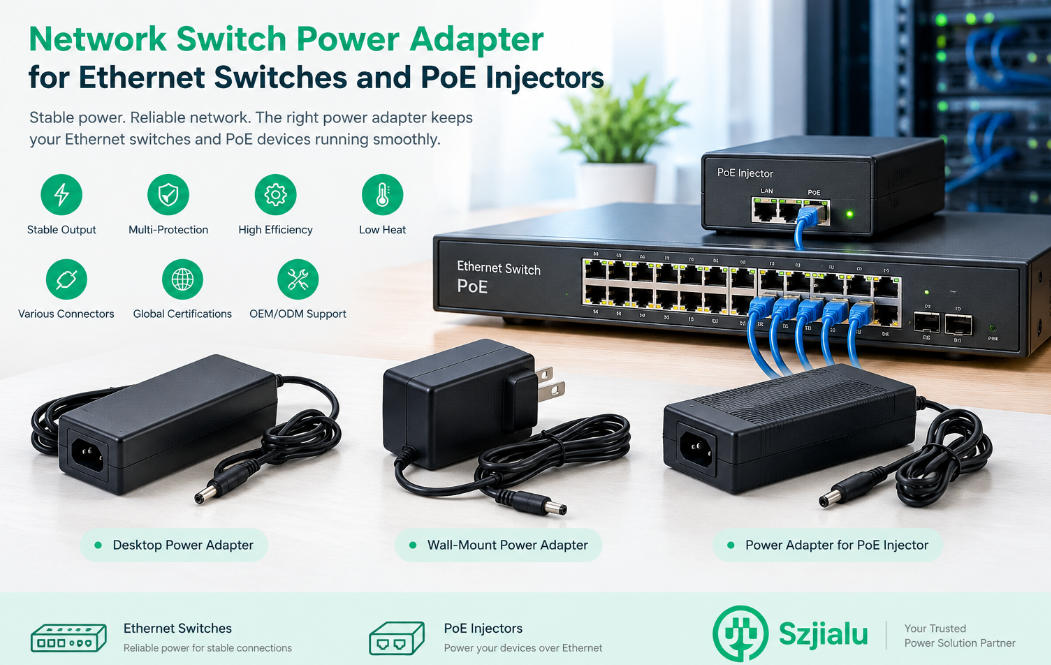
A wall-mounted adapter plugs directly into the AC outlet. It is compact, economical, and commonly used for low- to medium-power devices.
Typical applications include routers, small speakers, electronic toys, smart home products, LED controllers, cameras, and communication equipment.
A wall-mounted design reduces the number of cables, but the enclosure must not block nearby outlets or create excessive mechanical stress. You can review Szjialu’s wall-mount power adapter options when compact installation is a priority.
Desktop-Netzteil
A desktop adapter is connected to the wall outlet through a separate AC cord. The DC output cable then connects the adapter to the device.
This design is commonly used for higher-power applications because the larger enclosure provides more space for thermal management, filtering, and power components.
Desktop adapters are often used with monitors, printers, industrial devices, medical equipment, audio systems, POS terminals, and high-power LED products.
Interchangeable-Plug Power Adapter
An interchangeable-plug adapter uses removable AC plug heads for different countries or regions. A manufacturer can use the same adapter body with plug modules for the United States, European Union, United Kingdom, Australia, and other markets.
This reduces the need to develop and inventory completely separate adapters for each destination.
For products intended for international distribution, an austauschbarer Stecker Netzadapter can simplify logistics and regional product configuration.
6. Match the DC Connector
Even when the electrical ratings are correct, the adapter will not work if the DC connector is incompatible.
Common output connectors include:
- DC barrel plugs
- USB-A
- USB-C
- Micro-USB
- Mini-DIN connectors
- Aviation connectors
- Locking connectors
- Terminal connectors
- Custom molded connectors
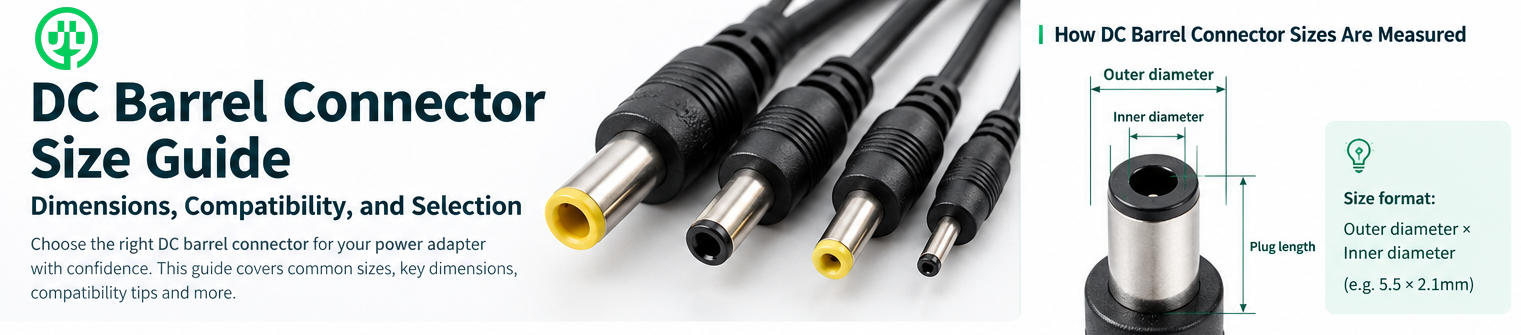
For a barrel connector, verify both the outer diameter and inner diameter. Common dimensions include 5.5 × 2.1mm and 5.5 × 2.5mm, but many other sizes are available.
A connector that appears to fit may still have an incorrect inner diameter, insufficient contact pressure, or an incompatible pin length. This can lead to intermittent power, arcing, unexpected shutdowns, or connector overheating.
You should also confirm:
- Straight or right-angle plug
- Cable exit direction
- Connector insertion depth
- Retention force
- Locking requirement
- Kabellänge
- Wire gauge
- Strain-relief design
For OEM projects, the DC cable and connector should be selected as part of the complete power system rather than treated as an afterthought.
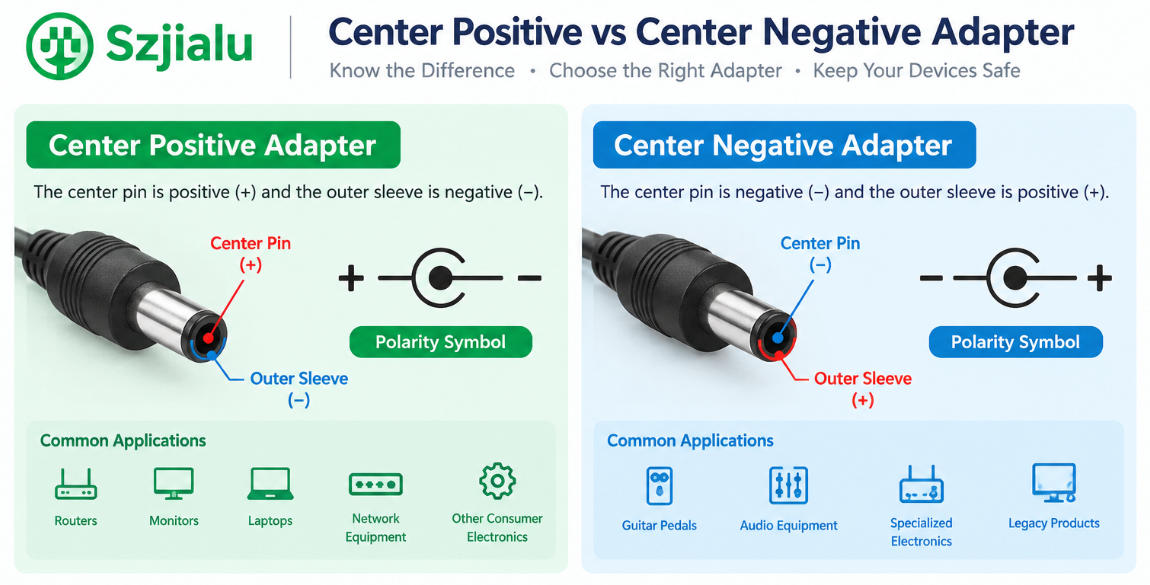
7. Verify Output Polarity
Polarity is critical for DC barrel connectors.
The two most common arrangements are:
- Center positive
- Center negative
Center positive is widely used, but you should never assume the polarity without checking the equipment label, schematic, or technical specification.
Reversed polarity may prevent the device from operating and can damage equipment that does not include reverse-polarity protection.
The polarity symbol on the adapter label should match the polarity symbol on the device. Purchasing teams should also include polarity in the approved specification to prevent production or sourcing errors.
8. Review Efficiency and Energy Performance
Power adapter efficiency affects energy consumption, enclosure temperature, reliability, and regulatory compliance.
A more efficient adapter wastes less electricity as heat. This can provide several benefits:
- Niedrigere Betriebstemperatur
- Reduced energy cost
- Longer component life
- Smaller enclosure possibilities
- Better environmental performance
- Easier compliance with efficiency regulations
Efficiency should be evaluated under multiple load conditions rather than only at maximum output. No-load power consumption is also important because many adapters remain connected to the outlet even when the device is turned off.
For products sold internationally, confirm that the adapter satisfies the applicable energy-efficiency requirements of the destination markets.
9. Check Safety Certifications and Market Requirements
Safety certification is one of the most important considerations when you Choose the Right AC DC Power Adapter for commercial equipment.
Required approvals vary according to the destination country, product category, application, and sales channel. Depending on the project, relevant marks may include UL, ETL, CE, CB, GS, PSE, KC, SAA, RCM, or other national and regional approvals.
Do not evaluate a supplier only by asking whether it has “certificates.” Confirm:
- Which exact adapter model is certified
- Which output ratings are covered
- Which plug types are included
- Whether the certificate is valid
- Whether the factory and applicant information match
- Whether the approval covers the intended application
- Whether the label artwork follows certification requirements
For regulated markets, using the wrong certificate or an approval that does not cover the final configuration can delay product launch and create compliance risks.
Szjialu provides information about its power adapter certifications and quality approvals, helping buyers review available compliance support for different markets.
10. Consider Protection Functions
A reliable AC DC adapter should include appropriate electrical protection. Common protection functions include:
- Überspannungsschutz
- Überstromschutz
- Kurzschlussschutz
- Overtemperature protection
- Überlastschutz
- Überspannungsschutz
These features help protect the adapter and connected equipment when abnormal conditions occur.
The required protection strategy depends on the application. An adapter used for an inexpensive household accessory may have different design requirements from one powering industrial communication equipment or a medical monitoring device.
Ask the supplier how the protection operates. Some adapters shut down and restart automatically, while others use latch-off protection and require the AC input to be disconnected before normal operation resumes.
11. Evaluate Ripple, Noise, and Regulation
Output voltage is not perfectly smooth. Switching power supplies generate a certain amount of ripple and high-frequency noise.
For many general electronic products, standard ripple performance is sufficient. However, audio equipment, cameras, sensors, measurement systems, RF equipment, and precision analog circuits may require lower-noise power.
Excessive ripple can contribute to:
- Audio hum
- Display interference
- Sensor errors
- Communication instability
- Image noise
- Unexpected system resets
Engineers should specify the maximum permitted ripple and noise, the measurement bandwidth, the test load, and the measurement method.
Load regulation and line regulation should also be reviewed. The adapter must keep its output within an acceptable range when the AC input changes or the connected equipment moves between standby, normal operation, and peak load.
12. Consider the Operating Environment
An adapter that performs well in a climate-controlled office may not be suitable for a factory, outdoor enclosure, vehicle, warehouse, or high-temperature installation.
Review environmental factors such as:
- Minimum and maximum operating temperature
- Storage temperature
- Humidity
- Altitude
- Ventilation
- Dust exposure
- Vibration
- Mechanical impact
- Indoor or outdoor use
Temperature has a major effect on power supply life. High internal temperature accelerates the aging of capacitors and other electronic components.
If the adapter will operate continuously near its maximum rated load, ask whether output derating is required at elevated ambient temperatures. Adequate ventilation and realistic load margin can significantly improve long-term reliability.
13. Check Cable Quality and Voltage Drop
Long DC cables and small wire conductors create voltage drop.
For example, an adapter may produce the correct voltage at its output, but the voltage measured at the device can be lower because of resistance in the cable and connector. The effect becomes more significant at higher current.
Voltage drop can cause problems such as:
- Failed startup
- Reduced motor torque
- Dim LED output
- Random resets
- Battery-charging errors
- Unstable wireless communication
When selecting a cable, consider length, conductor size, material, current, flexibility, temperature rating, and mechanical durability.
For custom products, cable drop can sometimes be compensated during adapter design, but the solution must remain within the device’s permitted voltage range under all load conditions.
14. Assess Supplier Quality and Manufacturing Capability
The adapter specification is only part of the purchasing decision. Supplier capability affects consistency, lead time, failure rate, compliance, traceability, and long-term support.
A qualified manufacturer should be able to provide:
- Technische Datenblätter
- Safety documentation
- Reliability test information
- Sample evaluation
- Technischer Support
- Production traceability
- Incoming material control
- Burn-in or aging tests
- Prüfung der elektrischen Leistungsfähigkeit
- Change-management procedures
- OEM labeling and packaging support
For custom projects, communication between the customer and power supply engineering team is especially important. Output cable design, enclosure structure, plug type, labeling, certification, packaging, and electrical performance may all need to be coordinated.
Szjialu provides OEM and custom power adapter services for customers requiring specific output ratings, cables, connectors, housings, logos, labels, packaging, or regional configurations.
A Practical AC DC Power Adapter Selection Checklist
Before approving an adapter, verify the following information:
- What is the device’s required DC voltage?
- What is the normal operating current?
- What is the maximum or startup current?
- How much output power is required?
- What AC input range is needed?
- Which countries will the product be sold in?
- Is a wall-mount, desktop, or interchangeable-plug design more suitable?
- What DC connector size and shape are required?
- What is the required polarity?
- What cable length and wire gauge are needed?
- Which safety certifications are required?
- What efficiency standard must be met?
- What ripple and noise limits apply?
- What protection functions are required?
- What operating temperature must the adapter support?
- Is continuous full-load operation expected?
- Is custom labeling or packaging required?
- Will the adapter need OEM or ODM customization?
Providing this information to the supplier at the beginning of the project can reduce development time and prevent repeated sampling.
Häufige Fehler, die es zu vermeiden gilt
One of the most common mistakes is choosing an adapter only because the connector fits. Mechanical compatibility does not guarantee electrical compatibility.
Other frequent errors include:
- Using the wrong output voltage
- Selecting insufficient current capacity
- Ignoring startup current
- Confusing wattage with voltage compatibility
- Using the wrong polarity
- Overlooking cable voltage drop
- Assuming all certifications cover every model
- Selecting the wrong regional plug
- Ignoring operating temperature
- Choosing the lowest price without reviewing reliability
- Approving a sample without testing it in the final equipment
The best approach is to test the adapter with the actual device under startup, standby, normal, maximum-load, and abnormal operating conditions.
Why Choose Szjialu as Your AC DC Power Adapter Supplier?
Szjialu specializes in the development and manufacturing of power adapters, chargers, power banks, and customized power solutions.
Customers can select from wall-mounted adapters, desktop power supplies, interchangeable-plug models, USB power products, and customized configurations. Depending on project requirements, Szjialu can support different output voltages, power levels, cable lengths, DC connectors, plug standards, labels, housings, and packaging.
For distributors and equipment manufacturers, working with an experienced power supply supplier can make it easier to coordinate electrical performance, safety compliance, mechanical design, production quality, and regional market requirements.
Abschluss
To Choose the Right AC DC Power Adapter, begin by matching the output voltage, then confirm the required current and wattage. After that, evaluate the input range, adapter style, connector dimensions, polarity, cable design, protection functions, efficiency, certification, operating environment, and supplier capability.
A suitable adapter should do more than turn the equipment on. It should provide stable power, operate safely, support the required service life, and comply with the regulations of the target market.
Careful selection at the beginning of a product project can prevent overheating, unstable operation, certification delays, field failures, and unnecessary redesign costs.
For standard or customized AC DC power solutions, contact Szjialu to discuss your required voltage, current, wattage, plug, connector, cable, certification, and application conditions.