Developing and testing smart locks requires more than a functional prototype. Before a smart lock reaches production, engineers typically need to evaluate electronic control boards, motors, solenoids, RFID modules, fingerprint sensors, wireless communication systems, status indicators, and other components under repeatable power conditions.
That makes the power supply an important part of the test bench itself.
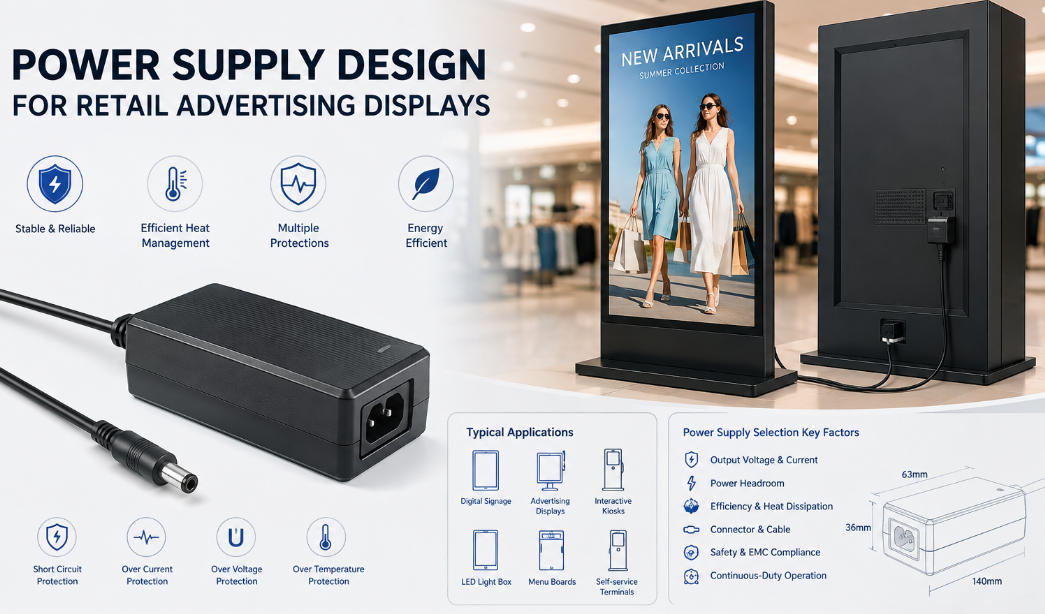
A suitable smart lock power adapter should provide stable output, sufficient current capacity, appropriate connectors, reliable protection, and consistent performance during repeated testing. For manufacturers and engineering teams, the right adapter can also make it easier to build standardized test stations for different smart lock models.
This guide examines the main power adapter options for smart lock test benches and explains what engineers and procurement teams should consider when selecting or sourcing them.
Why Power Supply Selection Matters in Smart Lock Testing
A smart lock may have a relatively low average power consumption, but its power demand is not always constant.
For example, an electronic lock may remain in a low-power standby state for most of the test cycle and then suddenly require more current when a motor starts, a solenoid activates, a wireless module communicates, or an access-control mechanism operates.
If the power adapter cannot respond properly to these transient loads, the test result may become misleading.
A voltage drop during motor activation can cause a controller to restart. An unstable output can interfere with wireless communication testing. Insufficient current capacity may make a prototype appear to have a hardware problem when the actual issue is the external power supply.
For this reason, a smart lock test bench should use a power adapter that is selected according to the complete electrical profile of the device rather than simply matching the nominal voltage.
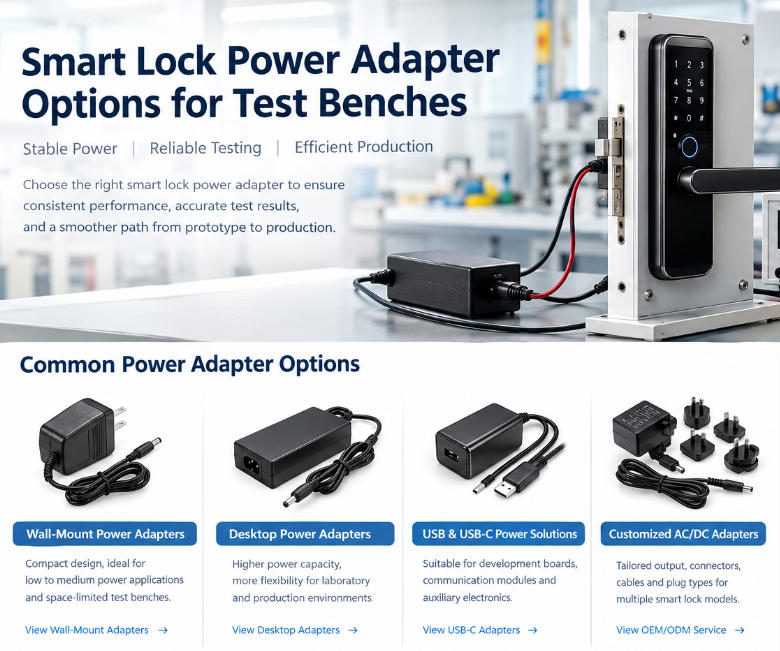
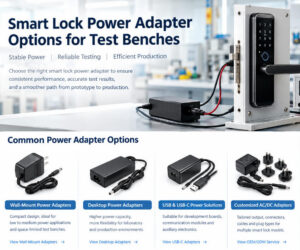
Common Smart Lock Power Adapter Options
There is no single power supply design that fits every smart lock test bench. The appropriate option depends on the lock architecture, test procedure, required output power, and physical arrangement of the laboratory or production line.
1. Wall-Mount Power Adapters
Wall-mount adapters are a practical choice for compact test benches where space is limited.
The adapter plugs directly into an AC outlet and provides regulated DC power through a cable. This configuration minimizes equipment footprint and keeps the bench relatively clean.
For smart locks that require low or moderate DC power, a wall-mount adapter can be particularly convenient for functional testing, prototype evaluation, and repeated engineering verification.
Output configurations such as 9V, 12V, or other customized DC voltages may be considered depending on the lock’s electronics.
For production-oriented applications, the plug type can also be selected according to the target market.
2. Desktop Power Adapters
Desktop adapters are more suitable when the test bench requires a separate AC cable and a larger power supply enclosure.
Compared with compact wall-mounted designs, desktop adapters can provide more flexibility for higher-power applications and more demanding thermal conditions.
They are also useful when the test equipment is permanently installed on a laboratory bench or production workstation.
A desktop design can be particularly useful when engineers need additional cable length, a specific AC inlet, or a higher-power output configuration.
3. USB and USB-C Power Solutions
Some smart lock prototypes use USB-C for development boards, communication modules, or auxiliary electronics.
In these cases, a USB or USB-C power solution may be useful for the development stage.
However, engineers should distinguish between powering a development board and powering the complete locking mechanism. A USB-C source may be appropriate for a controller or evaluation board but not necessarily for a motor-driven lock mechanism that requires a specific DC voltage and higher transient current.
When USB-C PD is used, the required voltage profiles and power negotiation should be verified before integrating the adapter into a standardized test bench.
4. Customized AC/DC Power Adapters
For smart lock manufacturers developing multiple product generations, a customized AC/DC adapter can provide a more consistent testing platform.
Instead of using different off-the-shelf adapters for every prototype, an engineering team can specify a common output voltage, current rating, connector, cable length, protection requirements, and regional plug configuration.
This approach becomes especially valuable when the company moves from prototype testing to pilot production and then to mass production.
Key Specifications for a Smart Lock Power Adapter
Selecting the correct adapter starts with the electrical specifications.
Output Voltage
Output voltage must match the smart lock’s power requirements.
A 12V smart lock should normally be tested with a regulated 12V DC supply unless the product design specifically permits another voltage range.
Do not assume that a higher-voltage adapter is acceptable simply because the connector fits. Excessive voltage can damage electronic components or create abnormal operating conditions.
Engineers should confirm the required voltage from the lock specification, PCB documentation, or original power supply.
Current Capacity
Current capacity is equally important.
If a smart lock requires 12V at 1.5A, an adapter rated at 12V 2A may provide useful headroom for transient demand, assuming the system is designed for that configuration.
The key is to distinguish between the lock’s normal operating current and its peak or startup current.
Motor-driven locks are a good example. The current required during motor startup can be significantly different from the current consumed while the lock is idle.
A properly selected adapter should therefore have enough capacity to support the highest expected load without excessive voltage drop.
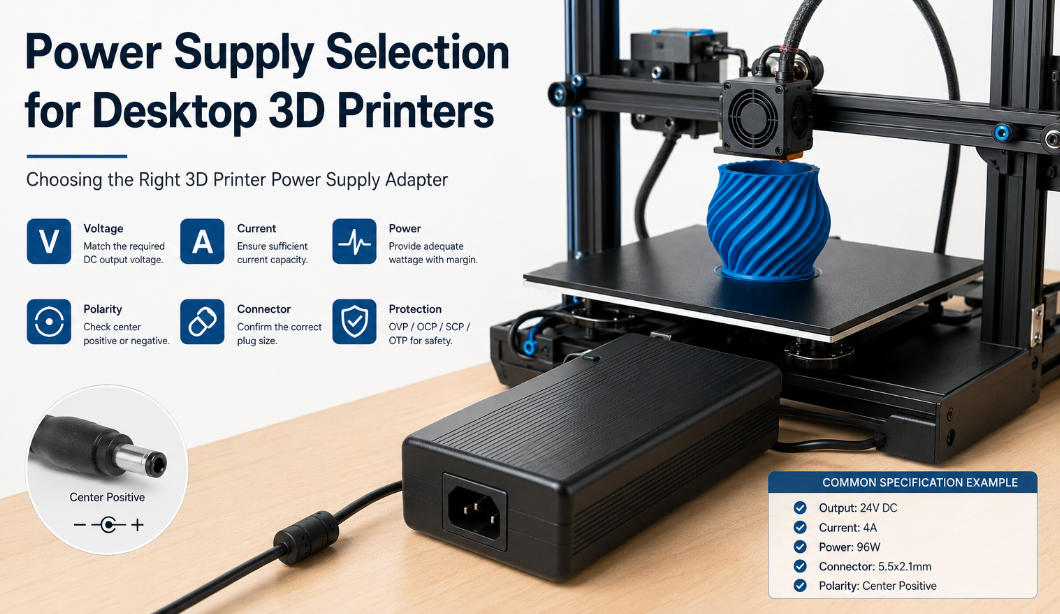
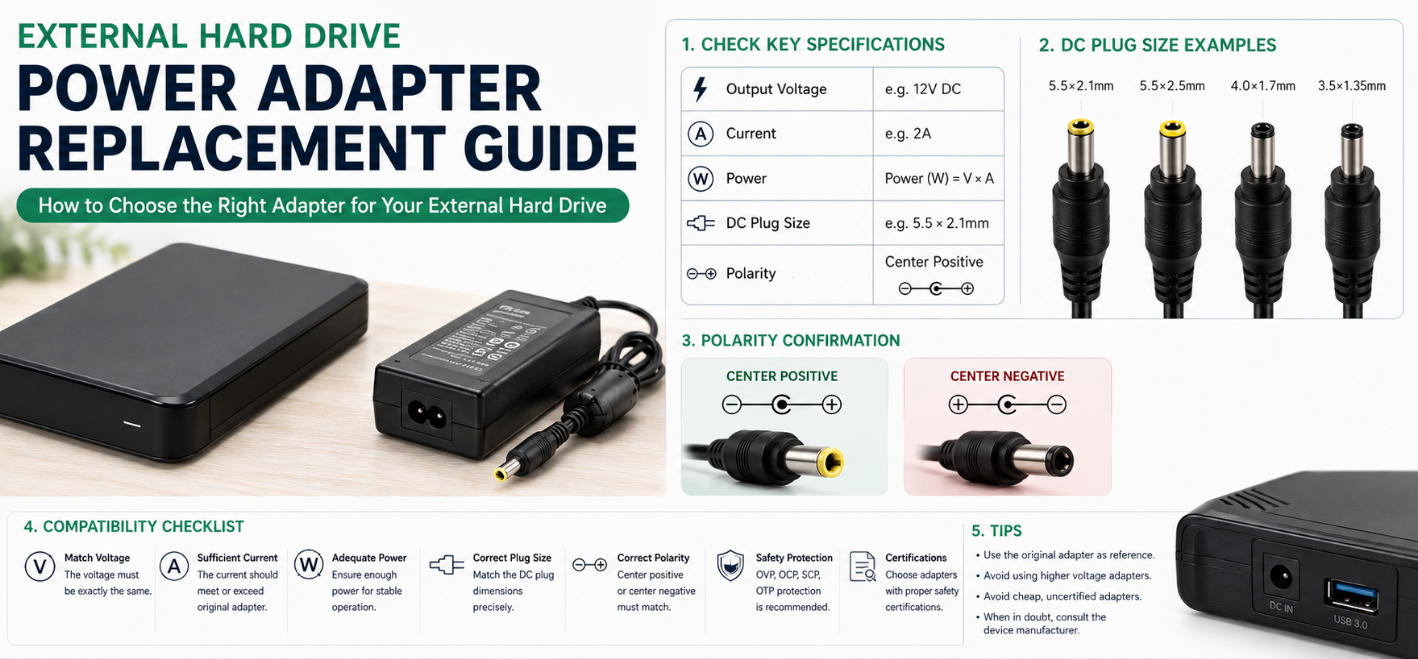
Connector Size and Polarity
Mechanical compatibility is often overlooked during test bench development.
A power adapter can have the correct voltage and current rating but still be unsuitable if the DC connector does not match the test fixture.
Common barrel connectors are available in different dimensions, and polarity also needs to be confirmed.
For engineering teams building repeatable test fixtures, it is often better to standardize the connector and cable specification across the entire testing system.
Schutzfunktionen
Smart lock electronics can be sensitive to abnormal electrical conditions, especially during prototype development.
Useful protection features may include:
- Überspannungsschutz
- Überstromschutz
- Kurzschlussschutz
- Überhitzungsschutz
These features help protect both the adapter and the device under test.
A short circuit caused by an incorrect prototype connection should not result in unnecessary damage to the test equipment or the smart lock control board.
Input Voltage and Regional Plug Configuration
For international smart lock manufacturers, the AC input specification should also be considered.
A wide-input adapter supporting common mains ranges can simplify testing across different markets. The physical AC plug can then be selected according to the destination region.
This is particularly useful for manufacturers developing the same smart lock platform for North America, Europe, the United Kingdom, Australia, or other markets.
Choosing the Right Adapter for Different Test Stages
Das Ideal smart lock power adapter can change as the product moves through development.
During early prototype development, engineers may prioritize flexibility and easy replacement. A standard adapter with a commonly available DC connector can be convenient for bench testing.
During engineering validation, reliability and repeatability become more important. The test team may standardize the output voltage, current capacity, connector, cable length, and adapter model.
During pilot production, the power adapter becomes part of the testing process itself. Every workstation should ideally use a consistent power configuration so that test results can be compared across units.
For mass production, manufacturers may require customized adapters with specific labels, connectors, cables, branding, packaging, and certification requirements.
This progression is one reason why working with a power adapter manufacturer can be more practical than continually sourcing different retail adapters.
Wall-Mount vs Desktop: Which Is Better for a Smart Lock Test Bench?
The choice between wall-mount and desktop designs depends primarily on the test environment.
| Requirement | Wall-Mount Adapter | Desktop Adapter |
|---|---|---|
| Compact workstation | Exzellent | Gut |
| Space-saving installation | Exzellent | Mäßig |
| Low-to-medium power | Exzellent | Exzellent |
| Higher-power applications | Application dependent | Generally more flexible |
| Permanent laboratory setup | Gut | Exzellent |
| Easy plug-in installation | Exzellent | Gut |
| Cable customization | Available | Available |
| OEM customization | Available | Available |
For a compact smart lock test fixture, a wall-mount adapter may be the simplest solution.
For a larger engineering bench with multiple instruments or higher power requirements, a desktop adapter may offer more flexibility.
The decision should ultimately be based on the electrical requirements and physical layout of the test system rather than the adapter’s appearance.
Why Standardization Improves Smart Lock Testing
One of the biggest advantages of using a dedicated adapter specification is test consistency.
Imagine that five test benches use five different power adapters. Even if all are labeled “12V,” their output regulation, current capacity, transient response, connector quality, and thermal behavior may differ.
That introduces unnecessary variables into the testing process.
Standardizing the smart lock power adapter across test stations can reduce this variation.
A standardized setup makes it easier to compare test results, identify actual product problems, maintain replacement inventory, and train production technicians.
For manufacturers producing several smart lock models, a modular power strategy can also be useful. Different output configurations can be assigned to different product families while keeping the overall test-bench architecture consistent.
Working with a Power Adapter Manufacturer
For smart lock companies purchasing adapters in volume, the supplier’s engineering and customization capabilities are worth evaluating alongside the product specifications.
Important questions include:
- Can the output voltage and current be customized?
- Can the DC connector be changed?
- Can cable length and wire specifications be customized?
- Are regional AC plugs available?
- What protection functions are included?
- Can required safety certifications be provided?
- Is OEM labeling or packaging available?
- Can engineering samples be supplied before bulk production?
Szjialu provides power adapter and customized power-supply solutions for different electronic applications, including wall-mount and desktop adapter configurations. Its product portfolio covers multiple power ranges, while OEM/ODM-Dienstleistungen can be used when a standard adapter does not fully match a customer’s test or production requirements.
For buyers who are still comparing specifications, the power adapter selection guide is also useful for reviewing voltage, current, connector, polarity, efficiency, and other selection factors.
Final Considerations
A smart lock test bench should reproduce the electrical conditions that the finished product is expected to experience.
That means the power adapter should not be treated as an interchangeable accessory. Output voltage, current capacity, transient demand, connector specifications, protection functions, physical format, and regional compliance can all influence test reliability.
For simple engineering prototypes, a standard wall-mount or desktop adapter may be sufficient. For repeated validation and production testing, a standardized adapter specification can provide much better consistency. For large-volume smart lock manufacturers, a customized power adapter may ultimately offer the best combination of compatibility, reliability, and supply stability.
The right smart lock power adapter is therefore not simply the adapter with the correct label. It is the power source that matches the complete electrical and mechanical requirements of the test system while remaining reliable throughout repeated testing.
For smart lock manufacturers, system integrators, and engineering teams, defining these requirements early can reduce troubleshooting time and create a more reliable path from prototype testing to production.